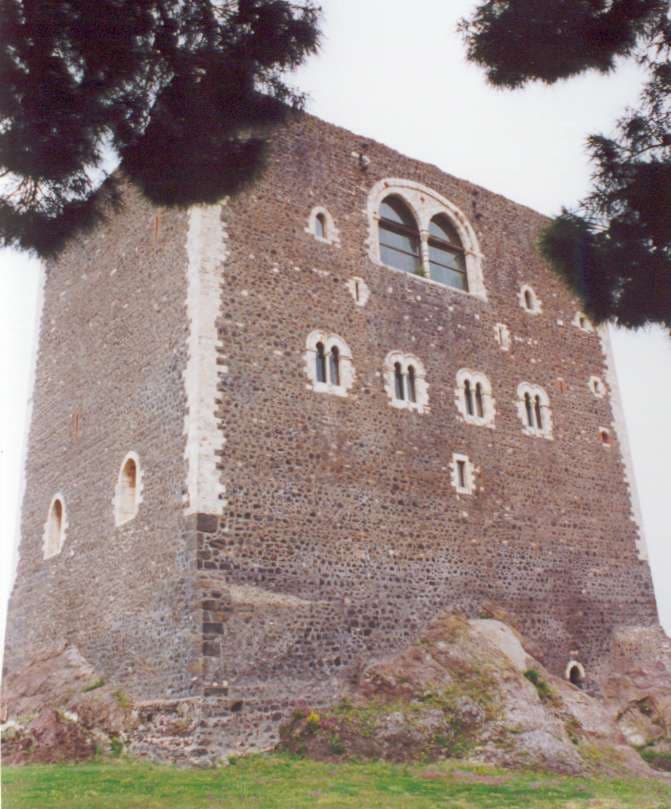
Paternò Castle
Paternò Castle, also known locally as Castello di Paternò, stands prominently on a 300 meters high rock overlooking the town of Paternò in the Catania province on the island of Sicily, Italy. This hill castle is a remarkable example of Norman military architecture from the high medieval period, specifically constructed in 1072 by the Norman count Roger I of Sicily, who later became the first King of Sicily. The castle's strategic location was chosen to dominate the surrounding landscape, providing both defense and control over the important plains near the city of Catania and the fertile valley of the Simeto river.
Historical context and origins
The site of Paternò has a long history predating the castle, likely corresponding to the Roman settlement known as Hibla Gaelatis. Throughout antiquity and the early medieval period, the area was a significant stronghold under various rulers, including the Romans, Byzantines, and later the Muslims during their control of Sicily. The castle itself was constructed on the probable site of a former Muslim watchtower, reflecting the ongoing contest for control of Sicily between the Normans and the Muslim Emirate of Sicily in the 11th century.
Count Roger's construction of Paternò Castle was part of his broader military campaign to conquer Sicily from the Muslims. The fortress was intended to secure the approaches to Catania, which remained under Muslim control at the time, and to serve as a base for the Norman siege and eventual conquest of the region.
Architectural features and style
Paternò Castle is a classic example of a Norman hill castle, featuring a prominent rectangular keep rising approximately 34 meters high. The keep is the dominant architectural element, designed for both defense and residence. Its massive stone walls and limited openings reflect the military priorities of the period, providing protection against sieges and attacks.
The castle's design shares similarities with nearby Norman fortifications such as Adrano Castle and Motta Sant'Anastasia Castle, which also feature rectangular keeps dating from the same era. These castles typically include defensive walls, battlements, and a courtyard, although much of the detailed layout of Paternò Castle is less documented due to its current state and limited access.
The castle's elevated position on a rocky outcrop enhances its defensive capabilities, allowing for extensive views of the surrounding countryside and early detection of approaching enemies. The two large windows in the keep would have provided commanding views, although access to the interior is currently restricted.
Ownership and historical significance
Throughout its history, Paternò Castle changed hands among several notable families and rulers. In the 12th century, it was held by a noble named Simon before passing to Manfredi Aleramica. Manfredi gave the castle as a dowry to his daughter Desideria, who married Bartholomew de Lucy, linking the castle to important Norman aristocratic lineages.
Following the arrival of the Aragonese dynasty in Sicily, the castle was granted by Frederick III of Sicily to the Count of Squillace. However, by 1398, it was reclaimed as royal domain and was supervised for a period by the influential nobleman Bernardo Cabrera. In 1456, the castle became the property of the Moncada family, a powerful noble house in Sicily, who retained it until the abolition of feudalism in 1812.
Current condition and accessibility
Today, Paternò Castle is well preserved in terms of its main keep, which still stands at its original height of 34 meters. However, the castle is not generally open to the public, and there is little information available regarding visiting hours or public access. The interior spaces, including the rooms with the large windows that offer panoramic views, remain inaccessible to visitors.
The castle's preservation status allows scholars and enthusiasts to study Norman military architecture in Sicily, though the lack of visitor access limits public engagement. Its commanding position and historical importance continue to make it a notable landmark in the region.
Comparisons with other Sicilian Norman castles
Paternò Castle shares architectural and historical features with other Norman fortifications in Sicily, particularly Adrano Castle and Motta Sant'Anastasia Castle. These castles all feature rectangular keeps typical of Norman military construction in the 11th and 12th centuries. Their strategic locations on hills or rocky outcrops allowed them to control key routes and territories.
The Norman castles of Sicily are important for understanding the island's medieval history, reflecting the transition from Muslim to Norman rule and the establishment of feudal lordships. Paternò Castle's survival and preservation contribute valuable insights into this transformative period.
Frequently asked questions (FAQ)
- How do I get to Paternò Castle?
- Paternò Castle is located in the town of Paternò, Italy, easily accessible by car or public transport from nearby cities such as Catania. Local buses run regularly to Paternò, and there is parking available nearby for those traveling by car.
- What is the historical significance of Paternò Castle?
- Paternò Castle, dating back to the 11th century, is a remarkable example of medieval architecture and has witnessed various historical events in Sicily. It served as a strategic fortress and residence for nobility, reflecting the rich history and cultural heritage of the region.
- When was Paternò Castle built?
- Construction of Paternò Castle began in the 11th century, with additional modifications and expansions occurring over the centuries. The castle has undergone various restorations, preserving its historical integrity while adapting to modern visitor needs.
- Can I visit Paternò Castle year-round?
- Yes, Paternò Castle is open to visitors throughout the year, although specific opening hours may vary by season. It's recommended to check the official website or local tourism information for the most accurate and current visiting hours.
- Why is Paternò Castle popular among tourists?
- Paternò Castle is popular for its stunning views of the surrounding landscape and its well-preserved architecture, attracting history enthusiasts and photographers. The castle's rich history and cultural significance provide visitors with a unique glimpse into Sicily's past.
- Is it possible to take guided tours of Paternò Castle?
- Yes, guided tours are available at Paternò Castle, offering visitors in-depth insights into its history and architecture. These tours can enhance your experience, providing context and stories that make the visit more engaging.
- What are the ticket prices for visiting Paternò Castle?
- Ticket prices for Paternò Castle are generally affordable, with discounts available for students and seniors. Special rates may apply for guided tours, so it's advisable to check the official website for the latest pricing information.
- What are the best times to visit Paternò Castle?
- The best times to visit Paternò Castle are during the spring and fall when the weather is mild and pleasant. Summer can be quite hot, so early morning or late afternoon visits are recommended for a more comfortable experience.
- Are there any nearby attractions to visit along with Paternò Castle?
- Yes, there are several nearby attractions, including the charming town of Paternò itself, with its historical churches and local eateries. Additionally, the stunning landscapes of Mount Etna are just a short drive away, making it a perfect day trip combined with your visit to the castle.
Photo gallery

Information
Address
Via dei Normanni, Paternò, Catania, Sicily, Italy
Loading map...
Visitor reviews
No reviews yet. Been here? Write the first review and help other travelers!
Write the first reviewVisited this castle? Share your experience
Your review helps other travelers and adds first-hand knowledge to our encyclopedia.


