Mosonmagyaróvár Castle
Mosonmagyaróvár Castle stands as a significant historical fortress located in the town of Mosonmagyaróvár, Hungary. Originally ordered by King Stephen I of Hungary in the early 11th century, the castle was constructed to defend the western border of the kingdom. The initial fortification was built on a small hill known as Király-domb, featuring wooden piles filled with earth to serve as a basic defensive structure and administrative center. This early castle quickly became a focal point for settlers, evolving into a bustling merchant town by the 11th century.
Throughout its history, Mosonmagyaróvár Castle witnessed numerous conflicts and transformations. In 1030, the fortress was captured by Holy Roman Emperor Conrad II during his campaign toward the Rába River. Later, during the Crusades, the castle served as a strategic stronghold for King Kálmán of Győr and Moson, who successfully repelled a large Swabian-Bavarian army. However, in 1271, the castle suffered severe destruction when Ottokar II of Bohemia razed it. Following this devastation, King Béla IV of Hungary chose not to rebuild the castle immediately, reflecting shifting priorities in royal defense strategies.
Medieval evolution and noble ownership
After the Mongol invasion of the 13th century, the wooden fortifications were replaced with a more resilient stone fortress to better withstand future assaults, particularly from western adversaries. The castle's ownership changed hands multiple times during the 14th century, initially controlled by the influential Kőszegi family before passing to the Anjou dynasty under King Charles I of Hungary. Subsequently, prominent noble families such as the Lackfi barons held the castle, reflecting the turbulent political landscape of medieval Hungary.
Strategic role in the Ottoman wars
From the 16th century onward, Mosonmagyaróvár Castle gained renewed military significance as a frontier fortress against the expanding Ottoman Empire. The castle underwent extensive modernization based on Italian military engineering principles, incorporating artillery bastions and reinforced walls. These fortifications surrounded both the medieval core and the adjacent town, which was protected by a water-filled moat fed by the Mosoni-Duna River. Despite these upgrades, the castle endured multiple sieges: it resisted attacks by Stephen Bocskai's hajduks in 1605 but surrendered without artillery resistance to Gabriel Bethlen's forces in 1619. In 1683, during the Ottoman campaign led by Grand Vizier Kara Mustafa, the fortress fell again amid the broader conflict surrounding the siege of Vienna.
Decline and transformation in the modern era
Following the War of Independence led by Francis II Rákóczi in the early 18th century, the castle remained under Habsburg control. Its strategic military importance diminished, leading to the dismantling of outer defenses later in the century. By 1721, the castle ceased to serve as a frontline fortress, with military assets transferred elsewhere. In 1818, the castle's interior was repurposed as an agricultural academy, marking a significant shift from military to educational use. This institution evolved into the modern Faculty of Agriculture and Food Sciences of the University of West Hungary, linking the historic site to contemporary academic pursuits.
Architectural features and archaeological significance
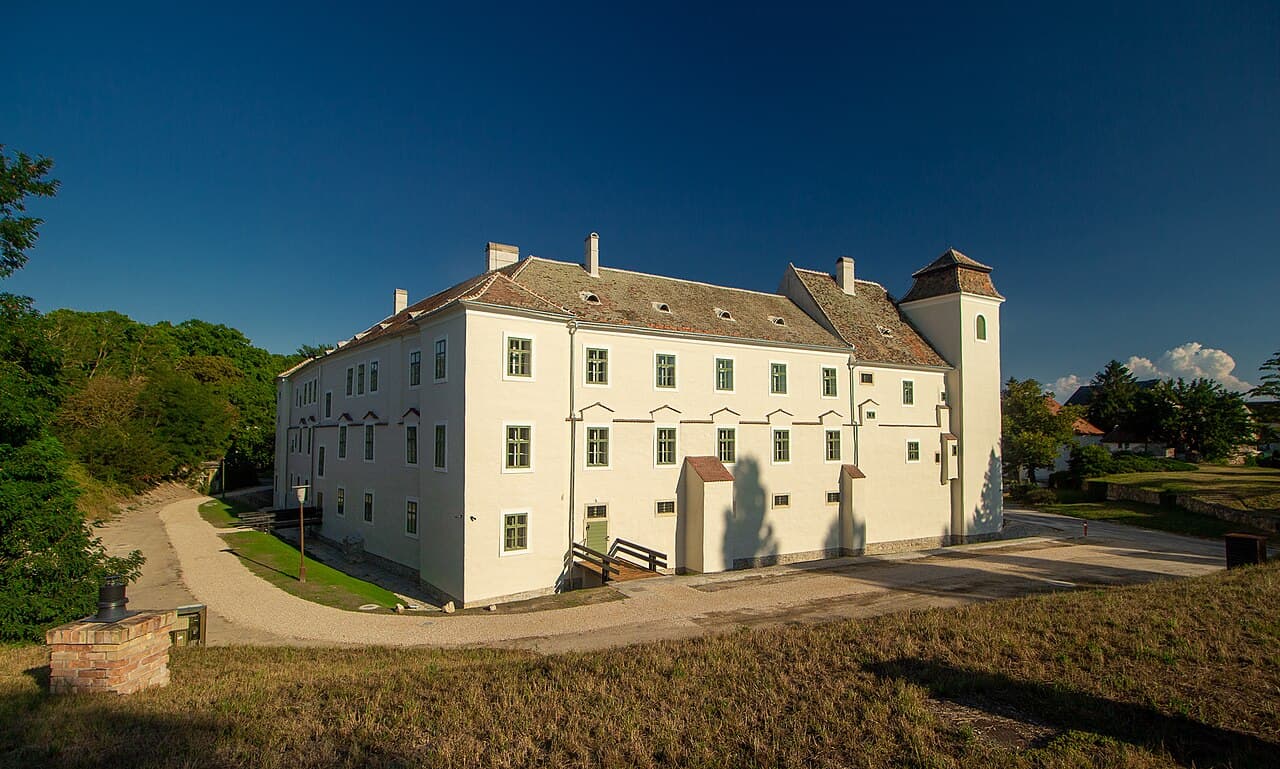
The present-day castle exhibits an irregular quadrilateral layout with two-story wings enclosing a central courtyard. Originally, four small towers stood at each corner; however, only two remain visible today, as the other two were integrated into a second floor addition around 1810. The castle's robust stone walls date back to medieval construction phases and bear traces of later modifications that enhanced its defensive capabilities.
Notably, embedded within the castle walls are Roman tombstones, offering tangible evidence of the site's ancient occupation. The courtyard has been renovated to serve as a reception and event space, adorned with relief sculptures honoring distinguished professors from the agricultural academy. Inside, classrooms coexist with a museum dedicated to the castle's layered history, providing visitors with insights into its architectural evolution and historical role.
Preservation and cultural heritage today
Monuments in the forecourt commemorate significant events such as both World Wars and the 1956 Hungarian Revolution, linking the castle to Hungary's broader national history. Recent restoration efforts, supported by the European Union, have focused on renewing the castle's exterior facade, remodeling the courtyard, and installing modern museum facilities including a shop, projection room, and educational workshops. These enhancements ensure that Mosonmagyaróvár Castle continues to function as a vibrant center for cultural heritage, education, and tourism.
Overall, Mosonmagyaróvár Castle exemplifies the dynamic history of Hungarian fortifications, reflecting centuries of military, political, and educational transformations. Its enduring presence offers valuable insights into medieval architecture, early modern military engineering, and the adaptive reuse of historic sites in contemporary Hungary.
Frequently asked questions (FAQ)
- When was Mosonmagyaróvár Castle originally built?
- Mosonmagyaróvár Castle was originally built in the early 11th century under the orders of King Stephen I of Hungary to defend the kingdom's western border.
- What architectural styles are present in Mosonmagyaróvár Castle?
- The castle features a mixed architectural style, reflecting its medieval origins and later modifications, including Italian military engineering influences from the 16th century.
- Can visitors explore the castle today?
- Yes, the castle is well-preserved and functions as part of the University of West Hungary, housing classrooms and a museum open to visitors interested in its history and architecture.
- What role did the castle play during the Ottoman wars?
- Mosonmagyaróvár Castle served as a critical defensive fortress against Ottoman incursions, undergoing modernization with artillery bastions and enduring several sieges during the 16th and 17th centuries.
- What is the significance of the Roman tombstones found in the castle walls?
- The embedded Roman tombstones indicate the site's ancient occupation, providing archaeological evidence that Mosonmagyaróvár was inhabited long before the medieval castle was constructed.
Photo gallery

Information
Sources & official resources
Verify the information above using these authoritative references.
Loading map...
Visitor reviews
No reviews yet. Been here? Write the first review and help other travelers!
Write the first reviewVisited this castle? Share your experience
Your review helps other travelers and adds first-hand knowledge to our encyclopedia.