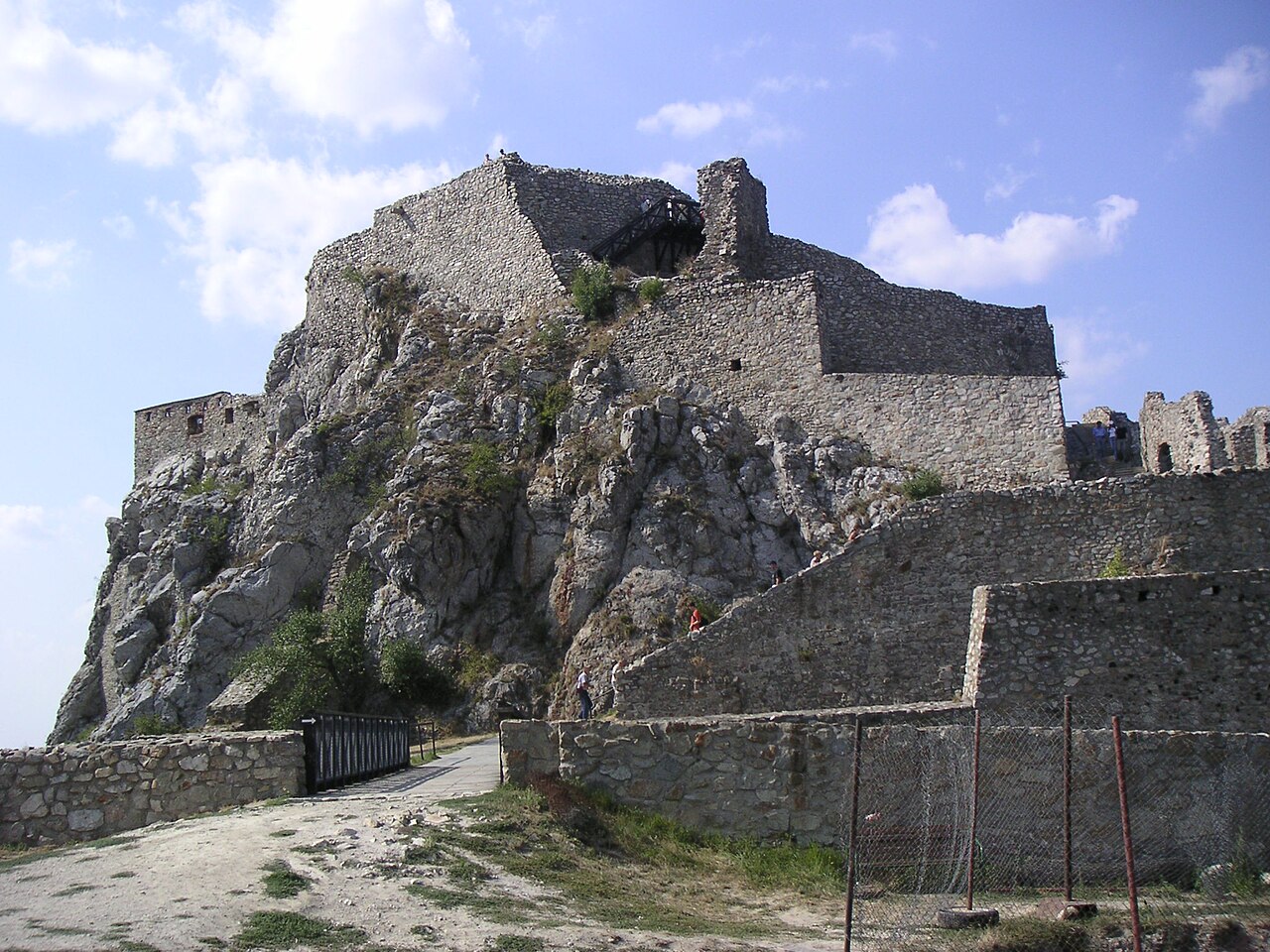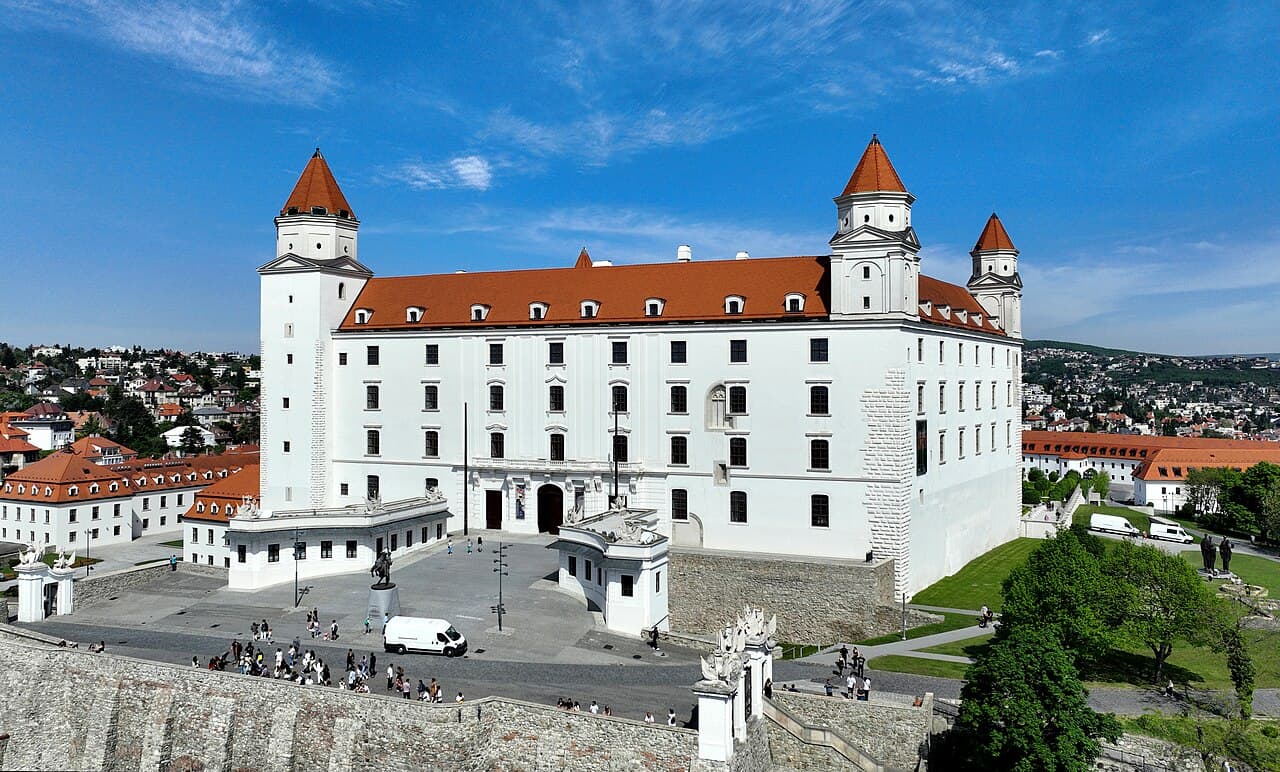
Bratysława — Slovakia castle

Bratysława

Bratislava Castle: historic bastioned fortress of Slovakia's capital
Bratislava, Slovakia
High Medieval (11th–13th c.)
Restored

Bratislava Castle, perched on a prominent hill overlooking the Danube River, is an iconic symbol of Slovakia's capital city. With a history spanning thousands of years, this bastioned fortress has played a crucial role in the region's military, political, and cultural development. Its strategic location at the crossroads of important trade routes, including the historic Amber Road, made it a coveted stronghold from prehistoric times through the medieval and modern eras.

The castle hill was first settled around 3500 BC by the Boleráz culture during the Eneolithic period, marking the site as a fortified settlement and a regional center. Later, the Celts established an oppidum here during the La Tène period, followed by Roman occupation that integrated the hill into the empire's northern frontier known as the Limes Romanus. Archaeological evidence reveals Roman buildings and fortifications, underscoring the site's long-standing military significance.

During the early medieval period, the Slavs, ancestors of modern Slovaks, constructed a large fortified settlement with wooden ramparts around the 8th or early 9th century, which was further developed during the Great Moravian Empire. This included a stone palace and a basilica, reflecting the site's dual military and religious importance. The castle is first mentioned in written sources in 907 AD, associated with a decisive battle between Hungarians and Bavarians that solidified Hungarian control of the region.

Medieval fortifications and royal significance

From the 10th century, under King Stephen I of Hungary, the castle became a key defensive and administrative center, serving as the seat of Pozsony county. The original wooden fortifications were gradually replaced by stone walls and towers. Notably, the castle withstood the Mongol invasions of 1241-42, a rare feat among Hungarian fortresses. In response to the Mongol threat, a large square residential tower was constructed in 1245, alongside additional towers including the donjon and the later Crown Tower.

Throughout the 13th and 14th centuries, the castle was contested by various Hungarian and regional noble families, reflecting the turbulent political landscape. By the 15th century, under King Sigismund of Luxembourg, the castle was transformed into a formidable Gothic fortress with thick defensive walls and multiple towers. The Sigismund Gate, dating from this period, remains one of the best-preserved Gothic elements of the castle today.

Coronation castle and crown jewels

Following the Ottoman conquest of Buda in 1541, Bratislava Castle became the capital of Royal Hungary and the coronation city for Hungarian kings. From 1552 to 1790, the castle housed the Hungarian crown jewels, including the revered Crown of Saint Stephen, securely stored in the Crown Tower. This elevated the castle's status as a symbol of Hungarian sovereignty and royal authority.

Renaissance and baroque transformations

In the mid-16th century, Emperor Ferdinand I ordered a Renaissance-style reconstruction to adapt the castle for artillery defense, adding artillery bastions on the northern and eastern sides. The 17th century saw further Baroque modifications under the stewardship of Count Paul Pálffy, including the addition of four corner towers—two newly built and two adapted from Gothic structures—and new bastions designed by military engineer Jozef Priami.

The castle's interiors were enhanced with richly decorated representative chambers, and two-story arcades were added to the southern wing. The Leopold Gate (1676) and the Vienna Gate (1713) were constructed, serving as ceremonial entrances. Under Empress Maria Theresa in the 18th century, the castle was transformed into a grand Baroque palace, featuring a three-winged building for servants and stables, formal French-style gardens, and modernized water supply systems engineered by Johann Wolfgang von Kempelen.

Loss, destruction, and restoration

After the death of Maria Theresa, the castle's importance declined. It was repurposed as a seminary and later as military barracks. In 1811, a devastating fire caused by negligence of the garrison destroyed much of the castle, leaving it in ruins for over a century. Attempts to demolish the castle for urban development were thwarted, and it was used sporadically for military purposes until after World War II.

Systematic archaeological research and restoration began in the 1950s, aiming to restore the castle to its last Baroque state while preserving Gothic and Renaissance elements. The restoration culminated in the late 1960s, with further renovations continuing into the 21st century. Today, Bratislava Castle is a well-preserved monument housing the Slovak National Museum's exhibitions and serving as a venue for official state functions.

Architectural features and layout

The castle's distinctive rectangular layout features four corner towers, the largest being the 13th-century Crown Tower on the southwest corner, historically used to safeguard the Hungarian crown jewels. The main building surrounds an inner courtyard with a deep well reaching approximately 80 meters, essential for sustaining the fortress during sieges.

The Sigismund Gate remains a prime example of Gothic military architecture, with its ribbed vault, decorative pinnacles, and profiled portal. The Baroque-era bastions and gates, including the Leopold and Vienna Gates, reflect the castle's evolution to accommodate artillery and ceremonial functions.

Surrounding the main palace are former service buildings, stables, and barracks, some of which have been repurposed for modern use by the Slovak National Council. Archaeological sites on the eastern terrace reveal foundations of early medieval ecclesiastical buildings, including a Great Moravian basilica and the Church of St. Savior.

Cultural and historical importance today

Bratislava Castle remains a dominant landmark visible from across the city and beyond, symbolizing Slovakia's rich history and resilience. It hosts exhibitions showcasing archaeological treasures such as the Venus of Moravany and chronicles Slovakia's national history. The castle also serves as a venue for political events and cultural gatherings, linking past and present.

Visitors can explore the castle grounds, including its courtyards, gates, and gardens, while enjoying panoramic views of Bratislava, the Danube, and neighboring countries. The castle's ongoing preservation ensures that this historic fortress continues to educate and inspire future generations.

Frequently asked questions (FAQ)

How do I get to Bratislava Castle?
Bratislava Castle is easily accessible by public transport, with several bus and tram lines stopping nearby. If you prefer walking, the castle is about a 20-minute stroll from the city center, offering scenic views along the way.
What is the historical significance of Bratislava Castle?
Bratislava Castle has a rich history dating back to the Stone Age and has served as a royal residence, a military fortress, and a political hub. Its strategic location overlooking the Danube River made it a key site for various empires throughout the centuries.
When was Bratislava Castle built?
The current structure of Bratislava Castle was built in the 18th century, although its origins can be traced back to the 9th century. The castle has undergone numerous renovations and restorations, particularly after being damaged in battles.
Can I visit Bratislava Castle year-round?
Yes, Bratislava Castle is open to visitors year-round, although the opening hours may vary seasonally. It's a good idea to check the official website for the latest information on visiting times and any potential closures.
Why is the architecture of Bratislava Castle unique?
The architecture of Bratislava Castle is characterized by its distinctive rectangular shape and four corner towers, which reflect a blend of Gothic, Renaissance, and Baroque styles. The castle's white limestone façade and beautiful gardens add to its picturesque appearance.
Is it possible to tour the interior of the castle?
Yes, visitors can tour the interior of Bratislava Castle, where you can explore various exhibitions showcasing Slovak history and culture. Guided tours are also available, providing deeper insights into the castle's significant past.
What are the ticket prices for Bratislava Castle?
Ticket prices for Bratislava Castle are quite affordable, with discounts available for students and seniors. Children under a certain age can enter for free, making it a great family-friendly destination.
What is the best time to visit Bratislava Castle?
The best time to visit Bratislava Castle is during the spring and early autumn when the weather is mild and pleasant. These seasons also offer beautiful views of the surrounding landscape and the Danube River.
Are there any nearby attractions worth visiting?
Yes, nearby attractions include the historic Old Town, St. Martin's Cathedral, and the Slovak National Museum. These sites can easily be combined with your visit to Bratislava Castle for a full day of exploration.

Photo gallery

Bratysława
Click to view

Photo by C.Stadler/Bwag•CC BY-SA 4.0

1 photo • Click any image to view in full screen

Information

Bastioned Fortress

Sources & official resources

Verify the information above using these authoritative references.

Loading map...

Visitor reviews

No reviews yet. Been here? Write the first review and help other travelers!

Write the first review

Visited this castle? Share your experience

Your review helps other travelers and adds first-hand knowledge to our encyclopedia.

Write a review

(5/5)

0/2000 characters

Your review will be visible after admin approval

Nearby castles

6.1 km

Pottenburg Castle

Wolfsthal, Austria

Pottenburg Castle stands as a testament to medieval military architecture and regional power struggles in Austria. Located in the municipality of Wolfsthal near the Austrian-Slovak border, this hill castle played a crucial role in guarding the Hainburger Pforte, a vital passage through the Lower Carpathians. Its strategic position atop the rocky Königswarte hill allowed it to oversee and control key routes, making it a significant border fortress from the late medieval period. The castle's origins are subject to scholarly debate, with some historians proposing initial fortifications as early as 990 to 1025, a turbulent era marked by Hungarian invasions. The earliest known owner was Count Poto, son of Count Palatine Hartwig of Regensburg, linking the site to early medieval nobility. However, more securely documented references date the castle's foundation to the early 13th century, with written records appearing by 1256. This timeline aligns with the broader European trend of castle-building during the High Middle Ages, reflecting the need for fortified border defenses. Historical ownership and political significance Throughout its existence, Pottenburg Castle experienced numerous changes in ownership, reflecting the shifting political landscape of the region. After Count Poto's rebellion and loss of control in 1054, the castle passed to the Bishop of Eichstätt. By the early 12th century, it was held by the Asparn family, until their lineage ended, after which it became a ducal fief in 1226, granted to Heinrich von Brunn. These transitions illustrate the castle's importance as a feudal asset and military stronghold. In the mid-14th century, ownership shifted again when Count Konrad von Schaunberg acquired Pottenburg in 1343, only to return it to his ruler by 1351. The castle underwent significant rebuilding campaigns in 1359 and 1437, reflecting ongoing military and residential needs. Notably, in 1460, imperial forces forcibly removed Gamareth Fronauer, who had resisted surrendering the fortress, underscoring its strategic value. King Matthias Corvinus of Hungary seized Pottenburg in 1482, holding it for a decade to bolster Hungary's border defenses against Austria. After its recapture, the castle was managed by a ducal steward but gradually lost its military function around 1500 as the nature of warfare and border defense evolved. In 1517, Emperor Maximilian I sold the castle to Wilhelm II of Zelking. The first Turkish invasion of 1529 saw Pottenburg fall with minimal resistance, after which it was abandoned and left to deteriorate. The estate passed to the Counts of Walterskirchen in 1544, who retained it into modern times, marking the transition from a fortress to a noble estate in decline. Architectural features and layout Pottenburg Castle occupies a quadrangular plateau on a rocky spur near the summit of Königswarte hill, commanding panoramic views of the surrounding landscape. The castle's design centers on a square inner bailey, which served as the fortified core of the complex. To the north lies an outer bailey functioning as an economic courtyard, supplemented by a northwestern outwork, creating layered defenses. The entire site is encircled by earthworks and stone fortifications, including ditches carved into the rock on the northwest, east, and south sides. A central rampart reinforces the southern approach, enhancing the castle's defensive capabilities. The outer defensive wall, dating from the mid-13th century, is constructed primarily from rubble stone, featuring beam holes that once supported a battlement walkway. Projecting corbels held defensive turrets and latrines, illustrating the castle's functional design. A notable defensive feature is a semicircular tower on the eastern flank, likely added around 1500, which strengthened the outer wall. Access to the outer bailey is through a Gothic-style portal made of squared stone blocks, entering via a depressed round arch through the northwestern outwork. Within this area are remains of a residential building with a courtyard and well, showing evidence of construction from the 1437 rebuilding phase. The bergfried: the castle's dominant keep The most prominent architectural element within the inner bailey is the bergfried, a tall tower approximately 26.5 meters high with six stories. Built in the second quarter to mid-13th century, it rests on walls about 3.5 meters thick, constructed from rubble stone with carefully shaped corner stones for added strength. Narrow arrow slits set in funnel-shaped recesses provided defensive positions for archers. The bergfried's upper platform was once surrounded by corbels and decorative gargoyles, serving both defensive and aesthetic purposes. Access was gained through an elevated doorway on the east side, a common medieval defensive feature to hinder attackers. Inside, the lower levels feature robust ribbed vaults supporting the upper floors, with staircases ingeniously built into the thick walls where space was limited, demonstrating advanced medieval engineering. Palas and living quarters East of the bergfried lie the remains of the palas, or main residential building, which may have also served as a chapel. The west wall of the palas includes an elevated doorway aligned with the bergfried's entrance, suggesting the existence of a connecting bridge between these two key structures. Below this entrance is a pointed arch portal, a hallmark of medieval Gothic architecture. Cultural and historical context Pottenburg Castle's multiple names, including Hasenburg and Mädchenburg, reflect its varied history and local traditions. The castle was closely linked to the now-lost settlement of Amberg below it, highlighting the interdependence between medieval fortresses and surrounding communities. This relationship was typical of border castles, which functioned both as military bastions and centers of local governance and economy. The castle's location near the Königswarte lookout tower situates it within a landscape rich in natural and historical significance. Local traditions note the surrounding game reserve, historically inhabited by wild boars, adding to the area's cultural heritage. Today, the ruins of Pottenburg offer valuable insights into medieval fortification techniques, feudal politics, and border defense strategies during a period of frequent conflict and shifting allegiances. Current condition and preservation Currently, Pottenburg Castle exists as partially preserved ruins. The surviving structures, including the bergfried, outer walls, and remnants of residential buildings, provide a tangible connection to its medieval past. The site’s earthworks and stone fortifications remain visible, allowing visitors to appreciate the castle's original defensive layout. Preservation efforts focus on maintaining the integrity of the ruins and making the site accessible for historical and cultural tourism. The castle's dramatic hilltop setting and architectural remains continue to attract historians, archaeologists, and visitors interested in medieval military architecture and Austrian history.

Late Medieval (14th–15th c.)
Details
9.7 km
Dziewin — Slovakia castle

Dziewin

Dziewin, Slovakia

Dziewin Castle stands as one of the most significant and oldest fortifications in Slovakia, perched on a high limestone cliff at the confluence of the Morava and Danube rivers. Its strategic location allowed control over vital trade routes, including the Danube and a branch of the Amber Road, making it a key defensive and political site throughout history. The castle's origins trace back to prehistoric times, with human settlement dating to the Neolithic period around 5000 BCE. Over millennia, the site evolved through Bronze and Iron Age fortifications, Celtic occupation, Roman military presence, and ultimately became a major stronghold during the Great Moravian Empire in the 9th century. Prehistoric and ancient origins The hill where Dziewin Castle now stands was inhabited from the Neolithic era, with archaeological evidence showing continuous settlement through the Bronze and Iron Ages. The Celts, associated with the La Tène culture, fortified the site in the early Iron Age, transforming it into a defensive hillfort. During the Roman period, roughly from the 1st to the 4th centuries CE, the location hosted a Roman fort as part of the Limes Romanus frontier defense system. Excavations have uncovered Roman stone buildings, including a four-room structure with a semicircular apse, likely related to military activities during the Marcomannic Wars. The Roman presence ended around 400 CE as imperial borders contracted. Great moravian fortress and early medieval development By the 9th century, the site had become a fortified center of the Great Moravian Empire. Historical records from 864 CE mention a heavily fortified settlement called "Dowina," believed to be Dziewin Castle. The fortress was one of three principal centers of Great Moravia, serving as a political and military hub. The natural defenses of steep slopes on two sides were augmented by deep moats and earthen ramparts on the east and north. Archaeological excavations have revealed the foundations of a 9th-century stone church and an 11th-century round rotunda, indicating the site's religious and cultural importance during this period. Medieval castle construction and expansion In the 13th century, a royal stone castle was constructed atop the cliff to protect the kingdom's border and river crossings. The initial fortress comprised a hexagonal tower surrounded by defensive walls on the northeast side, accessible via a bridge over a rock-cut moat. The castle was relatively small but strategically vital. In the 15th century, the castle underwent significant expansion, including an additional ring of walls and the creation of a large lower castle area called the "middle castle," which featured a Gothic palace built by the Goryanski family. This phase also saw the construction of a deep well carved into the rock and various utility buildings. Renaissance enhancements under the batory family Ownership passed to the Báthory family in 1526, who further developed the castle complex. They built a Renaissance-style palace in the middle castle area and added artillery bastions to the upper castle. A standalone watchtower known as the "Maiden Tower" was constructed on a solitary rock to oversee the Danube road called "Mniszka." The lower castle, serving economic functions, was fortified with walls and bastions, including three gates reinforced with semi-circular towers. These improvements reflected evolving military technology and the need for stronger defenses during the turbulent 16th century. Decline and destruction in the early modern period In 1635, the castle came under the ownership of the Pálffy family, who preferred residing in more comfortable estates and invested little in the fortress's upkeep. The castle's military importance waned as the region stabilized after the Ottoman threat diminished. However, in 1683, an artillery bastion was constructed between the upper castle and the western gate in response to renewed Turkish incursions. The fortress's final destruction occurred in 1809 during the Napoleonic Wars when retreating French troops blew up the walls, leaving the castle in ruins. Modern preservation and cultural significance The Slovak state purchased the ruins from the Pálffy family in 1932, recognizing the site's exceptional historical value. In 1961, Dziewin Castle was designated a National Cultural Monument of Slovakia. Ongoing archaeological research has uncovered rich layers of history, including Roman, Great Moravian, medieval, and Renaissance periods. Partial reconstructions have made the ruins accessible to visitors, who can explore the remains of all three gates, defensive walls, two palaces, a deep well, and the iconic Maiden Tower. The castle's image even appears on Slovak currency, underscoring its symbolic importance. Archaeological discoveries and museum exhibits Excavations have revealed foundations of Roman buildings, a Great Moravian church with a unique trefoil apse and fresco fragments, and a Romanesque circular chapel from the 11th to 13th centuries. The castle grounds feature terraces, staircases, and courtyards, with ongoing restoration efforts preserving these historical elements. A museum housed in the Renaissance palace basement offers seasonal exhibitions on the castle's history. Visitors enjoy panoramic views of the Danube and Morava rivers, appreciating Dziewin Castle's long-standing strategic and cultural role. Architectural features and defensive structures Dziewin Castle exemplifies a bastioned fortress with multiple layers of fortifications adapted to its rocky hilltop setting. The hexagonal tower, polygonal bastions, curtain walls, and deep moats demonstrate medieval military architecture evolving into Renaissance artillery defenses. The Maiden Tower, perched on a separate rock, served as a watchtower and signal point. The castle's three gates, reinforced with semi-circular towers and drawbridges, controlled access to the complex. The deep well carved into the rock ensured a reliable water supply during sieges. Defense adaptations over time The castle's fortifications reflect changing military needs from the early medieval period through the Renaissance. Initial earthworks and moats gave way to stone walls and towers designed to withstand siege engines and cannon fire. The addition of artillery bastions in the 17th century illustrates adaptation to gunpowder warfare. Despite these enhancements, the fortress was never captured in battle, underscoring its formidable defenses. Dziewin castle in slovak national identity Since the 19th century, Dziewin Castle has been a powerful symbol of Slovak heritage and Great Moravian history. It inspired Romantic poets and national revivalists such as Ľudovít Štúr. The castle's image has appeared on Slovak currency and remains a popular tourist destination. Its location on the border with Austria and proximity to Bratislava make it a significant cultural landmark bridging past and present.

Early Medieval (5th–10th c.)
Details
11.1 km

Röthelstein Castle

Hainburg an der Donau, Austria

Röthelstein Castle, also known locally as Burg Röthelstein, is a historic castle ruin situated north of the town of Hainburg an der Donau in the province of Lower Austria, Austria. Perched on a high rock overlooking the Danube River, the castle occupies a strategic position that once controlled river traffic and local land routes. Although now a modest ruin, Röthelstein's history reflects the turbulent dynamics of the late medieval period in this region. Early history and strategic location The castle was first mentioned in historical records in 1180, indicating its establishment during the High to Late Medieval period. Its location on a rocky outcrop beside the Danube provided a natural defensive advantage and control over the river passage. This position was critical for monitoring and taxing river traffic, a common practice that contributed to the castle's significance in the region. Ownership and medieval conflicts In 1411, the fief of Rotenstein, as the castle was then known, was granted to Wilhelm von Enzersdorf by Albert V, Duke of Austria. Wilhelm's ownership extended beyond the castle to the surrounding village and the nearby river passage. However, his tenure was marked by frequent disputes with the neighboring town of Hainburg, particularly over hunting and fishing rights. These conflicts illustrate the economic and territorial tensions common among medieval lords and towns in the region. Robber baron era and imperial intervention During the mid-15th century, Röthelstein Castle became infamous as the stronghold of Wenko von Ruckenau, better known as the robber baron Ledvenko. From this fortress, Ledvenko and his band of robbers exerted control over the surrounding area, including the installation of a barrier on the Danube River to extract unauthorized tolls from passing ships. This illegal activity disrupted trade and provoked the ire of regional authorities. In 1458, Albert VI, Archduke of Austria, led a siege against Röthelstein Castle to end Ledvenko's reign of terror. The castle was captured, the river barrier destroyed, and Ledvenko was forced to flee. The following year, in 1459, the castle was visited by Frederick III, Holy Roman Emperor, underscoring its continued political importance despite recent turmoil. Decline and later history Following the siege, Röthelstein Castle changed hands multiple times and was often leased out due to the financial difficulties of its owners. By 1511, the castle was already in decline and was presented to the town of Hainburg. After this point, historical records become sparse, with only a 1694 protest against its demolition noted, indicating the castle's deteriorating condition and diminished strategic relevance. Architectural features and current condition Today, Röthelstein Castle exists as a small castle ruin that reveals limited architectural detail due to its state of preservation. Its original structures likely included defensive walls, a gatehouse, and residential quarters typical of late medieval fortifications. The castle's rocky promontory and proximity to the Danube remain its most striking features, offering scenic views and a tangible connection to its historical role controlling river traffic. Visitors can reach the site after a 10-minute walk through the woods from the nearest road. The castle is freely accessible, making it a worthwhile destination for those interested in medieval history and the natural beauty of the Danube valley. Nearby, Hainburg Castle provides additional historical context and attractions. Röthelstein Castle in the context of regional history The castle's story reflects the broader patterns of medieval Austrian history, including feudal disputes, the impact of robber barons, and the shifting control of strategic sites along the Danube. Its capture by Archduke Albert VI and visit by Emperor Frederick III highlight its importance within the Habsburg domains during the 15th century. Despite its ruinous state, Röthelstein Castle remains a symbol of the complex interplay between local power holders, economic interests, and imperial authority in late medieval Austria. Its preservation as a ruin allows modern visitors to engage directly with this layered history.

Late Medieval (14th–15th c.)
Details