Moreton Corbet Castle
Moreton Corbet Castle stands as a remarkable historic site near the village of Moreton Corbet in Shropshire, England. This castle exemplifies the architectural evolution from a medieval Norman fortress to an Elizabethan manor house, reflecting centuries of English history and military significance. The castle's origins trace back to the late 11th century when the site was occupied by Anglo-Saxon thegns, Hunning and Wulfgeat, who likely maintained a fortified residence here. By the early 12th century, the estate was held by an Englishman named Toret, with his descendant Peter Toret recorded as lord of the manor by 1166, presumably residing within a castle structure on the grounds.
During the early 13th century, the castle—then known as Moreton Toret Castle—became a focal point of conflict amid the turbulent reign of King John. In February 1216, the castle was besieged by William Marshal, 2nd Earl of Pembroke, acting on the king's behalf against Bartholomew Toret. Following Bartholomew's death in 1235, ownership transferred to Richard de Corbet, who renamed it Moreton Corbet Castle, initiating a lasting association between the castle and the Corbet family that endures to this day.
Medieval origins and defensive architecture
The castle's medieval core is centered on a rectangular keep positioned at the west end of the site. This two-story tower above a basement dates from between the 11th and early 13th centuries. Its elevated entrance, designed for defensive advantage, and surviving fireplaces on the lower residential floor reveal its dual role as both fortress and home. Over time, the keep was repurposed as a storehouse, illustrating changing functional needs.
Connecting the keep to the northern gatehouse was a curtain wall, a defensive stone barrier that curved southward to enclose a large bailey or courtyard. While portions of the western and southern curtain walls have been lost, the remaining structures clearly demonstrate the castle's defensive design. The gatehouse itself was rebuilt in the 16th century under Sir Andrew Corbet, featuring a Gothic arched entrance with carved stone displaying the Corbet monogram and the date 1579. The gatehouse retains corbels that once supported battlements, underscoring its military purpose despite the loss of its roof.
16th-century transformations: Elizabethan manor and domestic ranges
In the 16th century, Sir Andrew Corbet enhanced the castle’s defenses by improving the gatehouse and curtain walls while maintaining its martial character. Adjacent to the curtain wall, he constructed a substantial domestic range housing kitchens on the ground floor and living quarters above. This block included a great hall with a large fireplace on the first floor and a smaller one below, as well as practical features such as doorways to latrines integrated into the curtain walls.
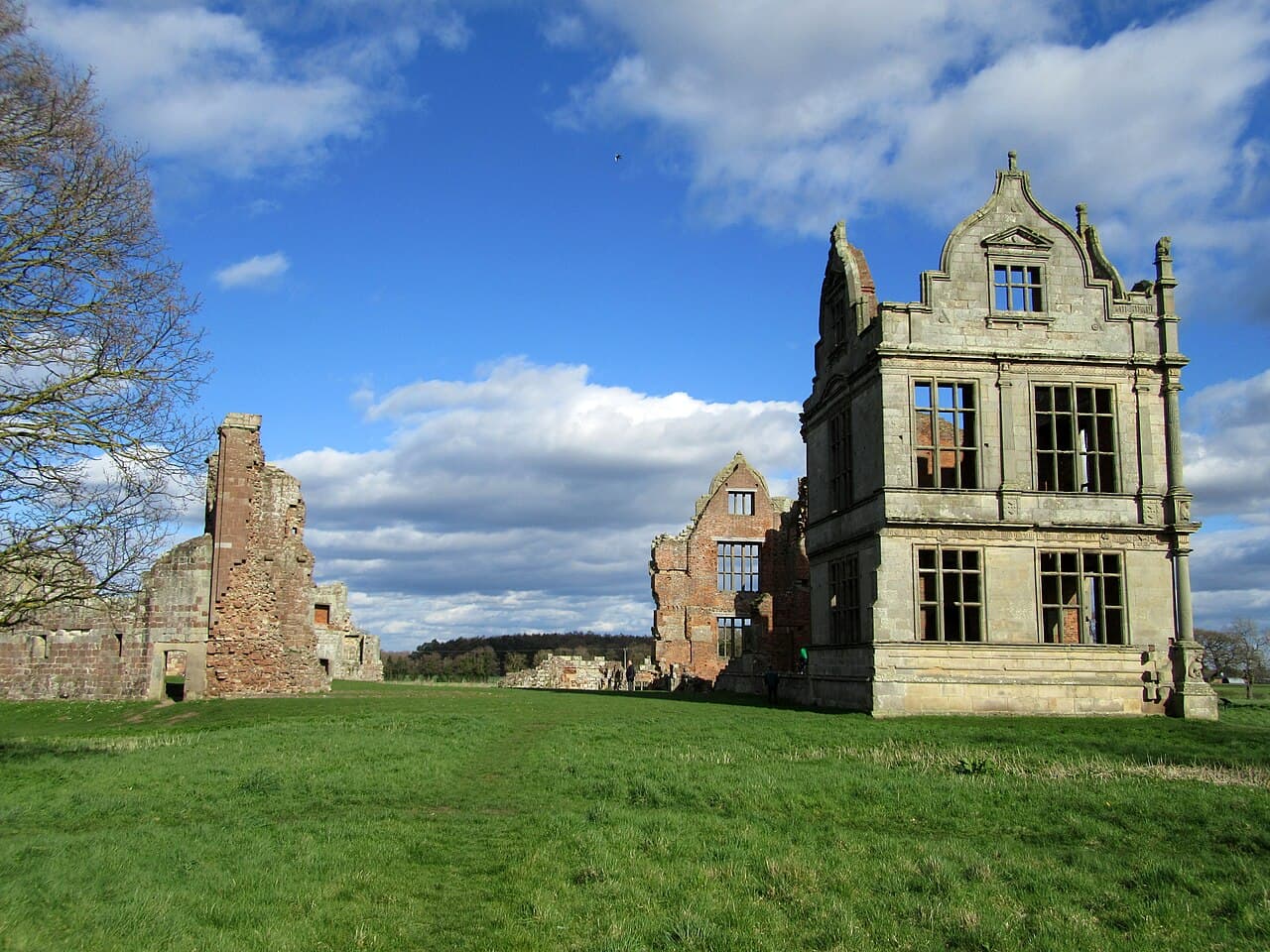
Following Sir Andrew’s death in 1578, his son Robert Corbet embarked on an ambitious project to build a new manor house in the Elizabethan style, heavily influenced by the classical architecture of Italy encountered during his travels. This residence, located south of the medieval castle, is characterized by a broad, shallow layout and incorporates Renaissance elements inspired by Andrea Palladio. The manor’s walls were constructed with brick cores faced with stone, and its main southern entrance is richly decorated with carved stonework. Notable sculptural features include a chimera on the southwest corner and a wyvern on the southeast, though these carvings exhibit a rustic style compared to their Italian models.
Robert Corbet’s untimely death from the plague in 1583 interrupted the manor’s construction, but his brothers Richard and Vincent completed the building, skillfully integrating the new Renaissance-influenced structure with the older medieval castle. This fusion of architectural styles at Moreton Corbet Castle offers a vivid example of the transitional period between fortified medieval residences and more comfortable, status-expressing Renaissance manor houses.
Role in the English Civil War and subsequent decline
Moreton Corbet Castle’s strategic location near Shrewsbury made it a significant Royalist stronghold during the English Civil War in the 17th century. The castle endured multiple sieges and changed hands at least four times, reflecting the fierce contest for control in the region. Evidence of the intense fighting remains visible today in the form of numerous musket ball marks pockmarked across the castle walls.
One notable episode occurred in 1644 when Parliamentary forces executed a daring nighttime assault to capture the castle. The damage inflicted during these conflicts contributed to the castle’s gradual decline as a military fortress. After the war, the Corbet family shifted their residence to the nearby Acton Reynald Hall, and Moreton Corbet Castle was partially demolished in the 18th century, ceasing to function as a noble residence.
Architectural features and present condition
Today, Moreton Corbet Castle presents a compelling architectural palimpsest, combining the remnants of its medieval defensive structures with the adjoining Elizabethan manor house. The medieval keep, curtain walls, and gatehouse stand alongside the Renaissance domestic ranges and manor, illustrating the castle’s evolution over several centuries.
The surviving gatehouse with its Gothic arch and carved heraldic stones remains a highlight of the site. The domestic range’s great hall and kitchen facilities reveal the practical aspects of castle life, while the Elizabethan manor house’s richly decorated façades and sculptural details showcase the influence of Renaissance aesthetics in England.
Despite its ruined and partially demolished state, Moreton Corbet Castle remains under the stewardship of the Corbet family and is preserved as a historic monument. Visitors can explore the site’s layered history, appreciating the architectural and historical significance of this unique English castle.
Frequently asked questions (FAQ)
- How do I get to Moreton Corbet Castle?
- Moreton Corbet Castle is located near the village of Moreton Corbet in Shropshire, England. It is accessible by car via local roads from Shrewsbury and nearby towns. There is limited parking near the site, so visitors should plan accordingly.
- What is the historical significance of Moreton Corbet Castle?
- Moreton Corbet Castle is significant for its origins in the late 11th century and its evolution through medieval and Elizabethan periods. It played a key role in the English Civil War and showcases a unique blend of defensive and Renaissance architecture.
- When was the Elizabethan manor house at Moreton Corbet Castle built?
- The Elizabethan manor house was initiated by Robert Corbet in the late 16th century, around the 1580s, and completed by his brothers after his death in 1583.
- Can I visit the interior of Moreton Corbet Castle?
- Visitors can explore the ruins of Moreton Corbet Castle, including the medieval keep, gatehouse, and parts of the Elizabethan manor house. However, some areas may be restricted due to safety concerns, so it is advisable to check current visitor information before planning a visit.
- Why does Moreton Corbet Castle have musket ball marks on its walls?
- The musket ball marks are a result of the intense fighting during the English Civil War when the castle changed hands multiple times between Royalist and Parliamentary forces.
- Is Moreton Corbet Castle wheelchair accessible?
- Due to the castle's ruined condition and uneven terrain, wheelchair access is limited. Visitors with mobility concerns should contact the site management in advance for detailed accessibility information.
Photo gallery

Information
Website
Visit websiteSources & official resources
Verify the information above using these authoritative references.
Loading map...
Visitor reviews
No reviews yet. Been here? Write the first review and help other travelers!
Write the first reviewVisited this castle? Share your experience
Your review helps other travelers and adds first-hand knowledge to our encyclopedia.