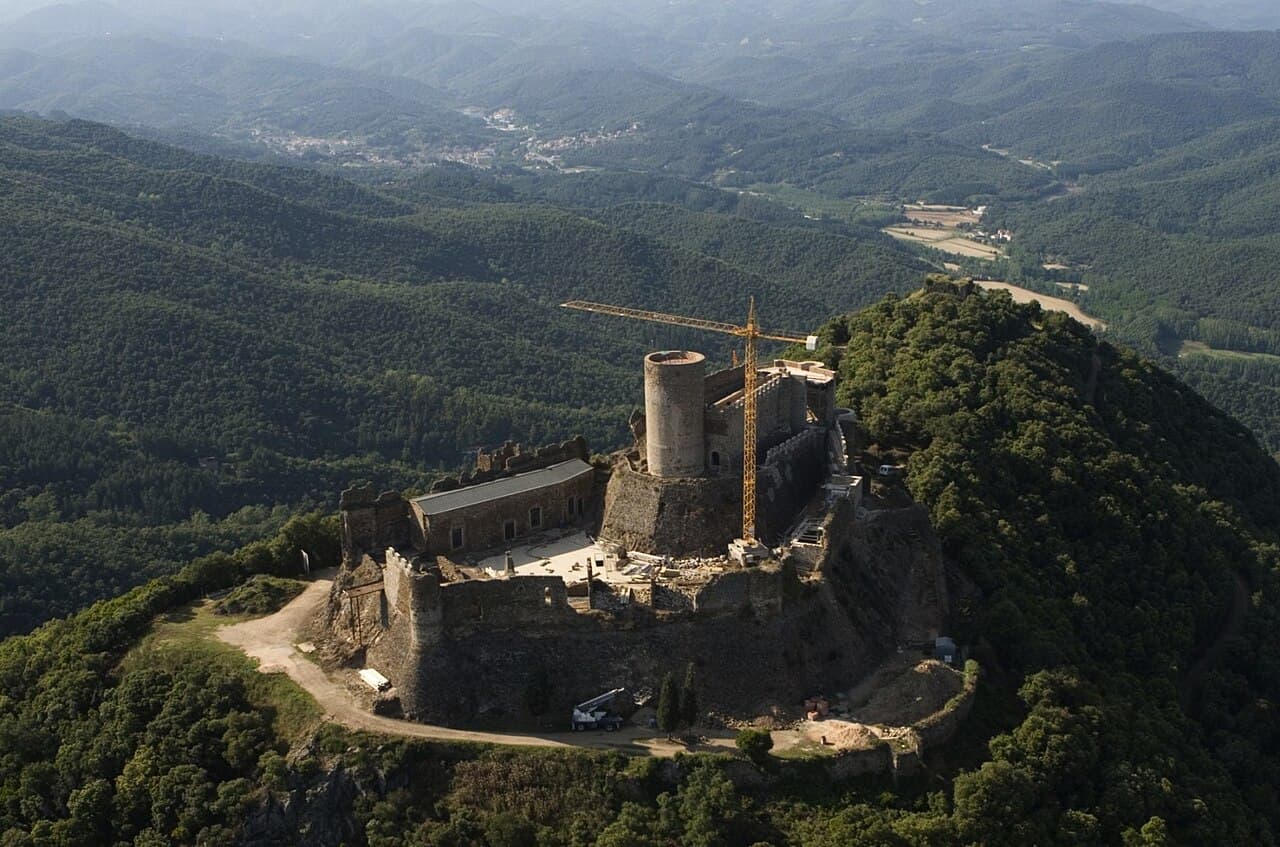
Montsoriu Castle
Montsoriu Castle stands as one of the most remarkable medieval fortresses in Catalonia, Spain. Perched strategically atop a rocky hill in the municipality of Arbúcies, it commands panoramic views over the surrounding landscape, including vital mountain passes and coastal towns. This commanding position made Montsoriu a key military and political stronghold from the early Middle Ages through the late medieval period.
The site of Montsoriu has been occupied since ancient times, with archaeological evidence indicating human presence during the Iberian period between the 4th and 3rd centuries BCE. Even earlier, a polished Neolithic axe found nearby suggests prehistoric activity in the area. The name "Montsoriu" appears in written records as early as the year 1002, initially referring to the hill itself rather than a constructed fortress. The first documented mention of the castle dates to 1053, marking its emergence as a fortified site.
Montsoriu's history is closely intertwined with the noble Cabrera family, who established their power base here through the marriage of Ermessenda de Montsoriu to Guerau I de Cabrera in 1033. This alliance linked the castle to the viscounts of Cabrera, who played a pivotal role in regional politics and military campaigns, including participation in the 13th-century Christian conquests of Mallorca and Valencia under King James I. The Cabreras also founded the nearby religious center, the monastery of Sant Salvador de Breda.
Medieval origins and strategic importance
The original fortress at Montsoriu was constructed during the early medieval period, with the central keep or tower of homage dating back to the late 10th century. This keep served as the castle's core defensive and symbolic structure. The castle's position on a rocky hill provided natural fortification, augmented by three concentric rings of defensive walls that evolved over centuries.
Throughout the 12th and 13th centuries, Montsoriu underwent significant expansions, including the addition of a new sovereign enclosure with a Gothic-style hall featuring a pointed barrel vault ceiling. The second enclosure, trapezoidal in shape, contained a spacious central courtyard known as the patio d’armes. Defensive features included a square tower, a deep moat, and two cylindrical corner towers equipped with arrow slits for archers and crossbowmen.
Religious structures within the castle
Religious life was integral to Montsoriu, evidenced by the presence of chapels within the castle walls. The oldest is a small pre-Romanesque chapel dedicated to Saint Peter, located near the main northern gate. This chapel preserves an apse and fragments of Romanesque murals, highlighting its early medieval origin and artistic decoration.
A later rectangular chapel, constructed in the late 12th or early 13th century, measures approximately 10 by 3.5 meters and features two small double-splayed windows, a lateral chapel attached to its west side, and a steeply pitched roof. Inside, wall decorations include human figures and crosses, underscoring its religious significance.
14th-century transformation into a palace-fortress
During the 14th century, Montsoriu was transformed by the Cabrera family into a palace-fortress that balanced residential comfort with military defense. New residential quarters were built, including dining and kitchen areas, and water cisterns were installed to ensure a reliable supply. The entrance to the keep was modified, and atop the existing Gothic hall, a large 100-square-meter hall with a fireplace and two Gothic windows was added, emphasizing the castle's role as a noble residence.
The defensive walls were significantly thickened, increasing from about 70 centimeters to between 1.2 and 1.5 meters in width. Continuous battlement walkways were constructed along the walls, allowing defenders to patrol and repel attackers efficiently. The second enclosure became primarily residential, with rooms opening onto the courtyard, some sheltered by arcaded galleries.
At the courtyard's center lies a substantial stone cistern approximately 12 meters long, 4.5 meters wide, and 5 meters deep, supplied by an extensive channel system and paved with marble from nearby Gualba. This cistern was vital for sustaining the castle during sieges.
The original 13th-century chapel was eventually replaced by a larger rectangular chapel measuring about 10 by 8 meters. This newer chapel features a presbytery area, a bell gable for hanging bells, and a notable Gothic window known as "the countess’s lookout," accessible directly from the courtyard, serving both religious and strategic purposes.
Defensive enhancements and layout
A third, lower defensive enclosure was added in the 14th century below the main fortifications, including a square tower near its entrance designed to strengthen the castle's defenses. Montsoriu's defensive system was complex, featuring seven gates arranged in successive stages, many equipped with traps to delay or capture attackers.
The castle's elevated location offered broad views across the surrounding mountains and coastal towns, as well as control over key passes such as Collsacabra and Sant Celoni. This vantage point was crucial for monitoring regional movements and defending the territory.
Decline and later history
By the 15th century, Montsoriu's military and political importance began to wane. The Cabrera family shifted their residence to more comfortable locations in Blanes and Hostalric. The evolution of warfare, particularly the introduction of gunpowder weapons, rendered traditional fortifications like Montsoriu less effective.
The castle suffered damage during the Remences War, a peasant revolt from 1462 to 1472, which further diminished its defensive value. Ownership passed through several noble families, including the Enríquez de Cabrera, Montcada-Aitona, and Sarriera families, before coming under the Dukes of Medinaceli in the mid-18th century.
Montsoriu saw renewed military use during the Peninsular War (1808–1814), when French troops occupied it, and again during the First Carlist War (1833–1840). After these conflicts, the castle fell into ruin and was rediscovered by early 20th-century travelers and historians fascinated by medieval architecture.
Restoration and cultural significance
Architectural documentation of Montsoriu began in 1914 and 1915, sparking interest in its preservation. Restoration efforts in the late 20th century have aimed to conserve the castle's Gothic architectural character while retaining important elements from earlier periods, including the pre-Romanesque chapel and its distinctive buttress tower.
Excavations have uncovered a rich collection of 16th-century Catalan ceramics, now housed in the Museu Etnològic del Montseny La Gabella in Arbúcies. Visitors can also view a detailed architectural scale model of the castle, created by Manuel Genovart i Boixet, exhibited in the castle's Noble Hall, which provides an insightful visualization of Montsoriu's historical form.
Today, Montsoriu Castle is managed by the Consell Comarcal de la Selva and is open for guided tours, allowing visitors to explore its extensive fortifications, residential quarters, chapels, and commanding views. The castle stands as a testament to Catalonia's medieval heritage and the architectural evolution of hilltop fortresses over several centuries.
Frequently asked questions (FAQ)
- When was Montsoriu Castle originally built?
- Montsoriu Castle's origins date back to the late 10th century with the construction of its central keep, marking its early medieval foundation.
- What architectural styles are represented at Montsoriu Castle?
- Montsoriu Castle primarily features Gothic architecture from its 13th and 14th-century expansions, along with earlier pre-Romanesque elements.
- Can visitors tour Montsoriu Castle today?
- Yes, Montsoriu Castle is open for guided tours managed by the Consell Comarcal de la Selva, providing access to its fortifications and historic structures.
- What defensive features make Montsoriu Castle notable?
- The castle boasts three concentric rings of defensive walls, seven gates with traps, a deep moat, and towers with arrow slits, showcasing advanced medieval military architecture.
- How did the Cabrera family influence Montsoriu Castle's history?
- The Cabrera family transformed Montsoriu into a palace-fortress in the 14th century and were key regional rulers involved in military and political events in Catalonia.
Photo gallery

Information
Opening hours
Guided tours available from 2011 onward
Current owner
Consell Comarcal de la Selva
Website
Visit websiteSources & official resources
Verify the information above using these authoritative references.
Loading map...
Visitor reviews
No reviews yet. Been here? Write the first review and help other travelers!
Write the first reviewVisited this castle? Share your experience
Your review helps other travelers and adds first-hand knowledge to our encyclopedia.



