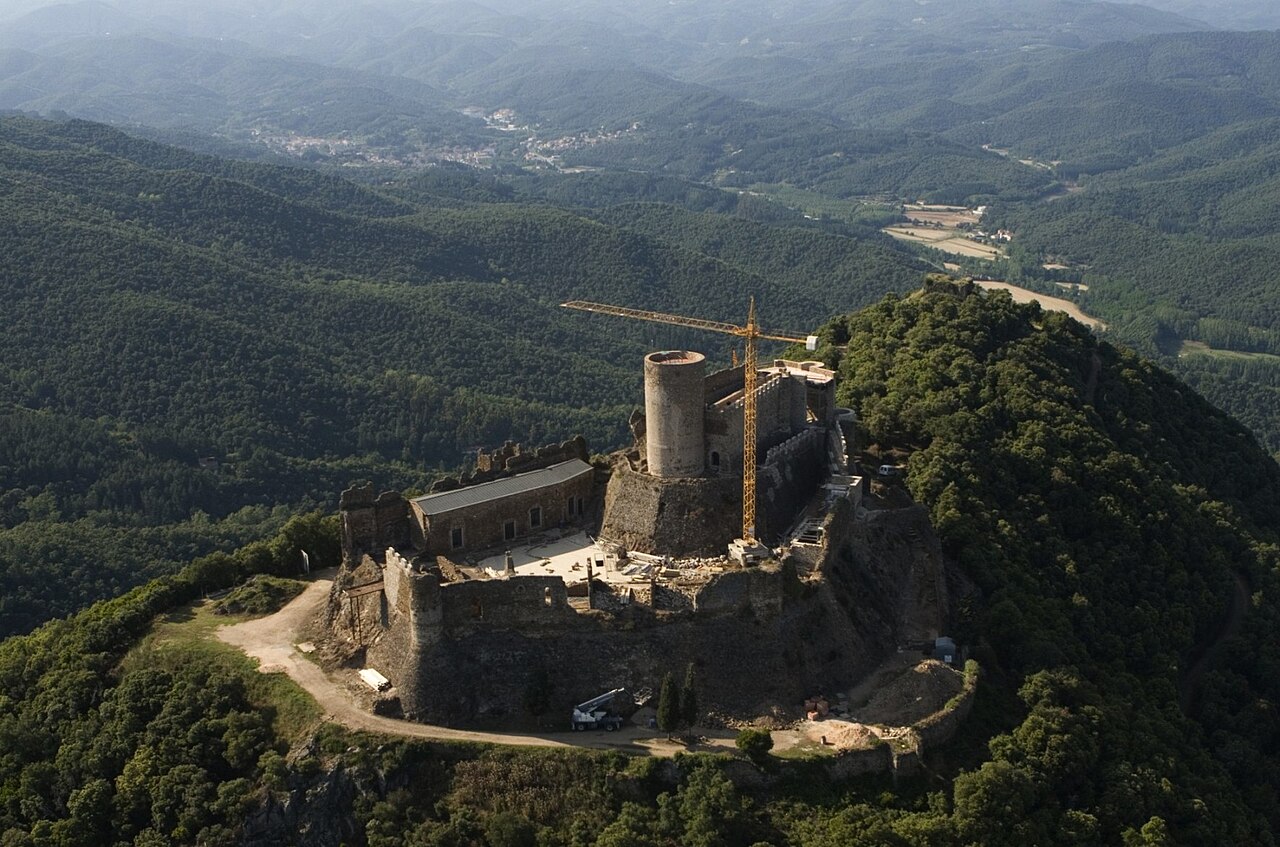
Montclús Castle
Montclús Castle stands as a remarkable example of medieval fortification nestled within the municipality of Sant Esteve de Palautordera in Catalonia, Spain. Its origins trace back to the early Middle Ages, specifically the 10th century, marking it as a significant site in the region's medieval history. The castle's strategic location on the foothills overlooking the plain of Palautordera was chosen for its natural defensive advantages and difficult accessibility, which were crucial for defense during turbulent times.
The origins and early history of Montclús Castle
The earliest phase of Montclús Castle began with the construction of an initial structure that included a circular tower and an adjoining hall. This phase, dating from the 10th century, laid the foundation for what would become a more extensive fortification in the 11th and 12th centuries. The castle's initial layout centered around this tower and hall, which formed the core defensive elements of the stronghold.
From the mid-11th century onward, the castle served as the center of a local barony governed by the Montseny family. These lords operated under the authority of the Knights Hospitaller, a prominent religious and military order linked to the commandery of Sant Celoni. This relationship underscored the castle's importance not only as a military fortification but also as a center of feudal and religious power in medieval Catalonia.
Ownership transitions and architectural evolution
Between 1230 and 1263, the castle gained renewed prominence when Guillem de Sesagudes adopted the Montclús surname and formally took lordship over the castle. This marked a period of consolidation of local power. In 1275, ownership shifted to Ramon de Cabrera, whose family maintained control through the 15th century. A pivotal moment came in 1403 when Bernardí de Cabrera purchased the chief lordship rights from the Hospitaller order, ending the castle's feudal dependence on the religious commandery and signaling a shift towards secular lordship.
During the 14th century, the castle underwent significant architectural transformation. Originally a purely military fortress, it was adapted towards residential use, reflecting broader trends in castle architecture where fortifications evolved into palace-like residences. This included modifications to accommodate more comfortable living quarters while maintaining defensive capabilities.
Nearby, the chapel of Santa Margarida was an important religious structure associated with the castle. It was restored in the early 16th century but fell into ruin by the mid-18th century. In 1739, the chapel was relocated to a nearby field called Parellada, reflecting changing religious and community needs.
Architectural features and defensive elements
The surviving architectural elements of Montclús Castle offer valuable insights into medieval construction techniques and defensive strategies. The circular tower from the initial phase still stands to a height of approximately 3.5 meters, serving as a tangible link to the castle's earliest period. This tower is adjoined by a hall enclosed by walls reaching up to two meters high, constructed with irregular stones and distinctive sections laid out in an opus spicatum or herringbone masonry pattern, a technique common in medieval Catalan construction.
Later medieval additions include a roughly square enclosure, likely from the 13th or 14th century, featuring a tower with lowered arches that provided both vantage points and structural support. The better-preserved north and west walls of this enclosure reflect the evolving defensive needs during this period of increased fortification.
Archaeological excavations have uncovered a relatively tall defensive wall near the main enclosure, equipped with arrow slits and battlements. This wall likely formed the main entrance to the castle, designed to control access and provide robust defense against attackers. The masonry throughout the site blends irregular stonework with carefully dressed blocks arranged in herringbone patterns, illustrating the castle's complex construction history spanning several centuries.
Religious significance and the chapel of Santa Margarida
The chapel of Santa Margarida was a significant religious site closely linked to the castle and its inhabitants. Its restoration in the early 16th century indicates its continued importance during the Renaissance period. However, by the mid-18th century, the chapel had fallen into disrepair and was eventually relocated in 1739 to a nearby field called Parellada. This relocation reflects broader changes in religious practices and the shifting priorities of the local community.
Archaeological research and preservation efforts
Interest in Montclús Castle was renewed in the late 20th century when archaeological activity began in 1995. These efforts aimed to uncover and preserve the castle's historical fabric, leading to restoration work initiated in 1996. The archaeological investigations have provided valuable information about the castle's construction phases, defensive features, and residential adaptations.
Today, access to the castle is via a dirt path crossing the Tordera River near the former location of the chapel. The site is recognized as a cultural asset of national importance in Spain, highlighting its significance in Catalonia's medieval heritage and its value as a historical monument.
Montclús Castle in the context of Catalan medieval fortifications
Montclús Castle exemplifies the typical evolution of Catalan hill castles from military fortresses to noble residences. Its history reflects the complex feudal relationships of medieval Catalonia, involving noble families like the Montseny and Cabrera lineages and religious orders such as the Knights Hospitaller. The castle's architectural features illustrate the adaptation of defensive structures to changing military and residential needs over several centuries.
The castle's location in the foothills provided strategic oversight of the surrounding landscape, crucial for controlling local territories and trade routes. Its preservation and archaeological study contribute to understanding the broader historical and cultural landscape of medieval Catalonia.
Frequently asked questions (FAQ)
- How do I get to Montclús Castle?
- Montclús Castle is accessible via a dirt path crossing the Tordera River near the former chapel site. Visitors should prepare for a hike as the terrain can be uneven.
- What is the historical significance of Montclús Castle?
- Montclús Castle was a medieval stronghold and baronial center under the Montseny family and later the Cabrera family, with ties to the Knights Hospitaller, reflecting feudal and religious power in Catalonia.
- When was Montclús Castle built?
- The castle's origins date back to the 10th century, with major construction phases in the 11th and 12th centuries and significant modifications in the 14th century.
- Can I visit the chapel of Santa Margarida?
- The chapel of Santa Margarida was relocated in 1739 and is no longer on the castle site. Visitors interested in the chapel should inquire locally about its current location in the Parellada field.
- What architectural features are notable at Montclús Castle?
- Key features include a 10th-century circular tower, walls with opus spicatum masonry, a 13th-14th century square enclosure with a tower, arrow slits, and battlements on the defensive walls.
Information
Website
Visit websiteSources & official resources
Verify the information above using these authoritative references.
Loading map...
Visitor reviews
No reviews yet. Been here? Write the first review and help other travelers!
Write the first reviewVisited this castle? Share your experience
Your review helps other travelers and adds first-hand knowledge to our encyclopedia.