Castell d’Hostalric
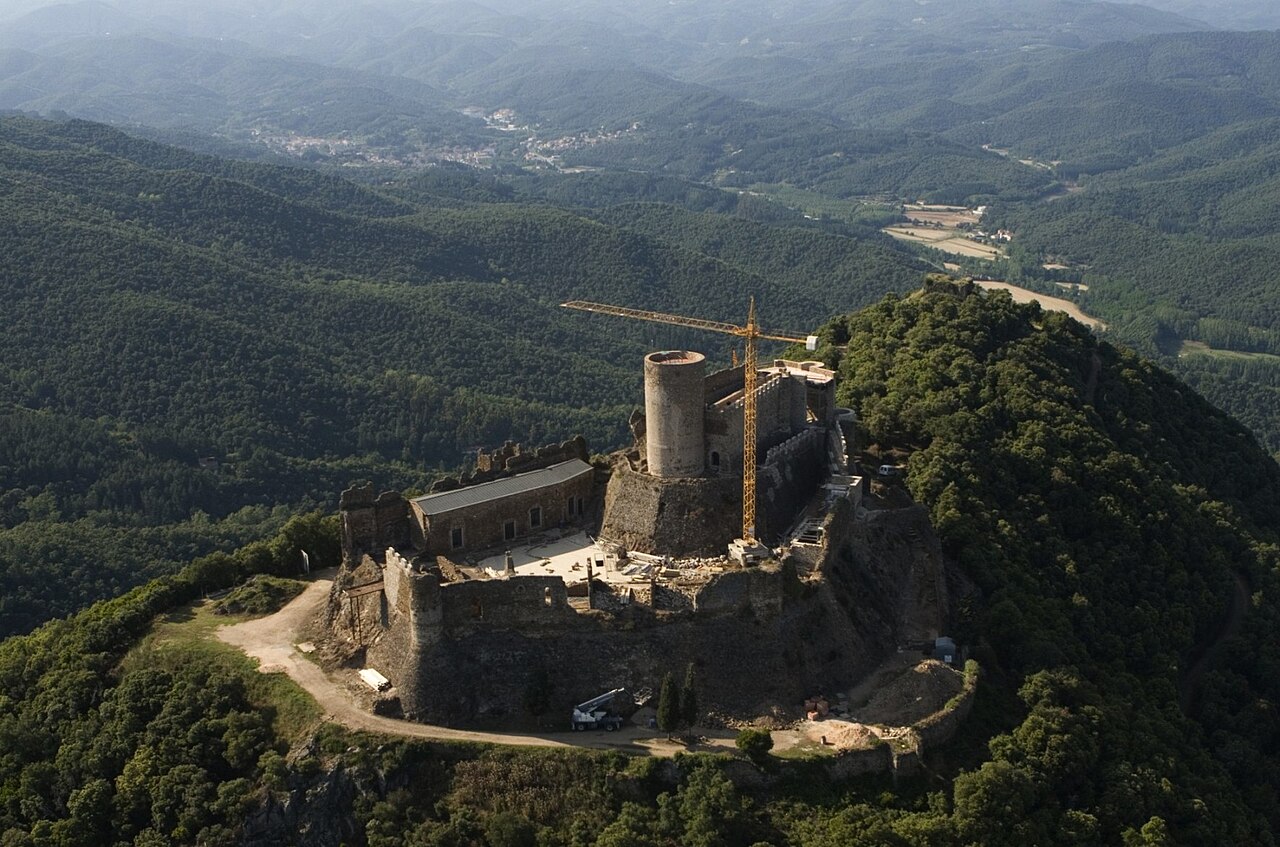
The Castell d’Hostalric stands as a remarkable example of a hill castle strategically positioned atop a volcanic cone in the municipality of Hostalric, Catalonia, Spain. Its origins date back to the 12th century, built upon the foundations of an earlier Iberian settlement. The castle's location on a natural summit of basaltic volcanic rock provided a formidable defensive advantage, overseeing the convergence of the Tordera River and Arbúcies stream. This geographic setting not only enhanced its defensive capabilities but also influenced the choice of local basalt as the primary construction material, lending the fortress a rugged and enduring character.
Medieval origins and the viscounty of cabrera
During the Middle Ages, particularly by the late 14th century, the castle became the administrative center of the Viscounty of Cabrera. The Viscount Bernat IV de Cabrera played a crucial role in shaping the castle and the surrounding town's defenses. He commissioned the construction of enclosing walls around Hostalric, incorporating four fortified gates to control access and enhance security. The castle itself was designed primarily as a practical residence and stronghold for the local rulers rather than a grandiose palace, emphasizing functionality and defense.
Fortifications and town walls
Approximately 600 meters of the medieval town walls have survived, predominantly along the northern and western perimeters. Among these fortifications, the Portal de Barcelona gate is a notable feature, reconstructed since 1969. This gate showcases a semicircular arch formed by wedge-shaped stones known as voussoirs and is defended by battlements. Flanked by a circular tower and adjacent wall sections, the gate's current location is slightly different from its original position, reflecting changes over time.
Architectural features and defensive towers
The castle complex includes a series of semicylindrical defensive towers that punctuate the town walls. These include the Torre dels Bous, Torre dels Cabrera, Torre d’Arenes, Torre Baylina, Torre d’en Caís, and Torre Tuies Negres. Among these, the Torre d’Ararà (also known as the Torre dels Presos) stands out for its prominent features dating from the 14th to 15th centuries. This tower is characterized by a marked sloping base or scarp and machicolations—stone projections with openings allowing defenders to drop objects or pour substances on attackers below. Originally, the tower housed several wooden floors above a vaulted ground level and controlled access to the main entrance road.
The torre dels frares and torre del convent
The Torre dels Frares, constructed in the 13th century and recently restored, is the tallest tower in the complex, rising to 33 meters. Internally, it contains three floors with distinctive dome-shaped vaults. Access to its middle floor was possible from the wall walkway, while a spiral staircase embedded within the wall connected to the upper levels. This tower exhibits evidence of multiple construction phases and derives its name from a nearby former Franciscan monastery.
Near the old convent building, now repurposed as the town hall, the Torre del Convent appears as a smaller circular tower with two interior floors. Unlike other towers, it shows signs of unfinished construction, adding to the complex's architectural diversity.
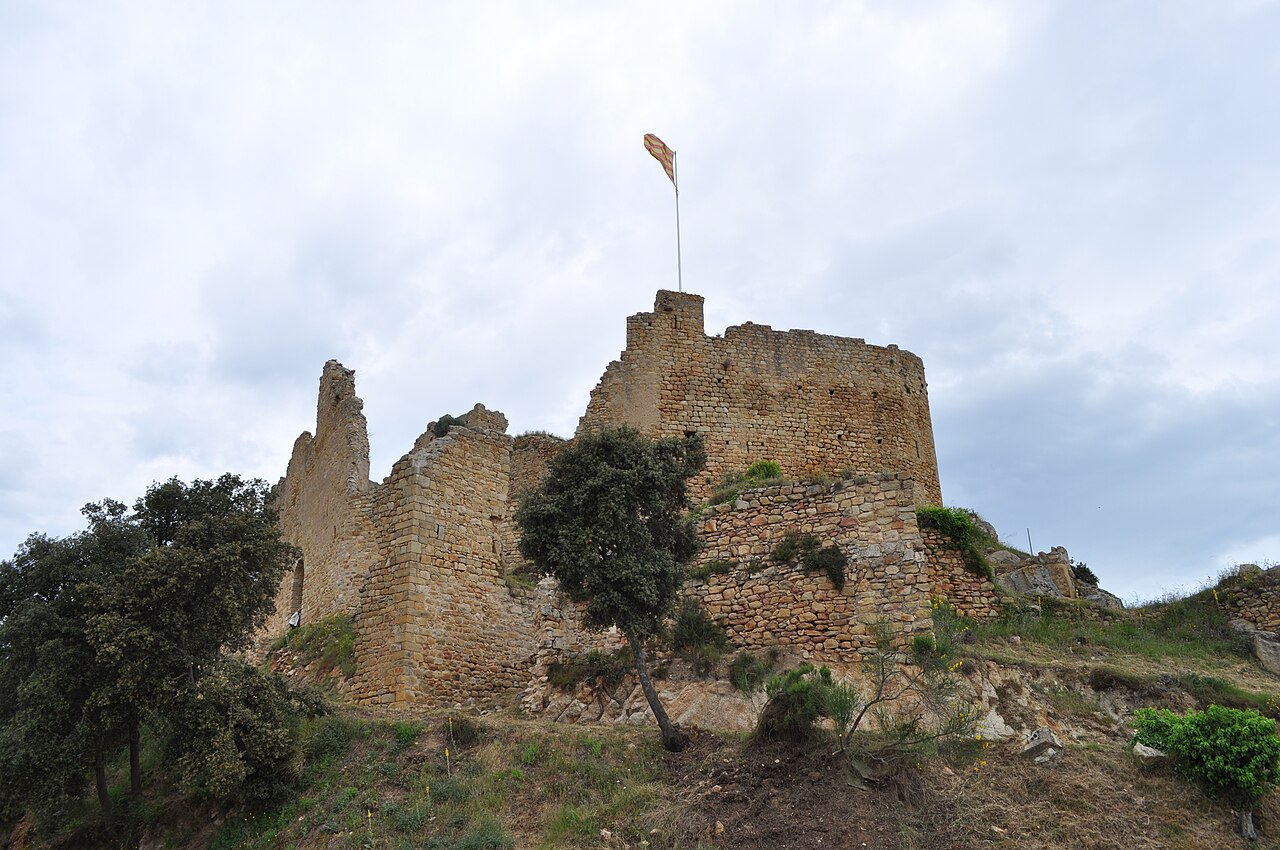
All towers are constructed from carefully shaped basalt stones arranged in circular layers up to the height of their vaulted ceilings. The vaulted ceilings were built using wooden frameworks and included hatches for vertical movement between floors. The masonry of the Torre dels Frares is particularly notable for the use of larger stones compared to other towers, highlighting variations in construction techniques and periods.
Early modern transformations and military significance
The castle endured significant conflict during the late 17th century, notably in July 1695 when French forces under the Duke of Noailles inflicted substantial damage. Reconstruction efforts began soon after, led by military engineer Josep Chafrion, who initiated partial rebuilding. The early 18th century brought further military tensions during the War of the Spanish Succession. In 1712, Francisco de Santa Cruz enhanced the fortress's defenses to support the Austrian claimant Charles, reflecting the castle's ongoing strategic importance.
Between 1719 and 1754, the fortress underwent a comprehensive transformation into a modern military stronghold under the direction of Pròsper de Verboom for King Philip V. This period saw the addition of advanced fortifications including three bastions, a protective moat, and a ravelin—a triangular outwork designed to absorb enemy attacks before reaching the main walls. These enhancements illustrate the evolution of military architecture from medieval to early modern styles, incorporating earthworks reinforced with masonry and lime mortar.
18th-century defensive structures
Surviving elements from this era include the subterranean entrance known as the Santa Tecla bastion, the main powder magazine used for storing gunpowder, a bastion nicknamed the "dent de serra" (sawtooth), and an open parade ground called the plaça de les armes. These features underscore the castle's role as a fortified military installation adapting to the demands of artillery warfare and siege tactics.
Role during the peninsular war and later history
During the Peninsular War (1808–1814), Castell d’Hostalric regained strategic prominence, particularly during the siege of Girona from January to May 1810. The fortress served as a vital supply base and successfully withstood French attacks, demonstrating its enduring military value. The castle continued to function as a military garrison with an assigned governor well into the 20th century.
Eventually, the fortress passed into municipal ownership and was repurposed for civic uses. Its historical significance was formally recognized in December 1963 when it was declared a Monument of Historical Interest. Restoration and archaeological investigations began in the 1990s, revealing ancient pathways and further illuminating the castle's layered history.
Architectural legacy and preservation
Today, the Castell d’Hostalric stands as a testament to centuries of military architecture and adaptation. The surviving medieval walls and towers, combined with the 18th-century bastions and earthworks, provide a comprehensive narrative of defensive strategies evolving from the Middle Ages through the early modern period. The use of local basalt stone throughout the complex not only connects the fortress to its volcanic landscape but also contributes to its distinctive aesthetic and durability.
Visitors can explore the reconstructed Portal de Barcelona, the imposing Torre dels Frares, and the various semicylindrical towers that once guarded the town. The layered construction phases visible in the masonry and vaults offer insights into the castle's architectural evolution. The fortress's preservation as a well-preserved historic site ensures that its cultural and heritage significance continues to be appreciated by scholars and tourists alike.
Overall, Castell d’Hostalric exemplifies the integration of natural topography with human ingenuity in fortification design, reflecting the changing political and military landscapes of Catalonia and Spain over nearly a millennium.
Frequently asked questions (FAQ)
- How do I get to Castell d’Hostalric?
- Castell d’Hostalric is located in the town of Hostalric, Spain, which is easily accessible by car or public transport. If you are coming by train, the nearest station is in the town center, from which you can walk to the castle in about 15 minutes.
- What is the historical significance of Castell d’Hostalric?
- Castell d’Hostalric is a medieval fortress that dates back to the 11th century and played a crucial role in the defense of the region. It was strategically built to control the passage between the regions of Girona and Barcelona, making it a significant military site throughout history.
- When was Castell d’Hostalric built?
- The castle was constructed in the early 11th century, with various modifications and expansions occurring over the centuries. Its architecture reflects the different styles and military needs of each era, showcasing its long-standing historical importance.
- Can I visit Castell d’Hostalric and explore its grounds?
- Yes, visitors are welcome to explore the grounds of Castell d’Hostalric. Guided tours are often available, allowing guests to learn about the castle's history and architecture while enjoying stunning views of the surrounding landscape.
- Why is Castell d’Hostalric a popular tourist destination?
- Castell d’Hostalric attracts visitors due to its rich history, impressive architecture, and scenic views. The castle's well-preserved structure and its significance in medieval warfare make it a fascinating site for history enthusiasts and tourists alike.
- Is it possible to access Castell d’Hostalric with mobility challenges?
- While Castell d’Hostalric is situated on a hill, making some areas less accessible, efforts have been made to accommodate visitors with mobility challenges. It is advisable to contact the castle's management in advance to inquire about specific accessibility options available during your visit.
- What are the opening hours for Castell d’Hostalric?
- Castell d’Hostalric typically opens to visitors from April to October, with varying hours depending on the season. It is best to check the official website or contact the castle directly for the most current opening times and any holiday closures.
- Are there any nearby attractions to visit while at Castell d’Hostalric?
- Yes, there are several attractions near Castell d’Hostalric, including the charming town center with its historical buildings and local shops. Additionally, the beautiful natural surroundings offer opportunities for hiking and exploring the scenic landscape of the region.
- What are the ticket prices for visiting Castell d’Hostalric?
- Ticket prices for Castell d’Hostalric are generally affordable, with discounts available for students, seniors, and children. It is recommended to check the official website for the latest pricing information and any special offers before your visit.
Information
Website
Visit websiteSources & official resources
Verify the information above using these authoritative references.
Loading map...
Visitor reviews
No reviews yet. Been here? Write the first review and help other travelers!
Write the first reviewVisited this castle? Share your experience
Your review helps other travelers and adds first-hand knowledge to our encyclopedia.