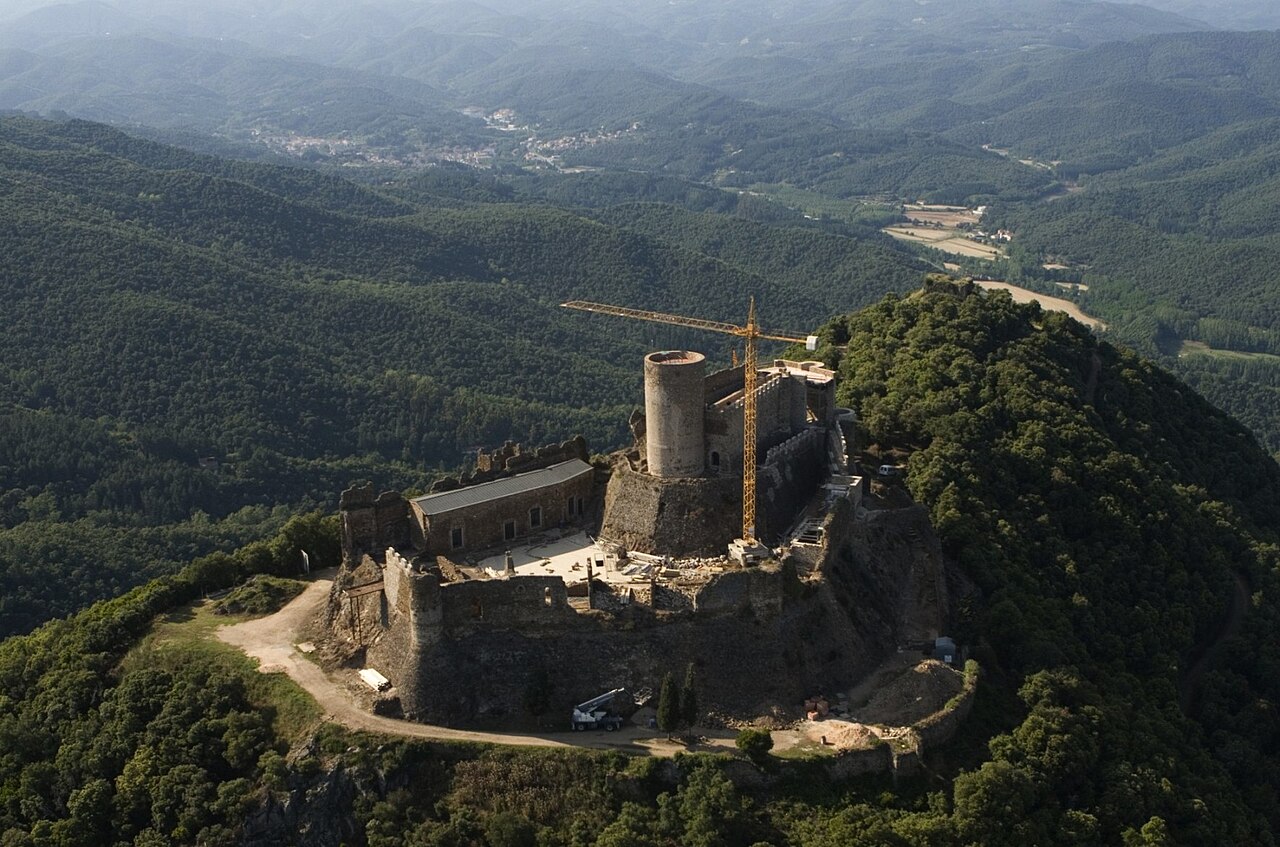
Castle of Farners
The Castle of Farners stands as a remarkable example of Romanesque military architecture in the Catalonia region of Spain. Perched strategically on a hill in the municipality of Santa Coloma de Farners, this fortress dates back to the 11th century, first documented in the year 1046. Its early historical significance is underscored by its association with prominent medieval figures such as Viscount Ramón Folc I of Cardona and Count Ramón Berenguer I, marking it as a key stronghold within the regional feudal hierarchy.
The castle originally formed part of the extensive holdings of the Viscountcy of Cardona and was managed by the Farners family until the 13th century, after which control shifted to the Vilademany family. This transition highlights the castle's role in the complex web of feudal allegiances and landownership that characterized medieval Catalonia. In 1240, Pedro Ramón de Vilademany conferred lordship of the castle to his son Arnau, thereby reinforcing familial ties to the influential Cardona lineage through Viscount Ramón Folc IV.
Medieval conflicts and political significance
The Castle of Farners was not merely a residential fortress but a focal point of political and military tension during the medieval period. Toward the end of the 13th century, a notable dispute erupted between King Peter III of Aragon and Viscount Ramón Folc VI of Cardona over the castle's jurisdiction. This conflict, which extended into the 14th century, reflects the broader struggle between royal authority and noble autonomy prevalent in medieval Spain. The castle's strategic importance was further demonstrated during the late 15th century Catalan civil unrest, where it was occupied by remensa peasants advocating for serf freedom. The fortress's role in these social upheavals underscores its significance beyond mere military defense.
Architectural features and defensive elements
Architecturally, the Castle of Farners occupies an irregular trapezoidal area of approximately 200 square meters, embodying the typical characteristics of Romanesque fortifications. The surviving walls, originally constructed in the 11th century, are broad and robust, rising about four meters in height. These walls were later heightened by an additional two meters during the 14th or 15th century, reflecting adaptations to evolving military technologies and defensive strategies.
A dominant feature of the castle is its keep, also known as the tower of homage. This imposing structure has a circular base measuring 8.40 meters in diameter and stands approximately 12 meters tall. The entrance to the keep is notably situated about seven meters above ground level, a design choice intended to enhance defensibility by restricting direct access and making assaults more difficult.
The main gateway is located on the west side of the castle and is characterized by a lowered semicircular arch. This entrance is further fortified by a small outwork measuring 2.75 by 1.75 meters, which includes three narrow arrow slits for archers to defend the gate while remaining protected. Such features are emblematic of medieval military architecture focused on maximizing defensive capabilities.
On the northern side, a modest door connects the castle to the nearby Turó del Vent (Hill of the Wind), indicating a strategic linkage between the fortress and surrounding terrain. The castle's walls are topped with battlements known as merlons, which provided cover for defenders and are a distinctive element of the castle's defensive design.
Historical transitions and later use
Throughout its history, the Castle of Farners passed through the hands of several noble families, including the Vilademany family, the Counts of Aranda, and the Duke of Híjar. These transitions reflect the shifting political landscape of Catalonia and Spain over the centuries. The castle's military relevance persisted until the 18th century, when it served as a garrison for a Bourbon regiment during the War of Spanish Succession. This marked the last known military use of the fortress, after which it gradually fell into decline.
Cultural and religious significance
At the foot of the hill on which the castle stands lies the Sanctuary of the Virgin of Farners, a religious site originally built in the 13th century. The sanctuary was completely rebuilt in the 17th or 18th century, demonstrating the area's enduring spiritual importance. This juxtaposition of military and religious architecture highlights the multifaceted role the site has played in the region's history.
Current condition and preservation
Today, the Castle of Farners remains a significant historical monument, with much of its original Romanesque structure still visible. The walls and the tower of homage stand as testaments to the fortress's medieval past. While the castle is partially preserved, ongoing efforts in heritage conservation aim to maintain its structural integrity and promote public awareness of its historical and architectural value.
Visitors to the site can appreciate the castle's strategic location, architectural features, and the rich history encapsulated within its stone walls. The castle offers insight into the feudal dynamics, military architecture, and social conflicts of medieval Catalonia, making it an invaluable cultural landmark.
Frequently asked questions (FAQ)
- When was the Castle of Farners originally constructed?
- The Castle of Farners was originally constructed in the 11th century, with the first historical record dating back to 1046.
- What architectural style characterizes the Castle of Farners?
- The castle is characterized by Romanesque military architecture, evident in its robust stone walls and semicircular arches.
- What is the significance of the tower of homage at the Castle of Farners?
- The tower of homage is a central defensive feature with a circular base and a high entrance to prevent easy access by attackers.
- Can visitors access the Castle of Farners year-round?
- Visiting hours and accessibility can vary, so it is recommended to check with local tourism offices for the most current information before planning a visit.
- Why was the Castle of Farners important during the late 15th century?
- During the late 15th century, the castle was a focal point in the Catalan civil unrest and was occupied by remensa peasants demanding freedom.
Information
Website
Visit websiteSources & official resources
Verify the information above using these authoritative references.
Loading map...
Visitor reviews
No reviews yet. Been here? Write the first review and help other travelers!
Write the first reviewVisited this castle? Share your experience
Your review helps other travelers and adds first-hand knowledge to our encyclopedia.