
Montreuil-Bellay Castle
Montreuil-Bellay Castle stands as a magnificent example of medieval military architecture nestled on a strategic hilltop overlooking the Thouet River in the historic region of Anjou, now part of the Centre-Val de Loire in France. Its origins date back to the 11th century, when the formidable Foulque Nerra, Count of Anjou, known as the Black Falcon, constructed the first citadel on the foundations of a Roman oppidum. This initial fortress laid the groundwork for what would become one of the most impregnable strongholds in the region, reflecting the turbulent power struggles of medieval France and England.
The castle’s early history is deeply intertwined with the rise of the Plantagenet dynasty, whose members, including Geoffroy Plantagenet, Henry II, Aliénor of Aquitaine, Richard the Lionheart, and King John, left a lasting legacy on both French and English history. The fortress was entrusted to Foulque Nerra’s vassal, Giraud Berlay, whose family name evolved into Bellay. This lineage helped establish Montreuil-Bellay’s reputation as a fortress of strategic importance during the protracted conflicts between the English crown and the French monarchy.
Medieval origins and architectural evolution
Foundations and early construction
The castle’s location atop a hill provided natural defensive advantages, enhanced by its proximity to the Thouet River. The initial fortifications constructed by Foulque Nerra in the early 11th century were primarily wooden structures that gradually gave way to stone constructions as military technology advanced. The site’s earlier use as a Roman oppidum underscores its long-standing strategic significance.
Expansion under the Berlay family
During the 12th and 13th centuries, Montreuil-Bellay underwent significant fortification upgrades. The Berlay family, particularly under Guillaume de Melun in the late 12th century, expanded the castle’s defenses by erecting massive stone walls and creating a complex of 13 interlocking towers. These towers formed a formidable curtain wall designed to withstand prolonged sieges. Access to the castle was tightly controlled through a single fortified gateway, emphasizing its role as a military bastion.
Architectural features and defensive elements
The castle’s design reflects typical high medieval military architecture, with thick curtain walls, battlements, and a moat system fed by the nearby river. The interlocking towers provided overlapping fields of fire for archers and crossbowmen, while the elevated position allowed for early detection of approaching enemies. The castle also contained residential quarters, a chapel, and storage facilities, illustrating its dual role as a fortress and noble residence.
Historical significance and notable events
Plantagenet conflicts and french royal visits
Montreuil-Bellay was a contested site during the power struggles between the Plantagenet rulers of England and the French crown. Between 1148 and 1151, the castle endured a three-year siege that culminated in Geoffroy Plantagenet overcoming resistance from Giraud II Berlay. Later, the castle hosted the courts of King Philip Augustus in 1208 and King Louis VIII in 1224, underscoring its importance as a royal stronghold.
Hundred years war and religious conflicts
The Hundred Years War brought hardship to Montreuil-Bellay and its surroundings. The castle served as a refuge for local populations during raids and famine. The lord at the time, William de Melun-Tancarville, died heroically at the Battle of Azincourt in 1415. The subsequent centuries saw the castle involved in the French Wars of Religion, where it was a site of arms exchanges between Catholic and Protestant forces. Despite the turmoil, the fortress itself remained largely intact.
Early modern period and notable residents
In the 17th century, the castle came under the ownership of Henry II of Orleans, Duke of Longueville, who played a diplomatic role in signing the Treaty of Westphalia in 1648. His wife, Geneviève de Condé, was a prominent figure during the Fronde rebellion and was confined to Montreuil-Bellay by order of Louis XIV. The castle thus continued to be a center of political intrigue and noble residence.
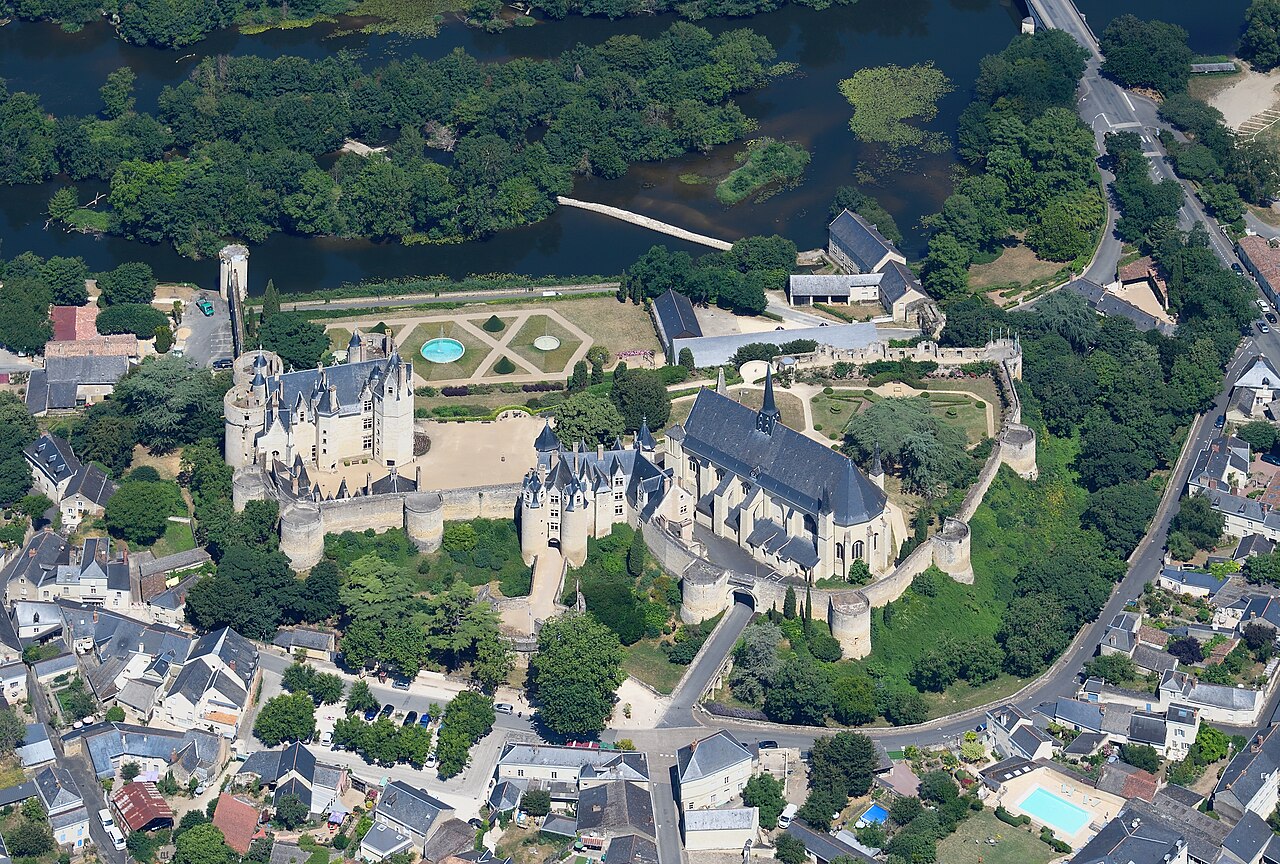
Photo by Carsten Steger • CC BY-SA 4.0
Modern history and restoration
Revolutionary period and subsequent ownership
During the French Revolution, the castle was confiscated and converted into a prison for women suspected of royalist sympathies. After the revolution, it was purchased by Adrien Niveleau, a wealthy merchant from Saumur. He subdivided the estate into rental units, reflecting changing social and economic conditions.
19th century restoration and contemporary status
In the mid-19th century, Niveleau’s daughter undertook a significant restoration project, refurbishing parts of the castle in the Troubadour style, a romanticized medieval revival architectural movement. The castle remains in the hands of her descendants today, who continue to preserve its historical and architectural heritage. The estate also produces a premium wine under the Montreuil-Bellay name, linking the site’s cultural significance to the region’s viticultural tradition.
Architectural highlights and visitor experience
Fortifications and towers
The castle’s 13 interlocking towers and massive curtain walls provide a striking example of medieval defensive architecture. Visitors can explore the battlements, fortified gateways, and moats that once protected the stronghold from invaders. The layout demonstrates the evolution of military design from early wooden fortifications to sophisticated stone castles.
Interior and stylistic elements
Inside, the castle features rooms restored in the Troubadour style, characterized by ornate medieval-inspired decor and furnishings. The blend of original medieval elements and 19th-century romantic restoration offers a unique glimpse into the castle’s layered history.
Cultural significance and heritage status
Recognized as a monument historique by the French Ministry of Culture, Montreuil-Bellay Castle is a protected heritage site that attracts visitors interested in medieval history, architecture, and French nobility. Its continuous ownership by the same family lineage adds to its authenticity and appeal.
Frequently asked questions (FAQ)
- How do I get to Montreuil-Bellay Castle?
- Montreuil-Bellay Castle is located in the town of Montreuil-Bellay in the Maine-et-Loire department of France. It is accessible by car via regional roads, and the nearest major city is Saumur. Public transportation options may be limited, so driving is recommended for convenience.
- What are the main historical periods represented at Montreuil-Bellay Castle?
- The castle primarily reflects <strong>high medieval</strong> architecture from the 11th century onward, with significant renovations in the 12th and 13th centuries. Later additions include 19th-century restoration in the Troubadour style, blending medieval and romantic elements.
- Can I tour the interior of Montreuil-Bellay Castle?
- Yes, visitors can explore the castle's interior, which features rooms restored in the 19th-century Troubadour style. Guided tours often highlight the castle's history, architecture, and the Plantagenet legacy.
- Is Montreuil-Bellay Castle suitable for families and children?
- The castle offers a family-friendly environment with spacious courtyards and accessible battlements. Children interested in medieval history will find the towers and fortifications engaging, though supervision is advised on staircases and elevated areas.
- When is the best time to visit Montreuil-Bellay Castle?
- The castle is best visited during the spring and summer months when the weather is favorable for exploring the extensive grounds and enjoying the scenic views from the hilltop. Special events and festivals may also take place during these seasons.
Photo gallery

Information
Website
Visit websiteSources & official resources
Verify the information above using these authoritative references.
Loading map...
Visitor reviews
No reviews yet. Been here? Write the first review and help other travelers!
Write the first reviewVisited this castle? Share your experience
Your review helps other travelers and adds first-hand knowledge to our encyclopedia.