
Montpoupon Castle
Montpoupon Castle stands as a remarkable example of a late medieval hill castle in the heart of the Loire Valley, within the Centre-Val de Loire region of France. Its strategic location on a rocky promontory overlooking the Cher valley has made it a site of military and noble significance for over a millennium. The castle's origins trace back to the early medieval period, with its name derived from the Germanic tribe known as the Poppo, who settled the site during the era of Charlemagne. Originally called Mons Poppo or "hill of the Poppos," the name evolved into Montpoupon over time.
The castle today is renowned for its blend of Gothic and Renaissance architectural features, reflecting centuries of construction, restoration, and adaptation. Though modest in size compared to other Loire castles, Montpoupon offers a fascinating glimpse into medieval fortification and Renaissance refinement, with surviving elements dating from the 10th century through the 19th century.
Early medieval origins and strategic importance
The initial fortifications at Montpoupon were established in the 10th or early 11th century, attributed to Foulques III Nerra, Count of Anjou, a formidable military leader known for his campaigns to consolidate power in the region. His construction of the massive circular keep or donjon formed the core of the castle's defenses. This keep, topped by a conical roof and featuring machicolations supported by intricately carved corbels, exemplifies early medieval military architecture and defensive ingenuity.
Montpoupon's position was critical in controlling the route between Blois and Loches, overseeing the Cher valley. The castle witnessed significant historical events, including the Battle of Pontlevoy in 1016, where Foulques Nerra secured his dominance over rival counts. By the 12th century, the castle passed into the hands of the influential House of Amboise, linking it to broader political struggles between the French crown and the Plantagenet kings of England.
Medieval transformations and renaissance enhancements
The castle endured the turbulence of the Hundred Years' War, suffering damage from multiple sieges but never falling to English forces. By the war's end, Montpoupon had fallen into disrepair. In 1460, Antoine de Prie and his wife, Madeleine d’Amboise, undertook restoration efforts to revive the castle as a noble residence. These efforts marked a transition from purely military fortress to a more comfortable dwelling reflecting Renaissance tastes.
The early 16th century saw further enhancements under Aymar de Prie, who added a distinctive two-story Renaissance gatehouse complete with a drawbridge and flanking turrets. This gatehouse is celebrated as a fine example of French Renaissance architecture, symbolizing the shift from defensive necessity to aesthetic expression.
The castle also hosted royal visits, including that of King Francis I, who stayed in a bedroom decorated by Italian artisans, highlighting the cultural exchanges that influenced the castle's interior design during the Renaissance.
Architectural features and layout
Montpoupon's layout is anchored by four corner towers, originally built for defense but later integrated into the Renaissance residence as ornamental features. The castle is enclosed by a low wall featuring a round tower and a shield house dating from the 16th century. Access to the courtyard is gained through a square gatehouse flanked by corner towers, leading to a central courtyard with a 15th-century well.
The residential wings developed along one side of the courtyard showcase mullioned windows under steep slate roofs, with late Gothic dormer windows adding decorative detail. Inside, the castle once contained a chapel destroyed during the French Revolution but partially restored in the 19th century, preserving fragments of frescoes depicting the Passion of Christ and the de Prie family coat of arms.
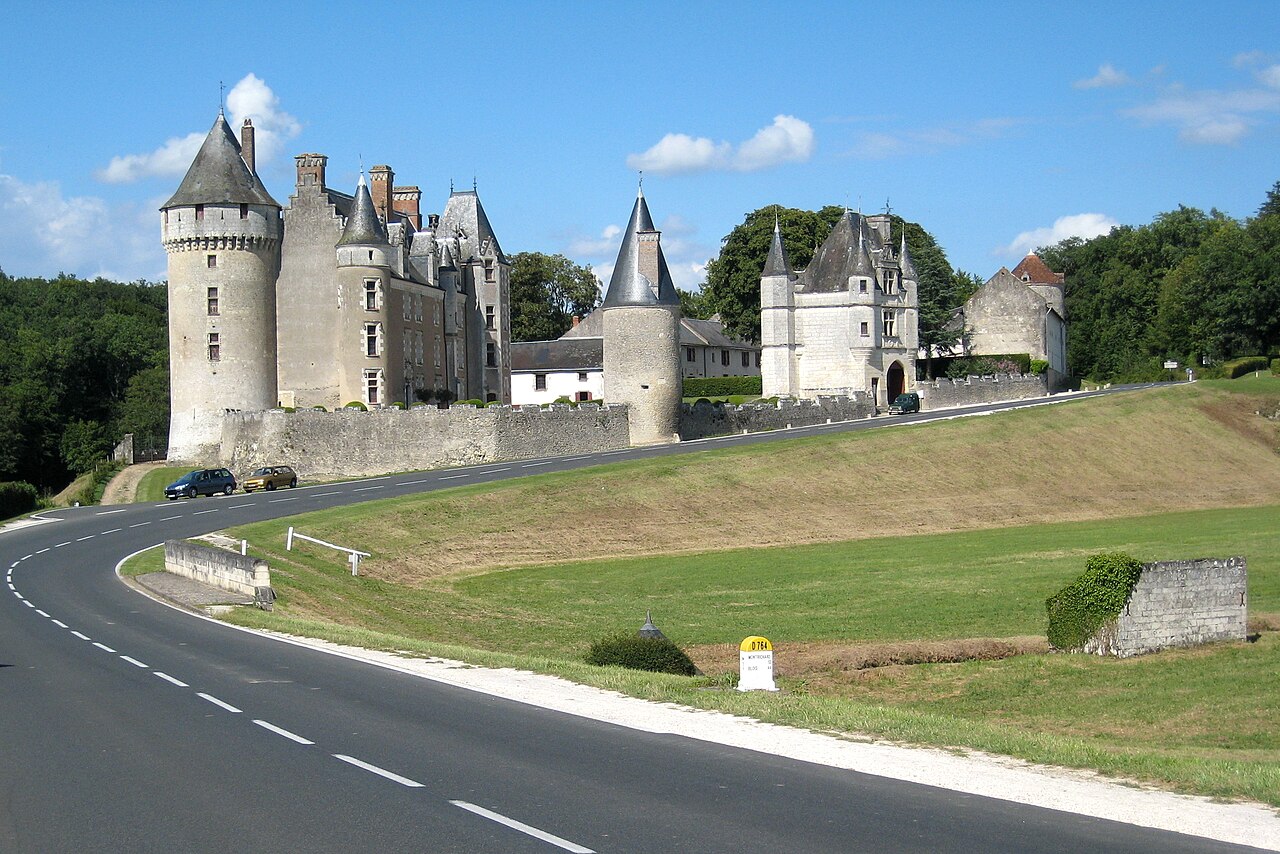
Photo by Nitot • CC BY-SA 3.0
Post-medieval history and restoration
Following the de Prie family's tenure, ownership passed through several noble families, including the La Mothe-Houdancourt and La Ferté-Senneterre lineages, often accompanied by legal disputes and estate sales. In 1763, the Marquis de Tristan acquired Montpoupon and initiated restoration and agricultural improvements. Despite the upheaval of the French Revolution, which destroyed the chapel, the castle remained largely intact.
The 19th century brought further transformations under the Farville family, who expanded agricultural buildings around the castle and maintained its furnishings. In 1857, Jean-Baptiste Léon de la Motte Saint-Pierre purchased the estate and restored many Renaissance features. His son, Émile Léon de la Motte Saint-Pierre, a trained forester and long-serving mayor, enhanced the estate's woodlands and infrastructure.
In the 20th century, modernization efforts included installing electricity, plumbing, and central heating. During World War II, the castle was briefly occupied by German troops but escaped damage. The de la Motte Saint-Pierre family endured wartime hardships, including hostage-taking and rescue by the French Resistance.
Cultural significance and present-day museum
Today, Montpoupon Castle is recognized as a French historic monument since 1966. The current owner, the Count of Louvencourt, has established the Musée du veneur (Hunting Museum) within the castle's outbuildings. The museum displays an extensive collection of hunting-related artifacts, including original copper kitchenware, 19th-century lace and pleated garments in the laundry, historic carriages in the stables, and antique horse harnesses in the saddlery, reflecting the estate's aristocratic and rural heritage.
The castle grounds feature elements of 18th-century French formal gardens, including geometric flower beds, a half-moon shaped parterre, and a fountain canal, though some original features like the central bridge have been lost. Surrounding forests, managed and expanded in the 19th century, continue to support local hunting traditions celebrated by the museum.
Montpoupon has also served as a filming location for productions such as the 1961 adaptation of "The Three Musketeers" and the 1971 mini-series "Quentin Durward," further cementing its place in cultural history.
The castle's well-preserved interiors, including the chapel, library, and former stables adapted for exhibitions, offer visitors a comprehensive insight into the site's layered history, architectural evolution, and noble lifestyle spanning from the medieval period through the modern era.
Frequently asked questions (FAQ)
- How do I get to Montpoupon Castle?
- Montpoupon Castle is located in Céré-la-Ronde, France, and can be easily reached by car or public transport. The nearest major city is Tours, from where you can take a train or drive approximately 35 kilometers to the castle. There is ample parking available for visitors.
- What is the historical significance of Montpoupon Castle?
- Montpoupon Castle dates back to the 15th century and has a rich history tied to the French nobility. It served as a residence for several prominent families and played a role in various historical events throughout the centuries. Today, it stands as a testament to the architectural styles and cultural heritage of the Loire Valley.
- When was Montpoupon Castle built?
- The construction of Montpoupon Castle began in the early 15th century, specifically around 1450. It was built as a fortified residence and has been well-preserved, allowing visitors to experience its historical architecture. Over the years, it has undergone various renovations to maintain its structure and historical integrity.
- Can I take photos inside Montpoupon Castle?
- Yes, photography is allowed in many areas of Montpoupon Castle, including the gardens and some interior rooms. However, please be respectful of any restrictions that may apply in certain exhibitions or private areas. Always check with the staff for guidelines on photography during your visit.
- Why is Montpoupon Castle a popular tourist destination?
- Montpoupon Castle is popular due to its stunning architecture, rich history, and beautiful surrounding gardens. Visitors are drawn to its unique blend of medieval and Renaissance styles, as well as its exhibitions showcasing the lifestyle of the nobility. The picturesque location also enhances its appeal, making it a favorite among history and architecture enthusiasts.
- Is it possible to visit Montpoupon Castle year-round?
- Yes, Montpoupon Castle is open to visitors year-round, though hours may vary by season. It's advisable to check the official website for current opening times and any seasonal events that may be taking place. Be sure to plan your visit accordingly to make the most of your experience.
- What are the ticket prices for Montpoupon Castle?
- Ticket prices for Montpoupon Castle vary depending on age and group size. Generally, adult tickets are around €10, while discounts are often available for students and children. Special rates may apply for family groups and guided tours, so be sure to check the official website for the latest pricing information.
- What is the best time to visit Montpoupon Castle?
- The best time to visit Montpoupon Castle is during the spring and early autumn months when the weather is mild and the gardens are in full bloom. Summer can be quite busy with tourists, while winter may limit access to certain areas. Visiting during the shoulder seasons allows for a more relaxed experience and beautiful scenery.
- Are there any nearby attractions to Montpoupon Castle?
- Yes, there are several nearby attractions worth exploring, including other châteaux in the Loire Valley like Chenonceau and Amboise. The charming village of Céré-la-Ronde also offers local dining and shopping options. Exploring the surrounding countryside can enhance your visit and provide a deeper understanding of the region's history and culture.
Photo gallery

Information
Website
Visit websiteSources & official resources
Verify the information above using these authoritative references.
Loading map...
Visitor reviews
No reviews yet. Been here? Write the first review and help other travelers!
Write the first reviewVisited this castle? Share your experience
Your review helps other travelers and adds first-hand knowledge to our encyclopedia.