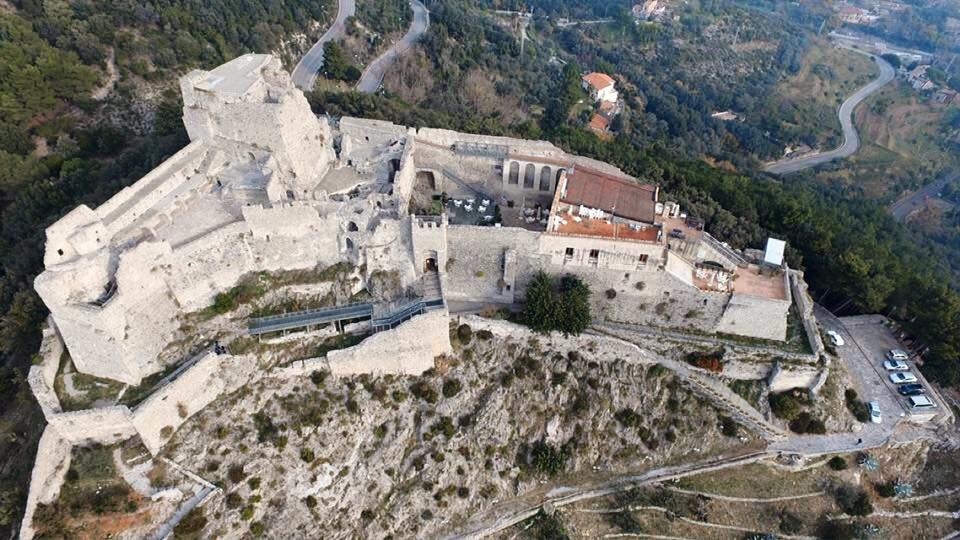
Montevetrano Castle

Montevetrano Castle in San Cipriano Picentino
San Cipriano Picentino, Campania, Italy
High Medieval (11th–13th c.)
Well Preserved

Montevetrano Castle stands as a significant medieval fortress located in the municipality of San Cipriano Picentino, Italy. Its origins trace back to a Roman castrum established in the 3rd century BC, initially constructed to oversee and control the Picentine populations relocated to the plain of Sele. This early military installation laid the groundwork for the castle's strategic importance throughout subsequent centuries.

Medieval development and architectural features

Between the 11th and 13th centuries, Montevetrano Castle underwent significant fortification enhancements, transforming it into a robust medieval stronghold. The castle was equipped with perimeter defensive walls designed to protect against invasions and raids common during the High Medieval period. A prominent entrance gate was constructed on the northern side, serving as the main access point. Inside the courtyard, a cylindrical tower rising three levels provided both a lookout and a last defensive refuge, typical of medieval military architecture.

The castle's layout includes four interior rooms that have survived through the centuries, reflecting the functional design of medieval fortresses which balanced defense with habitation. Additionally, two large cisterns were built within the complex to collect and store rainwater, an essential feature for sustaining occupants during sieges or droughts.

Strategic military use in modern history

In the 19th century, specifically in 1867, the castle was repurposed by the Carabinieri, Italy's national military police, to monitor and control bandit activity in the surrounding region. This use underscores the castle's continued strategic value due to its commanding position overlooking the Sele Valley.

During World War II, Montevetrano Castle was occupied by the German army. Its elevated position on a hill allowed German forces to maintain surveillance and control over the entire Sele Valley, demonstrating the enduring military significance of the site well into the 20th century.

Preservation and current condition

Today, Montevetrano Castle retains much of its original medieval structure. The intact perimeter walls still define the castle's defensive perimeter. The three-level cylindrical tower remains a dominant feature within the courtyard, alongside the surviving four interior rooms. The two large cisterns are also preserved, providing insight into the castle's self-sufficiency during prolonged periods of isolation.

The castle is classified as a hill castle due to its strategic location atop a hill, which historically provided natural defense advantages and extensive views over the surrounding landscape. Its construction during the High Medieval period is reflected in its robust stone masonry and defensive design elements typical of that era.

Architectural significance and cultural heritage

Montevetrano Castle exemplifies the evolution of military architecture from Roman times through the Middle Ages, showcasing how ancient fortifications were adapted and expanded to meet changing defensive needs. The cylindrical tower is a notable architectural element, illustrating medieval advances in fortification design aimed at improving visibility and defensive capability.

The castle's preservation offers valuable insights into the region's historical military strategies and the socio-political dynamics of southern Italy from antiquity through modern times. Its role in controlling the Picentine populations and later as a strategic military outpost highlights its continuous importance across centuries.

Visiting Montevetrano Castle

Visitors to Montevetrano Castle can appreciate its well-preserved medieval features and panoramic views of the Sele Valley. The castle's robust walls and historic structures provide a tangible connection to Italy's medieval past and its ongoing heritage conservation efforts.

Frequently asked questions (FAQ)

How do I get to Montevetrano Castle?
Montevetrano Castle is located in San Cipriano Picentino, Italy, and is easily accessible by car or public transportation. The nearest major city is Salerno, from which you can take a bus or taxi to reach the castle. Parking is available nearby for those traveling by car.
What is the historical significance of Montevetrano Castle?
Montevetrano Castle dates back to the 11th century and is an important example of medieval architecture in the region. It served as a strategic military stronghold and later became a noble residence, reflecting the rich history of the area. The castle is a testament to the feudal system and the historical conflicts that shaped Italy.
Can I take guided tours of Montevetrano Castle?
Yes, guided tours of Montevetrano Castle are available for visitors, providing an in-depth look at its history and architecture. Tours typically include access to various rooms and features of the castle, led by knowledgeable guides. It's recommended to check the castle's official website for the latest tour schedules and availability.
What are the opening hours for Montevetrano Castle?
Montevetrano Castle is generally open to visitors from Tuesday to Sunday, with specific opening hours that may vary by season. During peak tourist season, the castle may extend its hours for visitors. It's advisable to confirm the current opening times on the official website before your visit.
Is it possible to host events at Montevetrano Castle?
Yes, Montevetrano Castle offers facilities for hosting various events, including weddings, corporate gatherings, and private parties. The unique setting provides a picturesque backdrop for any occasion. Interested parties should contact the castle management for details on availability and services offered.
What is the best time to visit Montevetrano Castle?
The best time to visit Montevetrano Castle is during the spring and fall when the weather is mild and comfortable for exploring the grounds. Additionally, these seasons often feature fewer crowds, allowing for a more enjoyable experience. Summer can be quite hot, while winter may bring cooler temperatures, so plan accordingly.
Are there any nearby attractions to Montevetrano Castle?
Yes, there are several attractions near Montevetrano Castle, including the historic town of Salerno and the beautiful Amalfi Coast. Visitors can explore local churches, museums, and scenic viewpoints. Additionally, hiking trails in the surrounding area offer stunning views of the landscape.
What are the ticket prices for Montevetrano Castle?
Ticket prices for Montevetrano Castle are generally affordable, with discounts available for students and seniors. Children under a certain age may receive free admission. It's best to check the official website for the most current pricing and any special offers that may be available during your visit.
Is Montevetrano Castle accessible for visitors with disabilities?
Montevetrano Castle is committed to providing access for all visitors, including those with disabilities. However, due to its historical nature, some areas may have limited accessibility. It's recommended to contact the castle in advance to inquire about specific accommodations and accessible routes.

Information

Hill Castle

Loading map...

Visitor reviews

No reviews yet. Been here? Write the first review and help other travelers!

Write the first review

Visited this castle? Share your experience

Your review helps other travelers and adds first-hand knowledge to our encyclopedia.

Write a review

(5/5)

0/2000 characters

Your review will be visible after admin approval

Nearby castles

6.8 km

Forte La Carnale

Salerno, Italy

Forte la Carnale stands as a significant Renaissance coastal fortress near the mouth of the river Irno in Salerno, Italy. Constructed in 1563, it formed part of an extensive defense system of towers designed to protect the city from Saracen invasions during a period marked by frequent maritime threats. The fortress likely derives its name from a Saracen massacre around the year 872, a historical event that underscores the long-standing strategic importance of this location. Its position near the coastline allowed it to serve as a vital lookout point, where mounted sentinels could rapidly alert the city of approaching enemies from the sea. The design of Forte la Carnale reflects the military architectural principles of the Renaissance period, emphasizing both defensive strength and functionality to withstand the evolving nature of warfare in the 16th century.Historical significance and military roleThe fortress played a pivotal role in the defense of Salerno throughout its history. By the mid-17th century, it became a strategic base for Ippolito from Pastena, who led a rebellion against the Spanish rule. Around this time, a garrison of approximately 100 soldiers was stationed at the fortress to prevent the landing of French troops, thereby protecting Salerno from capitulation during ongoing European conflicts. This military use highlights the fortress's continued relevance well beyond its initial construction.During World War II, Forte la Carnale again became a site of military importance, witnessing historic events that left visible marks on the structure. Its enduring role in various conflicts illustrates its adaptability and strategic value over several centuries.Architectural features and restorationThe fortress is characterized by its robust walls and two-level structure, which now houses halls used for cultural exhibitions. The restoration efforts have preserved its original defensive features while adapting the interior for public use. Visitors can explore the halls that once served military purposes and now function as venues for art and cultural events.A notable feature is the belvedere terrace, offering panoramic views that extend from the Gulf of Salerno to the Amalfi Coast and the Cilento region. This vantage point underscores the fortress's original purpose as a lookout and warning station, providing expansive surveillance over the surrounding sea and land.Cultural and touristic importanceToday, Forte la Carnale is fully restored and open to the public, serving as a cultural hub in Salerno. Its halls host exhibitions and dining venues, making it a vibrant part of the local community and a destination for visitors interested in military history and Renaissance architecture. The fortress's location and preservation allow for an immersive experience into the defensive strategies of the past while enjoying spectacular natural views.Its combination of historical depth, architectural integrity, and scenic surroundings makes Forte la Carnale a noteworthy example of Renaissance military architecture on the Italian coast.

Renaissance (15th–17th c.)
Details
8.9 km
Arechi Castle — Italy castle

Arechi Castle

Salerno, Italy

Arechi Castle stands prominently atop Monte Bonadies, overlooking the city of Salerno in the Campania region of southern Italy. This hill castle traces its origins to the Byzantine period in the 6th century AD, when the general Narses established a military camp during the Gothic War (535-554). The site itself reveals signs of human activity dating back to ancient times, with coins from the 3rd to 2nd century BC attesting to early settlement in the area. The castle’s strategic location on a hilltop nearly 300 meters above sea level allowed commanding views of the Gulf of Salerno and the surrounding coastline, making it a vital defensive stronghold throughout its history. The early history and Lombard fortifications The castle’s name derives from Arechi II, the Lombard duke of Benevento and prince of the Lombard nobility in the 8th century, who significantly fortified the site. After the fall of the Western Roman Empire, the fortress evolved from a Roman military camp into a permanent stronghold. Arechi II moved the capital of the Duchy of Benevento from Benevento to Salerno to strengthen control over the coastline and vital communication routes within Campania. Under his leadership, the castle was expanded and fortified extensively from the 8th to the 11th centuries, with the construction of robust walls descending from the hill to enclose the ancient city of Salernum, giving it a distinctive triangular shape when viewed from the sea. Byzantine origins and Roman antecedents Before Lombard control, the site was used by the Byzantines, who built the earliest parts of the ramparts using opus quadratum technique with large sandstone blocks. Roman historians such as Strabo and Tito Livio described military camps in the hills above Salerno, indicating the site's longstanding military importance. The fortress played a role during the Gothic War, serving as a defensive position against Ostrogothic and Byzantine forces. Lombard expansion and city defenses Arechi II’s fortification efforts included constructing extensive walls that enveloped the city, connecting the hilltop fortress to the sea. The castle’s position and the encompassing walls made it nearly impregnable during this period. The fortress included multiple hills above Salerno, such as the northern Bastille watchtower, which provided additional surveillance and defense. This defensive system reflected the strategic importance of Salerno as a capital and military hub in the Lombard duchy. Norman conquest and medieval modifications In 1077, the castle fell to the Normans after a prolonged siege led by Robert Guiscard. The castle’s defenders, including the last Lombard duke Gisulfo II, surrendered due to starvation during the blockade. The Normans subsequently reinforced the fortress by raising the walls and adding architectural features such as a southern loggia and the northern Bastiglia tower on a rocky spur to cover vulnerable approaches. These modifications enhanced the castle’s defensive capabilities and adapted it to evolving military needs. Swabian and Angevin renovations Under the Swabian ruler Frederick II in the 13th century, plans were made to repair the castle, although few visible changes from this period remain today. The subsequent Angevin dynasty undertook extensive renovations, including the construction of new buildings, water cisterns, and curtain walls equipped initially with arrow slits and later modified with gun ports to accommodate artillery. The Angevin period also saw the introduction of a bathhouse and a thermal system fed by the castle’s cisterns, indicating a shift towards residential comfort alongside military functionality. Documented repairs from 1274 and restorations completed by 1299 demonstrate the castle’s ongoing strategic and residential importance. Aragonese expansion and later history During the 15th century, under Aragonese rule, Arechi Castle expanded to its largest extent. Large buildings were constructed east of the main courtyard, reflecting the castle’s use as a noble residence rather than solely a military fortress. The discovery of high-quality ceramics and majolica pottery from this period suggests a residence of status and comfort. The castle played a significant role in the Aragonese defense of the Kingdom of Naples. Decline and modern era uses By the early modern era, the fortress had lost much of its military importance and transitioned into a summer retreat for the Sanseverino princes. The castle’s elevated and isolated location made access challenging until a connecting road was built, as noted by English traveler Thomas Hoby. In 1820, the castle was the site of a failed conspiracy by the secret society Carbonari, aiming to incite popular uprising. After Italian unification, the castle fell into disuse until the last private owners sold it to the Province of Salerno in 1960, initiating preservation and archaeological studies. Architectural features and remains Arechi Castle’s layout is dominated by extensive defensive walls enclosing a large courtyard called the piazza d’Armi. The walls descend the slopes towards the city and sea, forming a protective circuit. The highest point features the turris maior, a rectangular main tower rising five or six floors high, which served as a lookout with commanding views of the port and land routes. Byzantine and Lombard construction techniques Significant sections of the fortress retain Byzantine opus quadratum walls made of large tuff blocks without mortar. Lombard expansions integrated these with walls extending to the sea, enclosing Salerno’s ancient urban area. The castle’s defenses were further enhanced by Norman additions such as the Bastiglia tower, featuring semicircular drum walls reinforced for cannon openings, a rare adaptation to early artillery. Angevin and Aragonese architectural elements The Angevin period contributed new buildings, water cisterns, and curtain walls with arrow slits converted to gun ports. Bathing facilities and a thermal system fed by cisterns highlight the castle’s residential evolution. Aragonese expansions included large buildings east of the courtyard, indicating noble habitation. Modern period rooms near the entrance reflect later use as a summer residence. Restoration and visitor experience Restoration efforts since the 1980s have focused on structural conservation and improving visitor access. The castle’s ditch floor has been paved, vaulted gun ports and fusilier rooms restored, and stone facing near the main tower repaired. An elevator installed inside a former cistern facilitates access for visitors with disabilities. The castle museum displays finds from archaeological excavations, including ceramics, glassware, metal objects, weapons, and coin hoards that trace the castle’s extensive history. Archaeological discoveries and cultural significance Excavations have uncovered nearly 400 ceramic fragments spanning from the 7th to the 15th centuries, featuring diverse styles such as red-band decorated ware, spiral patterns, lead-glazed tableware, early majolica, and graffito ceramics with vegetal and geometric motifs. Glass artifacts mainly date from the 12th to 15th centuries and include bottles, goblets, and ampoules, with notable pieces like a 13th-century colorless glass goblet decorated with polychrome enamel and applied beads. Metal finds include everyday items like nails, locks, knives, and buckles, as well as horse fittings and weapons such as arrowheads, crossbow bolts, and lances from the 12th century onward. A gilded bronze spur from the early 1300s reflects the high status of some castle inhabitants. Coin hoards discovered during restoration reveal connections to Norman rulers and Italian mints, with silver deniers from Rouen, gold tari from Sicily issued by Norman kings Roger and Tancred, and mixed silver and copper coins dated between 1392 and 1534. Some coins show signs of re-striking, indicating historical metal shortages. Arechi Castle also inspired cultural works such as the tragedy "Ricciarda" by poet Ugo Foscolo, written during a visit in 1812. Local folklore preserves tales of secret passages linking the castle to nearby watchtowers like Forte La Carnale, alongside ghost stories that contribute to its mystique. The castle remains a prominent symbol of Salerno’s medieval heritage and Lombard history, visible lit up at night from much of the city.

Early Medieval (5th–10th c.)
Details
12.7 km

Battipaglia Castle

Battipaglia, Italy

Battipaglia Castle is a striking example of Norman military architecture located in southwestern Italy, in the Campania region. Perched on a wooded hill above the city of Battipaglia, it commands panoramic views over the surrounding landscape, including the nearby Tusciano River and the fertile plains of the Piana del Sele. This strategic position was carefully chosen in the 12th century to protect the local population from invasions and natural threats such as flooding from the river. The castle, also locally known as Castelluccio, is an important cultural and historical landmark that reflects the Norman influence in southern Italy during the High Medieval period. Although the modern city of Battipaglia was officially established in 1929, the area has a rich history dating back to ancient times, with significant archaeological findings nearby, including tombs from the 7th to 6th centuries BC and a Roman villa ruin known as San Giovanni. Historical context and construction The origins of Battipaglia Castle trace back to the Norman conquest of southern Italy, which began in the 11th century. The Normans built a network of fortifications to consolidate their control over the region, and the castle at Battipaglia was part of this defensive system. Constructed in the 12th century, the fortress was designed to serve both as a military stronghold and as a refuge for the local population. The castle's location on a hill provided a natural defensive advantage, allowing defenders to monitor movements across the plain and along the river. This strategic siting was crucial during a period marked by frequent conflicts and power struggles among local lords and external invaders. Architectural features Battipaglia Castle exhibits typical elements of Norman castle architecture, characterized by robust stone construction and functional design aimed at defense. The fortress likely included a keep or donjon, which served as the last line of defense and residence for the lord or garrison commander. Surrounding the keep, there would have been curtain walls with battlements and possibly towers at key points for enhanced protection and surveillance. The castle's walls were constructed from local stone, providing both strength and durability. The presence of preserved murals inside the castle indicates that it also had areas intended for habitation and ceremonial use, reflecting the dual military and residential function of the structure. Defensive structures and layout The design of the castle incorporated features typical of Norman fortifications, such as narrow arrow slits for archers, and a well-protected gatehouse to control access. The elevated position on the hill enhanced the castle's natural defenses, making it difficult for attackers to approach unnoticed or mount an effective siege. Archaeological significance and surrounding sites The area around Battipaglia Castle is rich in archaeological remains that provide insight into the long history of human settlement in this part of Campania. Excavations have uncovered over a hundred tombs dating from the 7th to 6th centuries BC, indicating the presence of ancient communities well before the castle's construction. Additionally, the ruins of a Roman villa known as San Giovanni lie nearby, further attesting to the area's historical importance. Coins minted around 211 BC have also been found, highlighting the region's role in ancient trade and economy. Battipaglia today: cultural heritage and tourism Today, Battipaglia Castle stands as a prominent historical monument in the city, attracting visitors interested in medieval architecture and the rich cultural heritage of Campania. The castle overlooks the modern city, offering scenic views and a tangible connection to the region's past. The city of Battipaglia itself is renowned for its agricultural products, particularly Mozzarella di Bufala, a fresh buffalo milk cheese celebrated for its distinctive taste. Visitors to the castle can combine cultural exploration with culinary experiences unique to this part of Italy. The castle and its surroundings provide exceptional opportunities for cultural and historical tourism, with the site serving as a gateway to exploring the broader archaeological landscape of the region. Preservation efforts have maintained the castle's condition, allowing visitors to appreciate its Norman architectural features and the beautiful murals that remain within its walls. Visiting information Visitors to Battipaglia Castle can explore the hilltop fortress and enjoy the views over the city and the surrounding plain. The site offers a unique glimpse into medieval military architecture and the layered history of the Campania region. Nearby archaeological sites and local museums complement the visit, providing a comprehensive understanding of the area's historical development.

High Medieval (11th–13th c.)
Details