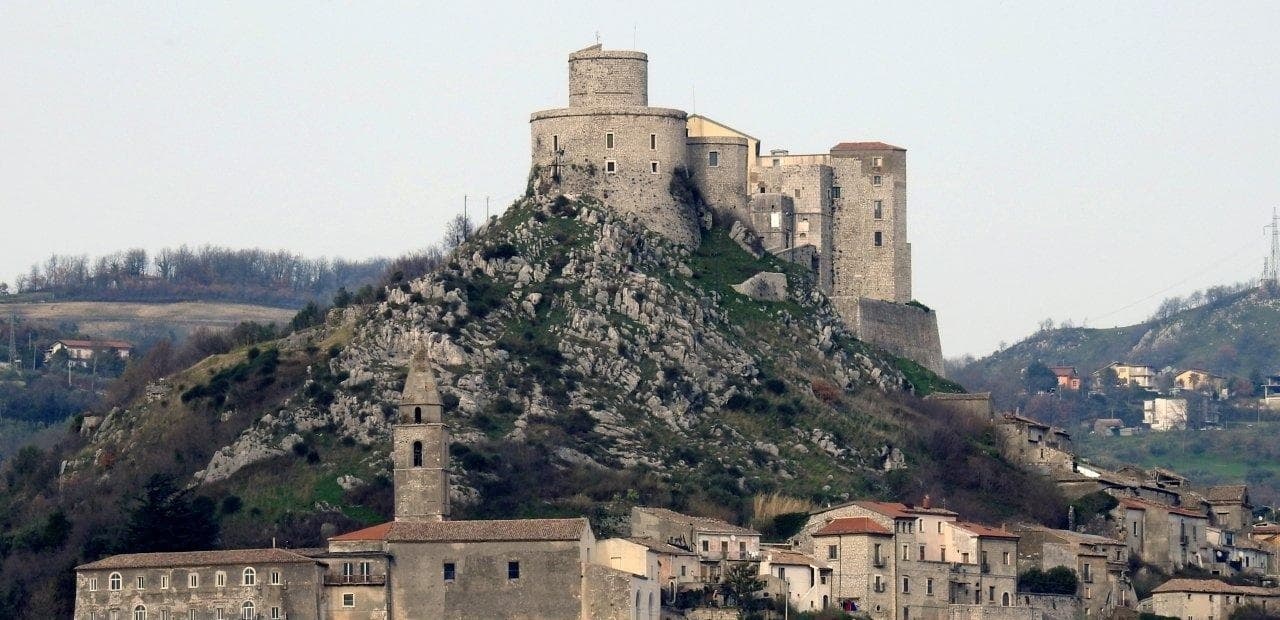
Montesarchio Castle
Montesarchio Castle, located in the town of Montesarchio in Campania, Italy, is a historic hilltop fortress with a rich and layered past spanning from the early medieval period to the modern era. Perched atop Monte Taburno, the castle commands a strategic vantage point overlooking the eastern boundary of the Valle Caudina. This location was crucial for controlling access through this important corridor, which was a significant military and territorial route throughout history.
The site of Montesarchio Castle has been fortified since at least the 8th century, with early builders establishing defensive works that would evolve over the centuries. The Lombards, under the rule of Arigis II of Benevento, initially fortified the area, followed by occupation by the Normans. These early phases laid the foundation for the castle's role as a military stronghold. The present form of the castle mainly reflects extensive building and renovation campaigns undertaken during the Aragonese rule of the Kingdom of Naples in the late medieval period.
Early medieval origins and strategic importance
The castle's origins in the early medieval period are tied to the need for regional defense and control over the Valle Caudina, a vital passageway connecting different parts of southern Italy. The Lombards, who controlled much of the region after the fall of the Western Roman Empire, recognized the military and administrative importance of this site. Their fortifications established Montesarchio Castle as a key defensive outpost.
Later, the Normans took possession of the castle, further reinforcing its fortifications. This period marked the transition from early medieval wooden and earthwork defenses to more permanent stone structures, reflecting changing military technologies and the need for stronger defensive capabilities.
Aragonese reconstruction and architectural features
The castle as it stands today owes much to the Aragonese dynasty, which ruled the Kingdom of Naples from the 15th to the early 16th centuries. During this time, the fortress was significantly rebuilt and expanded to serve both military and administrative functions. The Aragonese enhancements included strengthening the walls, adding towers, and improving the defensive layout to withstand artillery and siege warfare that had become prevalent in the late medieval period.
The fortress features a hill castle design, typical of medieval military architecture, utilizing the natural topography of Monte Taburno to maximize defensive advantage. The castle's layout includes courtyards, moats (now largely vanished), and a network of walls and battlements designed to repel attackers. A notable architectural element is the presence of niches in the masonry that once held the mechanisms for a drawbridge, a key defensive feature controlling access to the castle.
Opposite the main fortress stands the Torre di Montesarchio, a watchtower connected to the castle by an underground passage. This connection formed part of an integrated defensive system, allowing communication and reinforcement between the two structures during times of threat.
Historical transitions and uses
In the early 16th century, the castle's ownership changed following the Italian War of 1542-1546, a conflict involving the Holy Roman Emperor Charles V and King Francis I of France. In 1532, the castle was confiscated by the ruling authorities and granted to Alfonso II d’Avalos, the Marquis of Vasto, marking a shift in its political and military significance.
By the 19th century, the castle had been repurposed as a state prison, reflecting broader changes in the region's governance and military needs. Beginning in 1830, Montesarchio Castle housed several prominent 19th-century Italian patriots who were imprisoned for their involvement in the country's struggles for independence and reform. Notable detainees included Carlo Poerio, Sigismondo Castromediano, Michele Pironti, and Nicola Nisco. The prisoners left behind inscriptions carved into the castle walls, providing poignant testimony to this turbulent period in Italian history.
The castle continued to function as a prison through both World Wars, only ceasing this role after 1945. In the 1960s, it was transformed into the Istituto Mater Orphanorum, serving as an orphanage, before its current cultural role was established.
Modern cultural significance and museum
Since 2007, Montesarchio Castle has been home to the National Archaeological Museum of the Sannio Caudino (Museo Archeologico Nazionale del Sannio Caudino di Montesarchio). This museum showcases an extensive collection of artifacts from ancient Samnite settlements in the region, including those from Caudium, Saticula, and Telesia. The museum plays a vital role in preserving and interpreting the rich archaeological heritage of the Caudini tribe and the broader Sannio area.
The castle's transformation into a museum has allowed for the preservation of its architectural fabric while providing public access to its historical and cultural treasures. Visitors can explore the castle's courtyards, walls, and towers, as well as view exhibits that illuminate the ancient and medieval history of the region.
Architectural remains and features
The castle's surviving structures reflect a complex layering of construction phases, with elements from the Lombard, Norman, and Aragonese periods visible in the masonry and layout. The fortress's design showcases typical medieval military architecture adapted to the local terrain. Defensive features such as the drawbridge niches, battlements, and the moat system demonstrate the castle's role as a fortified stronghold.
The underground passage linking the castle to the Torre di Montesarchio is a distinctive feature, underscoring the strategic planning involved in the castle's defense. Inside the castle, the presence of inscriptions by political prisoners adds a human dimension to the fortress's history, connecting visitors with the personal stories of those who endured incarceration within its walls.
A stone plaque near the entrance commemorates the passage of Gustaf Mauritz Armfelt in 1792, linking the castle to broader European historical narratives and highlighting its role as a site of political and military significance over many centuries.
Visiting montesarchio castle today
Today, Montesarchio Castle stands as a well-preserved hill castle that offers visitors a unique glimpse into the layered history of southern Italy. Its commanding position, architectural features, and museum collections make it an important cultural and historical destination in the Campania region.
Visitors can explore the castle's extensive grounds, including its defensive walls, towers, and courtyards, while learning about the ancient Samnite civilization and the castle's role in medieval and modern history through the museum's exhibits. The site provides valuable insights into the evolution of military architecture and the socio-political history of the region.
Frequently asked questions (FAQ)
- How do I visit Montesarchio Castle and the archaeological museum?
- Montesarchio Castle and the National Archaeological Museum of the Sannio Caudino are open to visitors, typically during daytime hours. It is advisable to check the official website or local tourism offices for current opening times and any visitor guidelines.
- What is the historical significance of Montesarchio Castle?
- Montesarchio Castle has played a key role in regional defense since the early medieval period, serving as a Lombard and Norman fortress, an Aragonese stronghold, and later a prison for Italian patriots. Its strategic location and layered history make it an important cultural landmark.
- Can I see the inscriptions left by 19th-century political prisoners?
- Yes, visitors to Montesarchio Castle can view the inscriptions carved into the castle walls by political detainees from the 19th century, which provide a poignant insight into Italy's struggles for independence.
- What architectural styles are represented in Montesarchio Castle?
- The castle exhibits a mix of medieval architectural styles, primarily reflecting the <strong>high medieval</strong> period with significant <strong>Aragonese</strong> renovations. Elements from Lombard and Norman fortifications are also visible in the structure.
- Is Montesarchio Castle accessible for visitors with mobility issues?
- Due to its hilltop location and historic construction, some areas of Montesarchio Castle may be challenging for visitors with mobility impairments. It is recommended to inquire in advance about accessibility options and facilities.
Photo gallery

Information
Sources & official resources
Verify the information above using these authoritative references.
Loading map...
Visitor reviews
No reviews yet. Been here? Write the first review and help other travelers!
Write the first reviewVisited this castle? Share your experience
Your review helps other travelers and adds first-hand knowledge to our encyclopedia.


