Ceppaloni Castle
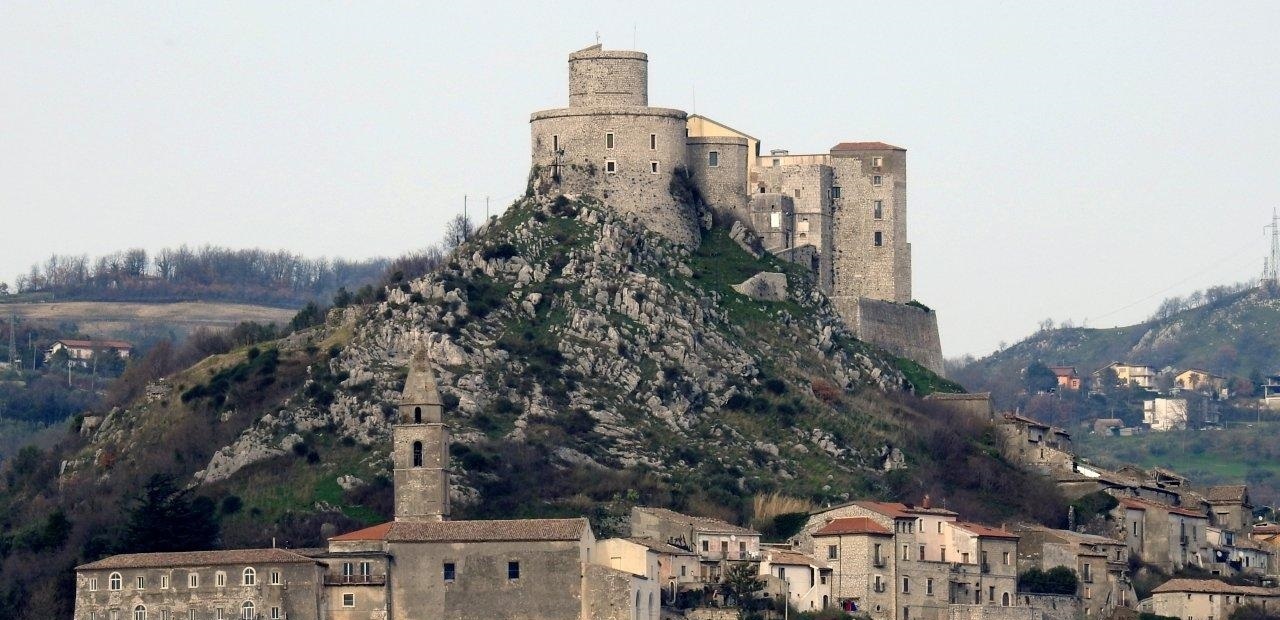
Ceppaloni Castle stands as a remarkable example of a Norman hill castle that evolved over centuries into a baronial palace, reflecting the complex history and architectural transformations characteristic of southern Italy. Located in the municipality of Ceppaloni, in the Campania region of Italy, this fortress dominates the landscape atop a rocky spur overlooking the Sabato River valley. Its strategic position controlled a vital passage on the ancient road connecting Benevento to Salerno, marking it as a key military and administrative site from the 11th century onward.
Originally constructed during the High Medieval period in the Norman era, the castle's earliest known lord was Raone II di Fraineta, who ruled in the early 12th century. The fortress was a contested border stronghold between the Kingdom of Naples and the Papal States, which governed Benevento from 1077 until 1860. Its history is marked by repeated conflicts, including destruction and rebuilding phases under prominent rulers such as King Roger II of Sicily, who reinforced the castle after its initial destruction by Beneventan forces in retaliation for attacks launched from the fortress.
Historical significance and military role
The castle's strategic importance is underscored by its role during the turbulent 12th and 13th centuries. In the early 1100s, it served as a base for Raone II's assaults against the Papal-controlled city of Benevento, prompting Pope Honorius II to order military actions against the city in 1128. Subsequently, the fortress was destroyed by Beneventan forces, only to be rebuilt by Roger II, who established Ceppaloni (then Cepparunum) as a fortified border town.
During the reign of Emperor Frederick II, the castle was again a focal point of conflict between imperial and papal forces. The inhabitants of Benevento occupied the castle until Frederick's return in 1220. However, in 1229, while Frederick was on crusade, papal and allied Guelph forces burned the castle. Frederick swiftly recaptured it upon his return, demonstrating its military and symbolic importance.
Under the Angevin dynasty, Ceppaloni Castle retained its military and administrative significance. It was governed by a castellan appointed by the royal court, overseeing royal lands and fiefs granted to French knights. The castle also played a role in the Angio-Aragonese wars, hosting notable figures such as King Alfonso V of Aragon in 1437 during his military campaigns. The presence of royal Aragonese troops in the vicinity during the 1460s further highlights its continued strategic value.
Architectural evolution and features
The castle's architecture reflects its long history, with a layout shaped by the natural contours of the rocky ridge on which it stands. The fortress has a roughly triangular plan with gently rounded corners enclosing an inner courtyard that mirrors this shape. The defensive walls closely follow the cliff's natural profile, enhancing its impregnable appearance.
Originally, the castle featured several circular Norman towers, a hallmark of Norman military architecture designed to provide comprehensive defense and vantage points. Today, only the northwest circular tower remains, situated near the original main entrance. This entrance was strategically placed behind a bend in the approach road, limiting direct access and improving defense.
In the 16th century, as military threats diminished and the castle's function shifted towards residential and administrative use, the original entrance was closed off. A new entrance was opened on the southwest side, reflecting the castle's transformation into a baronial palace. The interior buildings, standing two stories high, housed offices for the baronial court, including administrative chambers and a prison for feudal justice.
The castle's foundations reveal a complex construction history, with numerous alterations and expansions over nine centuries. These changes illustrate the adaptation of the fortress to evolving military technologies and social functions, transitioning from a purely defensive stronghold to a noble residence and local governance center.
Defensive structures and layout
The castle's defensive system was enhanced by its natural setting atop a rocky spur, with walls designed to maximize the natural cliff's protection. The triangular shape allowed for efficient defense coverage, with towers positioned to guard vulnerable points. The surviving northwest tower is a testament to the original Norman design, providing a commanding view of the surrounding valley.
Residential and administrative adaptations
As the castle's military role declined, its architecture adapted to accommodate the needs of the ruling nobility. The transformation into a baronial palace included the addition of more comfortable living quarters and administrative offices. The presence of a prison within the castle walls underscores its role as a center of feudal authority and justice.
Ownership and noble families
Following its military prominence, Ceppaloni Castle passed through the hands of several noble families, each leaving their mark on its history and structure. In 1534, Emperor Charles V granted the castle to Don Rodrigo d’Avalos, initiating a period of noble residence that lasted until 1576. The estate was then sold to the Cosso (Coscia) family, prominent in nearby Sant’Agata de’ Goti, with Giovan Tommaso Cosso residing there in the early 17th century.
By 1634, the castle was acquired by Fabio de Lagonessa, Archbishop of Conza and Patriarch of Antioch, who restored the fortress and made it his permanent residence. The della Leonessa family later occupied the castle, including Don Vincenzo della Leonessa, the first Duke of Ceppaloni, and Geronimo della Leonessa, connected to the influential Carafa family through marriage.
Despite its noble status, the castle suffered damage during the 1688 earthquake, leading to its gradual abandonment as a primary residence. The della Leonessa family relocated to Naples by around 1740, and the castle's role shifted towards administrative and judicial functions under the baronial court system.
Later history and restoration efforts
After the abolition of feudalism in 1806, Ceppaloni Castle's importance declined significantly. It served as the location for the Curia office, administering justice under feudal law, with the governor residing in the castle acting as judge. The prison within the castle walls was used during this period, but these functions ceased with the end of feudal privileges.
In the early 20th century, the castle was sold by Baroness Donna Maria Argentina Pignatelli della Leonessa in Carelli and divided into apartments by various local owners. Today, the Municipality of Ceppaloni owns the castle and has undertaken extensive restoration efforts to preserve this historic landmark.
Ceppaloni Castle now stands as a well-preserved testament to nearly a millennium of history, showcasing the architectural evolution from a Norman military fortress to a Renaissance baronial palace. Its walls, towers, and courtyards continue to tell the story of the region's complex political and social history, making it a significant cultural heritage site in Campania.
Frequently asked questions (FAQ)
- How do I visit Ceppaloni Castle?
- Ceppaloni Castle is open to visitors, with guided tours available through the Municipality of Ceppaloni. It is advisable to check local tourist information for opening hours and any special events.
- What is the historical significance of Ceppaloni Castle?
- Ceppaloni Castle played a strategic role as a border fortress between the Kingdom of Naples and the Papal States, witnessing key medieval conflicts and noble residencies.
- When was Ceppaloni Castle originally built?
- The castle was originally constructed in the 11th century during the Norman period, with subsequent modifications over the centuries.
- Can I explore the castle's architectural features?
- Visitors can explore the castle's triangular layout, inner courtyard, and the remaining Norman circular tower, which highlight its military and residential evolution.
- Is Ceppaloni Castle accessible for people with limited mobility?
- Due to its hilltop location and historical structure, accessibility may be limited. Visitors with mobility concerns should contact the local municipality for specific assistance options.
- What are the best times to visit Ceppaloni Castle?
- Spring and autumn offer pleasant weather for visiting Ceppaloni Castle and exploring the surrounding Sabato River valley.
Information
Sources & official resources
Verify the information above using these authoritative references.
Loading map...
Visitor reviews
No reviews yet. Been here? Write the first review and help other travelers!
Write the first reviewVisited this castle? Share your experience
Your review helps other travelers and adds first-hand knowledge to our encyclopedia.