Monterrei Castle
Monterrei Castle stands prominently on a hilltop overlooking the valley near the town of Verín in the province of Ourense, Galicia, Spain. This historic hill castle was originally constructed in the 12th century by Alfonso Henríquez, a grandson of Alfonso VI and an important figure in the early history of the Iberian Peninsula. The castle's strategic location near the Portuguese border made it a vital defensive stronghold throughout the Middle Ages and beyond.
Early origins and medieval significance
The site of Monterrei Castle has a history stretching back to pre-Roman times, built upon the remains of an ancient fortified settlement known as the Castro de Baroncelli. The earliest known documentation dates to around 950 AD, linking the fortress to Count Hermenegildo Gutiérrez, a prominent noble in the Kingdom of Galicia. The castle was reconstructed in the 12th century by Alfonso Henríquez, who reinforced its defenses to secure this frontier region.
Following the Treaty of Tuy in 1137, control of the castle shifted back to the Kingdom of León and Castile, despite Alfonso Henríquez's earlier role as the first king of Portugal. Throughout the Middle Ages, Monterrei Castle was governed by several influential noble families, including the Romay, Ulloa, Zúñiga, Viedma, Fonseca, and Acevedo lineages, as well as the Dukes of Alba. These families contributed to the castle's expansion and fortification over the centuries.
Architectural features and fortifications
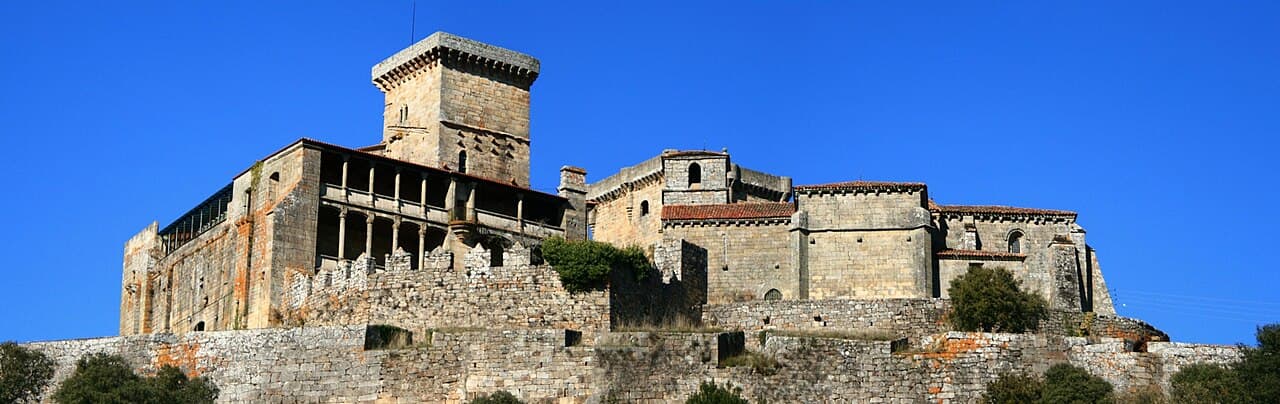
The castle complex is notable for its expansive layout, comprising three successive walled enclosures that form the largest acropolis in Galicia. This design reflects its role as a formidable border fortress against Portugal. The outer enclosure includes the current Parador Nacional hotel and a 17th-century stone cross marking the complex's boundary.
The second enclosure is accessed through a fortified gateway flanked by two guardhouses with observation openings. It is further protected by several bastions, typical of the period's artillery defense systems. The innermost enclosure houses the castle proper and key structures such as the Keep (Torre de Don Sancho), the Counts' Palace, and the Church of Santa María de Gracia.
The keep and towers
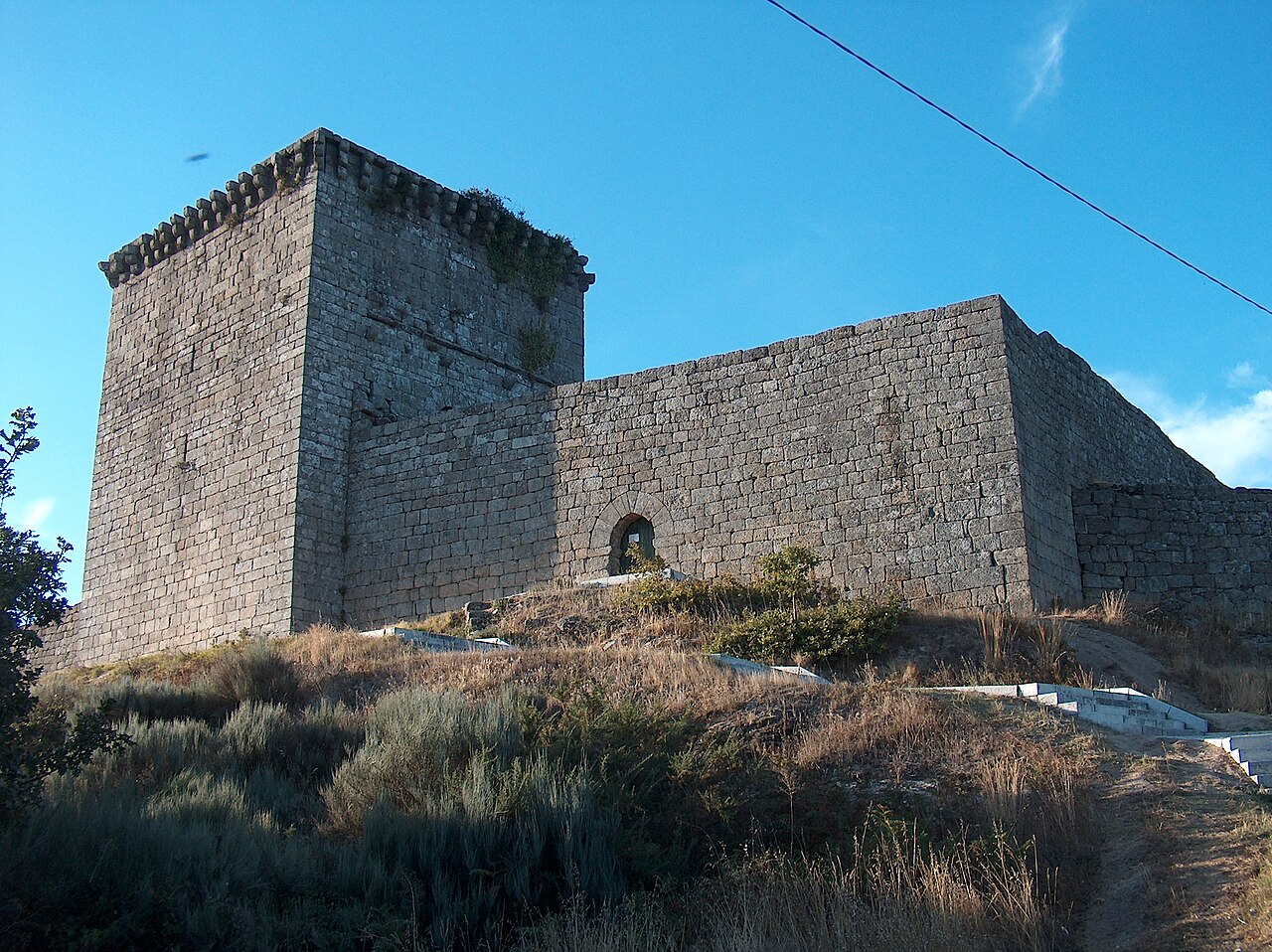
The Keep, constructed in 1482 by Sancho Sánchez de Ulloa, the first Count of Monterrei, is a square granite tower rising 22 meters high. It features a drawbridge entrance, coats of arms of the Ulloa and Zúñiga families, and defensive elements including arrow slits and openings for cannon fire. Inside, the keep contains multiple floors connected by a wide staircase, rooms with fireplaces and stained glass windows, and a terrace surrounded by a barbican with eight round turrets for observation.
Another prominent tower is the Torre de las Damas (Ladies Tower), dating from the late 13th or early 14th century. It is smaller and may represent the original fortress keep, showcasing the castle's medieval origins.
Palace and religious buildings
The Counts' Palace was built between the 15th and 17th centuries in the Renaissance style and has been recently restored. It features arcaded lower and upper floors with columns bearing coats of arms from noble families associated with the castle. The palace's southern façade adapts to the uneven terrain with slightly pointed arches, while the western side integrates with the defensive walls.
The Church of Santa María de Gracia combines Romanesque and Gothic architectural elements and dates from the late 13th or early 14th century. It has a wooden roof, a rectangular apse with rib vaulting, and strong 17th-century buttresses added for defense. The church contains significant religious art, including a Gothic stone altarpiece depicting Christ triumphant and scenes related to the Camino de Santiago pilgrimage.
Historical events and cultural importance
Monterrei Castle played a key role during the Castilian civil war in 1366 when King Pedro I (“the Cruel”) took refuge within its walls. Later, the castle hosted a notable meeting in 1506 between Philip the Handsome and Cardinal Cisneros, emphasizing its importance as a political and military center.
In the 16th and 17th centuries, the castle was modernized with bastioned enclosures designed by engineers Juan de Villarroel and Carlos de Grunemberg to protect nearby religious institutions. It also became a cultural site where Galicia's first incunable, the Missale Auriense, was printed in 1494.
During the Peninsular War in the early 19th century, Monterrei Castle served as headquarters for the Galician Army before falling to French forces under Marshal Soult in 1809. Its military significance waned afterward, but its historical and architectural value was recognized with its designation as a National Monument in 1931.
Preservation and current use
Today, Monterrei Castle is well preserved and functions as a Parador hotel, allowing visitors to experience its rich history firsthand. The castle complex includes a museum housed in the Counts' Palace, showcasing local historical artifacts, pilgrimage-related materials, and religious art.
Visitors can explore the castle's extensive fortifications, towers, chapel, and courtyards, gaining insight into medieval military architecture and the noble families who shaped its legacy. The castle's location offers panoramic views of the surrounding valley and the nearby Portuguese border, underscoring its historical strategic importance.
Architectural and cultural legacy
Monterrei Castle exemplifies the evolution of medieval fortifications in northwestern Spain, blending Romanesque, Gothic, and Renaissance architectural styles. Its successive expansions reflect changing military technologies and political dynamics over several centuries.
The castle's integration of religious, residential, and defensive functions within a single complex illustrates the multifaceted role of such fortresses in medieval society. Its preservation as a hotel and cultural site ensures that this heritage remains accessible to the public, contributing to the understanding of Galicia's historical landscape.
Overall, Monterrei Castle stands as a remarkable testament to the region's medieval history, noble lineages, and architectural ingenuity, making it a significant landmark in Spanish heritage and a compelling destination for history enthusiasts and travelers alike.
Frequently asked questions (FAQ)
- How do I get to Monterrei Castle?
- Monterrei Castle is located near the town of Verín in Galicia, Spain. It is accessible by car via local roads and there is parking available near the Parador hotel on the castle grounds.
- What are the opening hours for visiting Monterrei Castle?
- The castle generally opens to visitors from 10:00 to 18:00, but hours can vary seasonally. It is best to check in advance, especially if you plan to stay at the Parador hotel.
- Can I stay overnight at Monterrei Castle?
- Yes, Monterrei Castle operates as a Parador hotel, offering guests the unique experience of staying within the historic fortress.
- What architectural styles are represented in Monterrei Castle?
- The castle features a blend of Romanesque, Gothic, and Renaissance architectural styles, reflecting its long history and successive expansions.
- Why is Monterrei Castle historically significant?
- Monterrei Castle has been a key defensive site on the Spanish-Portuguese border since the 12th century, hosting important historical figures and events, including King Pedro I during the Castilian civil war and a meeting between Philip the Handsome and Cardinal Cisneros.
- Is Monterrei Castle accessible for visitors with mobility issues?
- Due to its medieval structure and terrain, some areas of Monterrei Castle may be challenging for visitors with mobility issues. It is advisable to inquire with the Parador hotel for specific accessibility information.
Photo gallery

Information
Opening hours
Varies seasonally, generally 10:00-18:00
Ticket prices
Varies depending on accommodation and tours
Website
Visit websiteSources & official resources
Verify the information above using these authoritative references.
Loading map...
Visitor reviews
No reviews yet. Been here? Write the first review and help other travelers!
Write the first reviewVisited this castle? Share your experience
Your review helps other travelers and adds first-hand knowledge to our encyclopedia.