Monte Sant'Angelo Castle
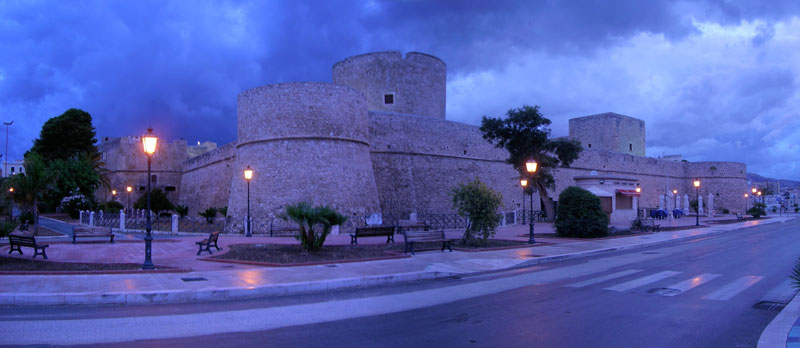
Monte Sant'Angelo Castle stands as a remarkable example of medieval military architecture in the Apulia region of southern Italy. Perched on a hilltop commanding sweeping views of the surrounding Gargano landscape, this fortress embodies centuries of strategic importance, architectural evolution, and historical significance. Originally constructed in the early 9th century, the castle has witnessed Byzantine, Norman, Holy Roman Empire, Angevin, and Aragonese influences, each leaving an indelible mark on its structure and function.
The castle's origins date back to around 837 AD, when it was built under the auspices of Orso I, bishop of Benevento and Siponto, to secure the region known as the Honor Sancti Angeli. This initial fortification replaced an earlier Byzantine castrum, establishing a defensive stronghold on the highest point of Monte Sant'Angelo town. Over time, the complex expanded and was reinforced by successive rulers, adapting to changing military technologies and political needs.
Architectural features and evolution
The torre dei giganti and early fortifications
The most ancient and iconic part of the castle is the Torre dei Giganti (Giants' Tower), a pentagonal tower approximately 18 meters tall with walls measuring up to 3.7 meters thick. Constructed in the 11th century during the Norman period, this tower exemplifies the robust defensive architecture of the era. It served both as a lookout and a last refuge during sieges, with its massive walls designed to withstand assaults and artillery fire.
Norman enhancements and the treasure hall
Under the Normans, particularly Robert Guiscard, the castle saw significant expansion, including the addition of a quadrangular tower (Torre Quadra) and the construction of the Sala del Tesoro (Treasure Hall). This vaulted chamber, characterized by a large central pillar supporting its ceiling and a solitary window, was used for ceremonial purposes and reflects the Norman architectural style. The Normans also fortified the town surrounding the castle with defensive walls, integrating the fortress into a broader defensive network.
Frederick ii's contributions and the medieval renaissance
In the 13th century, the castle came under the possession of Emperor Frederick II, who made it a favored residence. He is credited with restoring and enhancing the fortress, including the addition of architectural features emblematic of his reign, such as the grand vaulted halls and refined stonework. The castle also became associated with Frederick's mistress, Bianca Lancia, adding a layer of romantic legend to its history.
Later modifications and military engineering
The castle's defensive capabilities were further improved during the late 15th century under Ferdinand I and the military engineer Francesco di Giorgio Martini. They adapted the fortress to withstand the emerging threat of gunpowder artillery, adding mandorla-shaped towers, bastions, and a moat system. These modifications illustrate the transition from medieval to early modern military architecture, blending traditional fortifications with new innovations.
Historical significance and notable inhabitants
Norman and angevin periods
Monte Sant'Angelo Castle served as a residence for prominent Norman rulers such as Rainulf I of Aversa and Robert Guiscard. During the Angevin period, it was repurposed primarily as a state prison, housing notable prisoners like Philippa of Antioch and possibly Queen Joanna I of Naples. The castle's role as a prison reflects the shifting political landscape and the fortress's strategic importance in controlling dissent.
Skanderbeg and the kastrioti family
From 1464 to 1485, the castle was the residence of the exiled Albanian condottiero George Kastrioti Skanderbeg, a celebrated military leader rewarded with the fiefdom for his service to the Kingdom of Naples. This period highlights the castle's continued political relevance during the Renaissance and its connection to broader European conflicts and alliances.
Birthplace of charles iii and later ownership
The castle is historically significant as the birthplace of Charles III of Durazzo, who later became king of Naples and Hungary. Ownership eventually passed to noble families such as the Serra Grimaldi, Arcella, and Vischi families, who maintained the fortress into the 18th century. The municipality of Monte Sant'Angelo acquired the castle by the early 19th century, ensuring its preservation as a cultural monument.
Castle layout and surviving structures
Defensive elements and towers
The castle's layout is characterized by a series of defensive towers, curtain walls with embrasures, and bastions arranged to maximize protection. The pentagonal Torre dei Giganti dominates the complex, complemented by two truncated conical towers and an eastern bastion. Originally, a moat and drawbridge secured the main entrance, though these have been replaced by a fixed two-arched bridge.
Residential and service buildings
Within the castle precincts are residential quarters for the castellan and officials, alongside service buildings such as stables, warehouses, cisterns, a mill, and a bakery. These facilities underscore the castle's function as a self-sustaining fortress capable of withstanding prolonged sieges. Workshops for carpentry and other crafts supported daily operations, while a chapel provided spiritual services.
The sala del tesoro and internal chambers
The Sala del Tesoro remains one of the castle's most impressive internal spaces, showcasing the architectural sophistication of the 13th century. Its vaulted ceiling and central pillar create a grand atmosphere suitable for banquets and official ceremonies. Surrounding chambers served as living spaces for the castellan and courtiers, reflecting the dual military and residential nature of the fortress.
Cultural legacy and present-day use
Monte Sant'Angelo Castle holds a prominent place in the cultural heritage of Apulia and Italy at large. It is enveloped in local legends, including tales of the ghost of Bianca Lancia, whose sighs are said to haunt the castle during winter months. The fortress today functions as a museum and exhibition space, inviting visitors to explore its rich history and architectural grandeur.
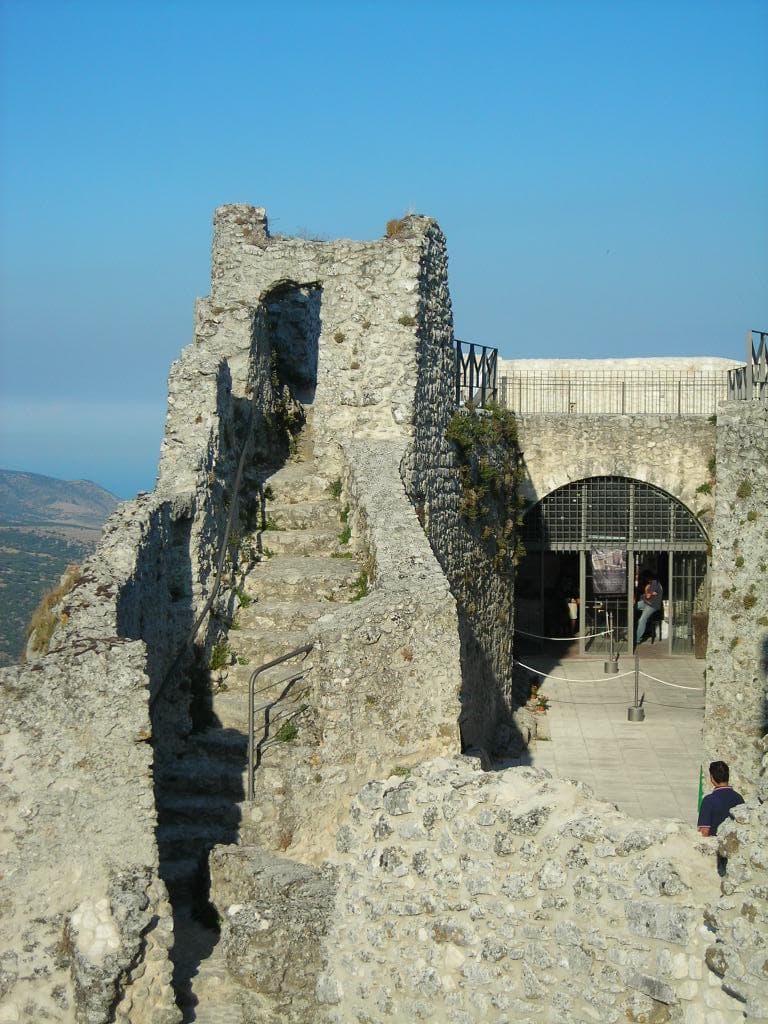
Ongoing restoration efforts have preserved the castle's structural integrity and historical features, allowing it to serve as a tangible link to the region's medieval past. Its commanding position and well-preserved elements make it a compelling destination for those interested in military architecture, medieval history, and cultural tourism.
Frequently asked questions (FAQ)
- How do I get to Monte Sant'Angelo Castle?
- Monte Sant'Angelo Castle is located in the town of Monte Sant'Angelo in Apulia, Italy. Visitors can reach it by car or local bus services from nearby cities such as Foggia. The castle is situated on a hilltop, so be prepared for a short uphill walk from the town center.
- What are the opening hours for visiting Monte Sant'Angelo Castle?
- The castle is generally open to visitors daily from 9:00 AM to 6:00 PM, but it is advisable to check the official website or local tourist information for seasonal variations and special closures.
- Is there an admission fee to enter Monte Sant'Angelo Castle?
- Admission fees vary depending on the season and any special exhibitions. Typically, there is a modest entrance fee, with discounts available for children, seniors, and groups. Some days may offer free entry, especially during cultural events.
- What architectural styles are represented in Monte Sant'Angelo Castle?
- Monte Sant'Angelo Castle showcases a mix of architectural styles including Norman military architecture, Frederician Gothic elements, and Renaissance modifications. This blend reflects its long history and the various rulers who shaped its design.
- Can I explore the interior rooms and towers of Monte Sant'Angelo Castle?
- Yes, visitors can explore many of the castle's interior spaces including the Torre dei Giganti, Sala del Tesoro, residential quarters, and defensive towers. Guided tours are often available to provide historical context and architectural insights.
- What is the historical significance of Monte Sant'Angelo Castle?
- The castle has played a key role from the Byzantine era through the Norman and Holy Roman Empire periods, serving as a fortress, royal residence, prison, and military stronghold. It is also linked to notable historical figures such as Frederick II, Skanderbeg, and Charles III of Durazzo.
Photo gallery

Information
Sources & official resources
Verify the information above using these authoritative references.
Loading map...
Visitor reviews
No reviews yet. Been here? Write the first review and help other travelers!
Write the first reviewVisited this castle? Share your experience
Your review helps other travelers and adds first-hand knowledge to our encyclopedia.