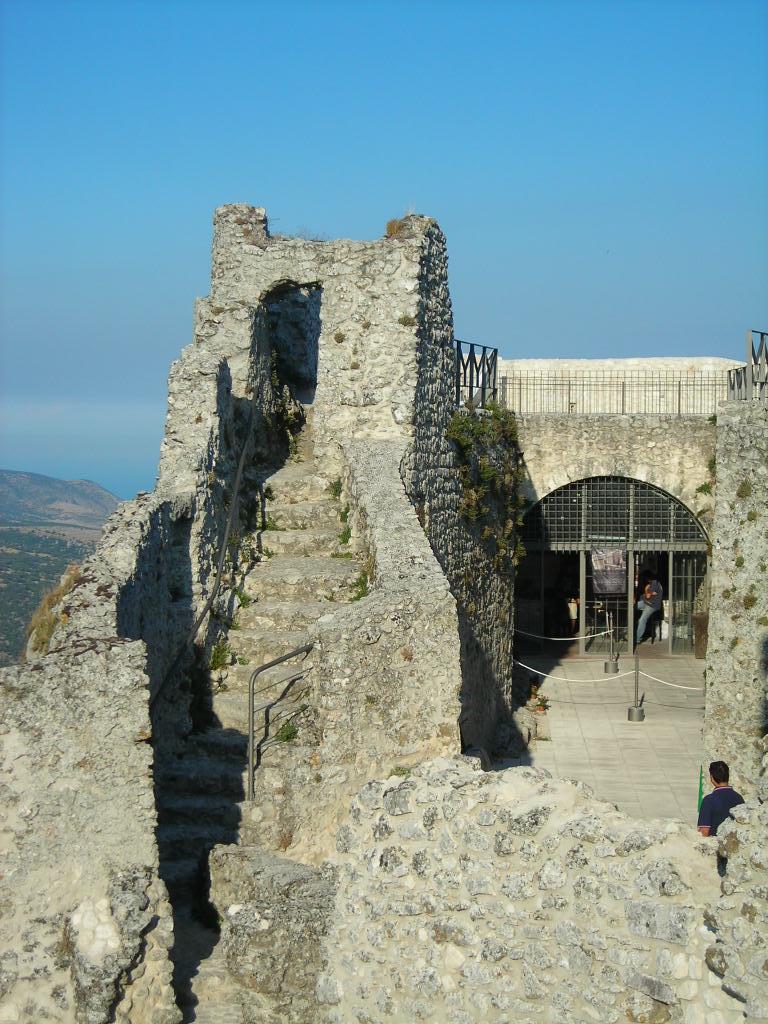
San Nicandro Castle
San Nicandro Castle, prominently situated in San Nicandro Garganico in the Apulia region of Italy, is a remarkable example of a hill castle with a layered history spanning from the early medieval period through the Renaissance and into modern times. The castle as it stands today dates primarily from the 15th century, built upon the foundations of an older fortress established during the Norman and Swabian periods. This historic site illustrates the evolution of military architecture, feudal residence, and civic adaptation over several centuries.
The castle occupies a commanding position atop a hill at an elevation of 224 meters, designed to oversee and control the surrounding territory. Its trapezoidal plan is oriented roughly along the cardinal points, a strategic layout enhancing defensive capabilities. Four corner towers anchor the castle's perimeter: two square towers on the north and west sides, which are remnants of the original Norman construction from the 9th century, and two round towers on the south and east sides, added during the Aragonese expansion in the 15th century. This blend of architectural elements reflects the castle's continuous adaptation to changing military and residential needs.
The origins and early medieval history
The site of San Nicandro Castle was initially fortified in the early medieval period, with the earliest known structure being a watchtower constructed by the Normans around the 9th century. This tower, supported by a nearby garrison, served as a vital lookout point to monitor the region and defend against invasions. The strategic importance of the hill is underscored by its commanding views and natural defensibility.
During the Swabian period, the fortress continued to serve as a military stronghold. Notably, the castle was associated with significant historical figures such as Emperor Frederick II of the Hohenstaufen dynasty and King Manfred of Sicily. Both rulers used the castle as a residence and hunting retreat, highlighting its dual function as a defensive structure and noble domicile.
In the late 13th century, the castle also gained prominence as a place of refuge for Pope Celestine V after his abdication, illustrating its role as a sanctuary during times of political instability.
Aragonese expansion and Renaissance modifications
The 15th century marked a significant transformation of the castle under the influence of the Aragonese rulers and the local feudal family, the Della Marra. The original Norman tower was expanded into a trapezoidal fortress through a process known as incastellamento, which integrated the castle more closely with the surrounding settlement of San Nicandro Garganico. This expansion not only enhanced the defensive capabilities but also reinforced the castle's status as a feudal residence.
The two round towers on the southern and eastern corners, built by the Aragonese, face the nearby mother church of Santa Maria del Borgo. These towers likely served both protective and symbolic functions, emphasizing the castle's dominance within the community and its relationship with the church.
In the 16th century, further architectural enhancements were made, including the construction of a richly decorated portal at the eastern entrance and a loggia that connected the castle to a large palace situated between the gate and the eastern walls. This palace, along with the Palazzo Fioritto built on the western side during the same period, reflects the Renaissance influence and the shift towards more comfortable and prestigious residential spaces.
Palazzo Fioritto and cultural adaptation
The Palazzo Fioritto, constructed in the 16th century, now serves as the home of the "A. Petrucci" municipal library and an ethnographic museum dedicated to rural life. This adaptation of the palace from a noble residence to a cultural institution exemplifies the castle complex's ongoing evolution and its integration into the civic life of San Nicandro Garganico.
Baroque era and modern transformations
During the Baroque period and continuing into the 20th century, the castle underwent various modifications to accommodate private residential use. These changes included the construction of a new entrance on the eastern side and the permanent closure of the original drawbridge, which historically spanned above the current street level and served as the main access point.
Ownership of the castle passed through several families, including the Zaccagnino family in the 19th century and later the Centulio and Tozzi families. Each owner contributed to the castle's maintenance and adaptation, ensuring its preservation despite changing functions.
In early 2020, the castle came under the stewardship of the municipality of San Nicandro Garganico, marking a new phase focused on conservation, public access, and cultural promotion.
Architectural features and defensive elements
The castle's trapezoidal layout is a distinctive feature, designed to maximize defense and surveillance. The four corner towers provide overlapping fields of fire and observation, a common defensive strategy in medieval fortifications.
The two square towers on the north and west sides are the oldest parts of the castle, showcasing the robust stone masonry typical of Norman military architecture. These towers were primarily used for lookout and defense, with thick walls and narrow windows.
The round towers on the south and east sides, added during the Aragonese period, reflect advancements in military architecture, including improved angles for cannon fire and better resistance to siege weaponry. Their proximity to the Santa Maria del Borgo church also highlights the interplay between military and religious structures in the town's layout.
The eastern entrance is notable for its 16th-century portal, which is richly decorated and serves as a ceremonial gateway. The adjoining loggia creates a covered passageway linking the castle to the palace, blending functional and aesthetic elements.
Interior modifications and residential adaptations
Inside, the castle's layout was altered over the centuries to suit residential needs rather than purely military functions. The closure of the original drawbridge and the establishment of a new eastern entrance reflect this transition.
The castle's interiors were reorganized during the Baroque period to create more comfortable living spaces, including reception rooms and private chambers, while preserving key defensive features.
San Nicandro castle today
Today, San Nicandro Castle stands as a testament to the rich and complex history of the Apulia region. It embodies the architectural and historical layers from the Norman conquest through the Aragonese rule and into modern civic use. The castle's preservation and adaptive reuse as a cultural hub, including the municipal library and ethnographic museum, make it an important landmark for visitors interested in medieval and Renaissance architecture, feudal history, and regional heritage.
Visitors to the castle can explore its imposing towers, walk along the fortified walls, and appreciate the blend of military and residential architecture that has evolved over more than a millennium. The castle's commanding hilltop location offers panoramic views of the surrounding landscape, further enhancing its historical and aesthetic appeal.
Efforts by the municipality ensure that San Nicandro Castle remains accessible and well-maintained, promoting cultural tourism and education about the region's past. Its significance as a historic fortress, noble residence, and modern cultural center continues to attract scholars, tourists, and locals alike.
Frequently asked questions (FAQ)
- How do I get to San Nicandro Castle?
- San Nicandro Castle is located in San Nicandro Garganico, Italy. You can reach it by car or public transport, with the nearest train station in Foggia. From there, local buses or taxis can take you to the castle, which is situated on a hill offering beautiful views of the surrounding area.
- What is the historical significance of San Nicandro Castle?
- San Nicandro Castle dates back to the 11th century and has played a crucial role in the region's defense throughout history. It reflects the architectural styles of different periods, showcasing its evolution through the centuries. The castle is a testament to the strategic importance of the Gargano area during medieval times.
- When was San Nicandro Castle built?
- The construction of San Nicandro Castle began in the 11th century, likely around the time of the Norman conquests in Southern Italy. Over the following centuries, it underwent various renovations and expansions that contributed to its current structure. Its long history makes it a fascinating site for visitors interested in medieval architecture.
- Can I visit San Nicandro Castle year-round?
- Yes, San Nicandro Castle is open to visitors throughout the year, although opening hours may vary seasonally. It is recommended to check the official website or local tourism information for the most accurate hours before your visit. Exploring the castle during spring or fall can offer a more pleasant climate for a leisurely tour.
- Why is San Nicandro Castle a popular attraction?
- San Nicandro Castle attracts visitors not only for its historical significance but also for its stunning architecture and panoramic views of the Gargano landscape. The castle's well-preserved structures provide insight into medieval life and military strategy. Additionally, it serves as a picturesque backdrop for photography and leisurely walks.
- Is it possible to enter all areas of San Nicandro Castle?
- While many areas of San Nicandro Castle are accessible to visitors, some sections may be closed off for preservation purposes or due to safety regulations. Guided tours are often available, providing access to the most significant parts of the castle and offering detailed historical context. Always check for any restrictions before your visit.
- What are the ticket prices for visiting San Nicandro Castle?
- The ticket prices for San Nicandro Castle are generally affordable, with discounts often available for students, seniors, and groups. Admission fees help support the maintenance and preservation of this historical site. Check the castle’s official website for the latest pricing and any special offers.
- What are the opening hours for San Nicandro Castle?
- San Nicandro Castle typically opens to visitors in the morning and closes in the late afternoon, with hours varying by season. It is advisable to plan your visit during the day to fully enjoy the castle and its surroundings. For the most accurate hours, refer to the official website or local tourism offices.
- Are there any nearby attractions worth visiting?
- Yes, the area surrounding San Nicandro Castle offers several attractions, including the beautiful Gargano National Park and the charming town of San Nicandro Garganico itself. Visitors can explore local churches, enjoy traditional cuisine, and partake in outdoor activities such as hiking. The proximity to other historical sites makes it an excellent base for further explorations.
Information
Loading map...
Visitor reviews
No reviews yet. Been here? Write the first review and help other travelers!
Write the first reviewVisited this castle? Share your experience
Your review helps other travelers and adds first-hand knowledge to our encyclopedia.