Manfredonia Castle
Manfredonia Castle, located in the town of Manfredonia, Italy, stands as a remarkable example of medieval and Renaissance military architecture. Built initially in the 13th century during the reign of the Hohenstaufen and later expanded under the Angevin and Aragonese dynasties, the castle reflects centuries of evolving defensive strategies and architectural styles. It currently houses the National Archaeological Museum of Manfredonia, preserving and showcasing the rich history of the surrounding region.
Early construction and historical context
The castle's origins trace back to the late 13th century, with the earliest documented reference dating to 1279, when workers were recruited to commence construction. Though the initial fortress likely incorporated pre-existing structures, the main building phase is attributed to King Charles I of Naples, also known as Charles of Anjou. Under his rule, the fortress was designed to serve as a stronghold in the strategically important coastal area near the ancient city of Siponto.
The architectural supervision during this period is credited to Pierre d’Angicourt, an architect associated with the Angevin court, who contributed to the castle’s original layout characterized by a quadrilateral plan enclosed by fortified walls and five square towers. Four of these towers were positioned at the corners, while the fifth likely stood near the main entrance on the northeast side. This design reflects typical high medieval fortification principles, emphasizing geometric regularity and defensive functionality.
Architectural evolution through centuries
Transformation under the aragonese
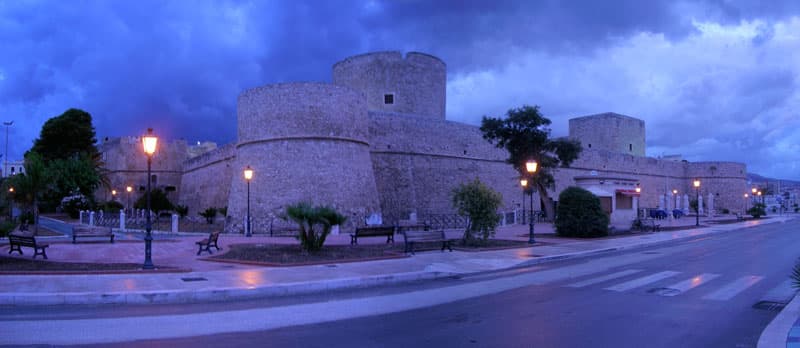
In the mid-15th century, around 1442, the castle underwent significant modifications under the rule of the House of Aragón. A new outer enclosure wall was constructed as part of a broader coastal defense system designed to protect against increasing maritime threats. This outer wall incorporated four cylindrical towers, lower than the inner ones, optimized for the evolving artillery technology of the time.
Renaissance additions and fortification enhancements
The 16th century saw the addition of a pentagonal bastion on the western side of the castle. This bastion enclosed one of the existing round towers and was intended to strengthen the fortress’s defenses against potential attacks originating from the city side. Known as the Torre dell’Annunziata, the bastion is distinguished by a marble relief depicting the Annunciation, a religious motif that adds both symbolic and artistic significance to the structure.
Military significance and decline
The castle’s military role was notably tested in 1620 when it capitulated to a Turkish attack. This event exposed critical vulnerabilities, including insufficient artillery and the absence of protective parapets, which compromised the defenders' ability to hold the fortress. The surrender underscored the need for modernization that was not fully realized, leading to the castle's gradual decline as a military stronghold.
By the 18th century, the fortress had lost its primary defensive function and was repurposed as a barracks. The western tower, in particular, was used as a prison, marking a shift from military to administrative and penal uses.
Modern usage and cultural heritage
Ownership of the castle changed hands in the 20th century when the municipality of Manfredonia acquired it in 1901. Later, in 1968, the fortress was donated to the Italian state, which undertook preservation efforts and established the National Archaeological Museum of Manfredonia within its walls. Since 2014, the Ministry of Cultural Heritage has managed the site, ensuring its maintenance and promoting its historical and cultural significance.
The museum hosts a wide array of artifacts, including limestone funerary stelae from the Daunian culture dating between the late 8th and early 5th centuries BCE. Other exhibits feature Roman amphorae recovered from the sea, architectural fragments, and inscribed materials primarily sourced from the nearby archaeological park of Siponto. These collections provide valuable insights into the region's ancient past and continuous human occupation.
Architectural features and defensive design
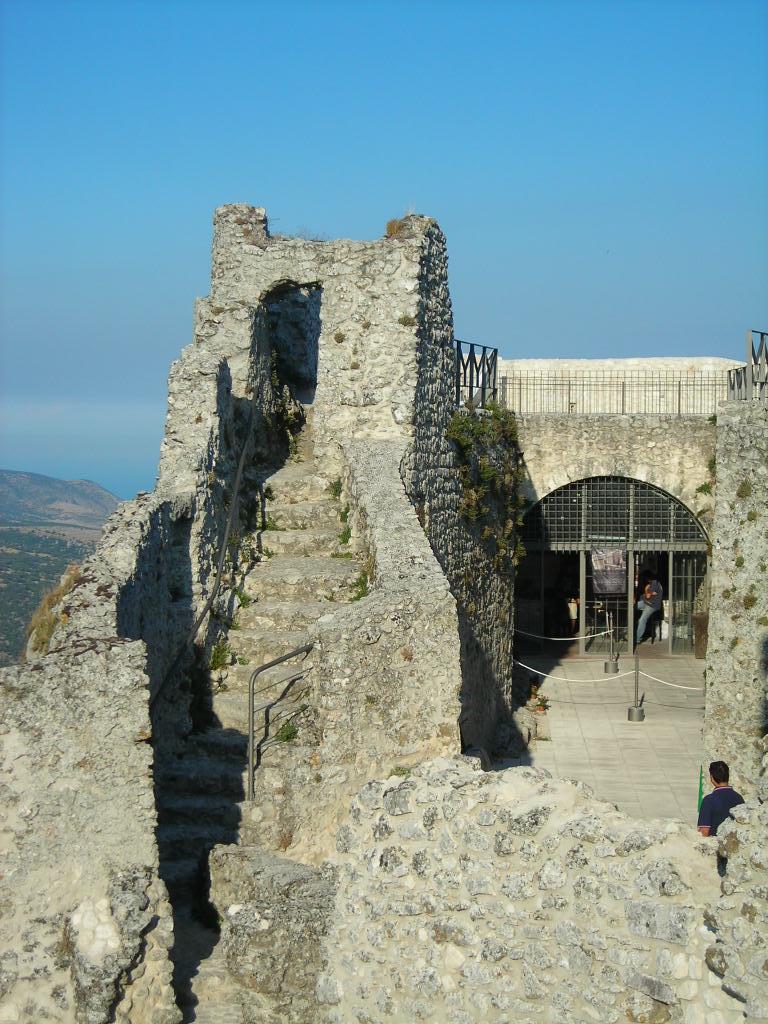
The original castle was designed with a quadrilateral layout, surrounded by a ring of fortified walls and five square towers. The four corner towers were later transformed into larger round towers, reflecting advancements in military architecture that favored rounded shapes for better deflection of projectiles. The fifth tower, near the main gate, has mostly disappeared, leaving only traces.
The outer wall built by the Aragonese includes four cylindrical towers that are lower than the inner towers, suited for the artillery and defensive tactics of the period. The pentagonal bastion on the west side, incorporating one of the round towers, is a notable feature designed to counter attacks from the city side. The bastion’s marble relief of the Annunciation adds a unique decorative and symbolic element to the otherwise utilitarian structure.
From an architectural perspective, the castle exhibits the regularity and geometric linearity characteristic of Hohenstaufen military constructions, combined with later adaptations to Renaissance artillery warfare. The evolution of its fortifications mirrors broader trends in European military architecture from the high medieval period through the Renaissance.
Cultural and historical significance
Manfredonia Castle is not only a testament to the military and architectural history of southern Italy but also a cultural landmark that embodies the region's complex past. Its layers of construction and adaptation reflect the shifting political powers, from the Hohenstaufen and Anjou to the Aragonese and Spanish rulers.
Today, the castle serves as a vital educational resource through its archaeological museum, connecting visitors with the ancient heritage of the Gargano area and the historical city of Siponto. It stands as a symbol of resilience and transformation, illustrating how medieval fortresses evolved to meet changing military, political, and cultural needs over centuries.
Visitor experience and accessibility
Visitors to Manfredonia Castle can explore its well-preserved towers, bastions, and walls, gaining insight into medieval and Renaissance fortification techniques. The museum's extensive collections offer a deep dive into the archaeological and historical context of the region. The castle's location on a hill provides panoramic views of the town and the Adriatic coast, enhancing the visitor experience.
Frequently asked questions (FAQ)
- How do I visit Manfredonia Castle and what are the opening hours?
- Manfredonia Castle is open to visitors daily, typically from 9:00 AM to 7:00 PM. It is advisable to check the official website or local tourist information for any seasonal changes or special closures.
- What can I see at the National Archaeological Museum inside the castle?
- The museum houses a rich collection of artifacts including Daunian funerary stelae, Roman amphorae, and inscriptions from the Siponto archaeological site, offering insights into the region's ancient history.
- When was Manfredonia Castle originally built and by whom?
- The castle was originally constructed in the 13th century under King Charles I of Naples, incorporating earlier structures and reflecting the military architecture of the Hohenstaufen and Angevin periods.
- Why is the Torre dell’Annunziata significant?
- The Torre dell’Annunziata is a distinctive pentagonal bastion added in the 16th century, notable for its marble relief depicting the Annunciation, symbolizing both religious and defensive importance.
- Is Manfredonia Castle accessible for people with mobility issues?
- While efforts have been made to improve accessibility, some areas of the castle, especially the towers and battlements, may be challenging for visitors with mobility impairments due to historic architectural features.
Photo gallery

Information
Sources & official resources
Verify the information above using these authoritative references.
Loading map...
Visitor reviews
No reviews yet. Been here? Write the first review and help other travelers!
Write the first reviewVisited this castle? Share your experience
Your review helps other travelers and adds first-hand knowledge to our encyclopedia.