Montalbano Castle
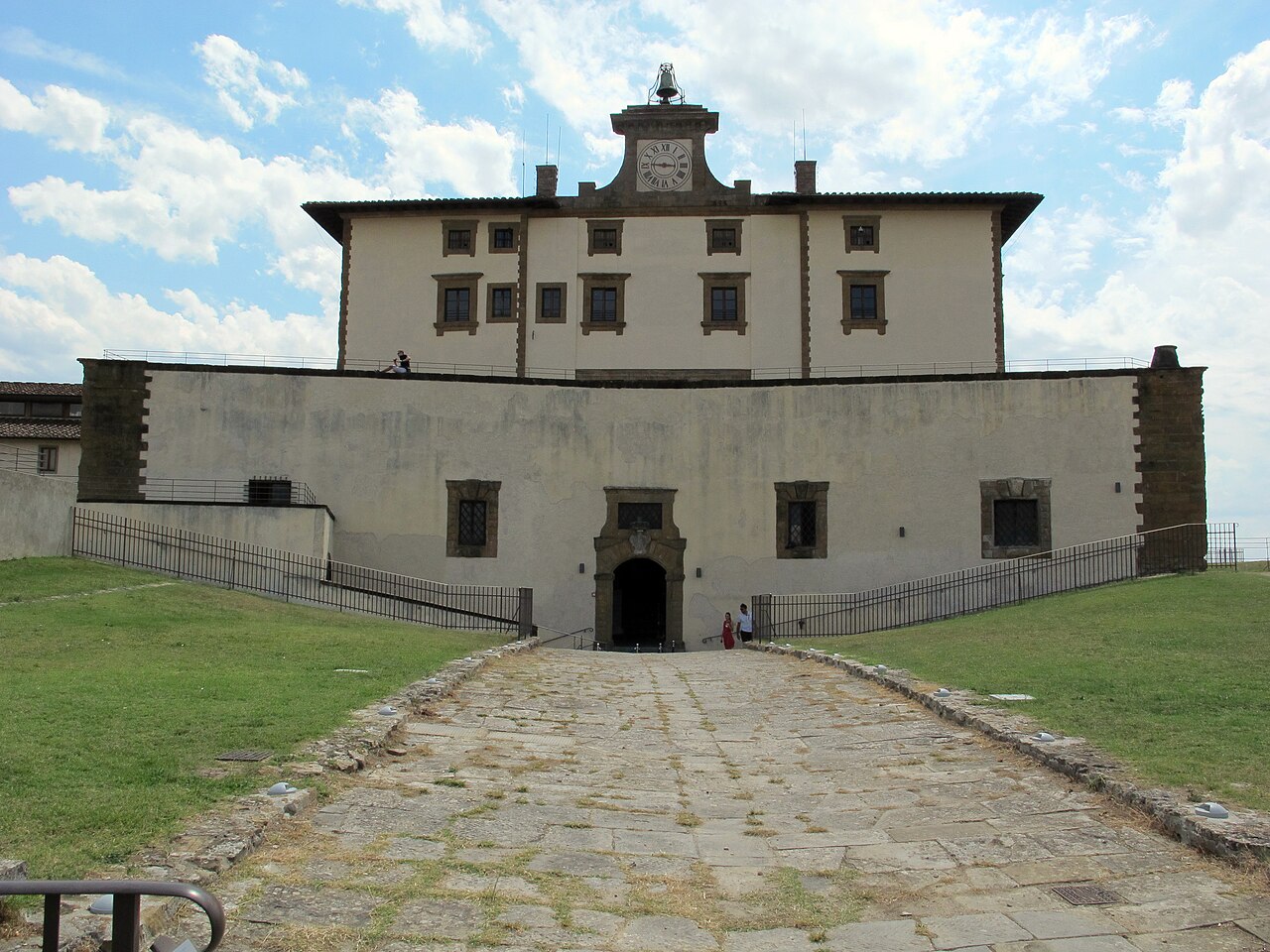
Montalbano Castle is a historic fortress located in the municipality of Florence, Italy, perched on the hill known as Monte Albano. This castle, originally known as Rocca de’ Tedaldi, was constructed by the medieval noble Tedaldi family from nearby Fiesole. Tradition and the 14th-century historian Giovanni Villani suggest that the castle's origins likely predate the founding of Florence itself, marking it as an important early medieval stronghold in the region.
The castle's strategic position on a hill facing east allowed it to control the surrounding territory effectively, a typical feature of a medieval rocca. The site is historically significant not only for its military role but also for its connection to early medieval European history. A plaque above the entrance commemorates an event in 768 when Charlemagne reportedly stayed at the castle to celebrate Christmas, linking the fortress to one of the most influential rulers of the early Middle Ages.
Medieval origins and renaissance admiration
Throughout the High Medieval and Late Medieval periods, Montalbano Castle remained a symbol of noble power in the region. By the Renaissance, the castle had gained cultural prominence. The renowned historian Guido Carocci recorded that Michelangelo was familiar with the castle and admired it as one of the most beautiful castles he had encountered. This admiration reflects the castle's architectural and aesthetic qualities that resonated with Renaissance ideals.
Despite this prestige, by 1527 the castle had fallen into disrepair. Its last Tedaldi owner, Bartolo di Leonardo, began renting it out, marking the start of a decline in its status as a noble residence. Ownership later transferred to the church of Sant’Andrea a Rovezzano and subsequently to the Morelli family in the 17th century, reflecting a shift in the castle's function and stewardship.
19th-century renovation and architectural transformation
The early 19th century brought structural challenges to Montalbano Castle, leading to partial demolition. However, a significant transformation occurred later that century when Laudadio Della Ripa, owner of the nearby Villa del Loretino, undertook a comprehensive renovation. His work converted the dilapidated fortress into a comfortable villa while consciously preserving the castle's medieval fortress appearance.
This renovation illustrates the 19th-century trend of adapting medieval structures for modern residential use, blending comfort with historical aesthetics. The castle's architectural fabric thus combines original defensive elements with villa-style modifications, maintaining its identity as a hill castle with a layered history.
Architectural features and interior details
Among the castle's distinctive features is the main hall's terracotta floor, arranged in a striking black and white checkerboard pattern. This floor dates from the Fascist era and reflects the design preferences of that politically charged period. It remains a rare surviving element that connects the castle's interior decoration to 20th-century history.
The castle also includes a chapel with an adjoining bell tower. These religious structures were active during the castle's use as a convent for former prostitutes under the Fascist regime but have since been desacralized. Their preservation offers insight into the castle's varied social and religious functions across centuries.
20th-century political and social history
During the Fascist regime, Montalbano Castle was repurposed as a convent for former prostitutes, reflecting the regime's social policies. A notable historical event took place on April 2, 1929, when the castle hosted a meeting between Benito Mussolini and British Prime Minister Neville Chamberlain, during which an agreement was signed. This event adds a significant political dimension to the castle's history.
World War II further altered the castle's use. It served as a civilian internment camp primarily for Yugoslav detainees, typically holding 30 to 50 individuals. After Italy's armistice in September 1943, the castle was converted into a concentration camp for non-Jewish Italians until liberation in the summer of 1944. These uses reflect the turbulent wartime history embedded within the castle's walls.
Post-war cultural adaptation and modern use
Following the devastating 1966 flood in Florence, the castle was acquired by the production company Studio K. It became a filming location for commercials, including early advertisements for Fernet Branca. Later, the castle hosted the advertising agency Co.Mark.P., known for introducing Hasbro's Mio Mini Pony to the Italian market and producing notable toy commercials filmed in the castle's cellar.
Today, one wing of Montalbano Castle houses Misseri Studio, an animation company founded by Francesco Misseri. This studio has produced popular stop-motion series such as Mio Mao and Mofy. Other parts of the castle have been adapted to provide tourist accommodations, blending cultural heritage with contemporary hospitality.
Location and landscape context
Montalbano Castle is situated near the Villa del Loretino on the right bank of the Arno River within the Rovezzano area of Florence. Its hilltop position offers commanding views and a symbolic orientation, with the rising sun appearing behind the fortress due to its east-facing aspect. This location underscores the castle's original defensive purpose and its continued prominence in the landscape.
The castle's architectural evolution from a medieval fortress to a Renaissance admired site, a 19th-century villa, a 20th-century political venue, and a modern cultural hub illustrates the adaptability of historic structures. Montalbano Castle remains a tangible record of Florence's layered history, visible in its hill castle form, architectural details, and multifaceted uses across more than a millennium.
Frequently asked questions (FAQ)
- What is the historical significance of Montalbano Castle?
- Montalbano Castle is historically significant for its medieval origins predating Florence, its connection to Charlemagne, Renaissance admiration by Michelangelo, and its varied 20th-century uses including political meetings and wartime internment.
- Can visitors tour Montalbano Castle today?
- Parts of Montalbano Castle have been adapted for tourist accommodations, allowing visitors to experience its historic atmosphere, though public tours may be limited due to private ownership and current uses.
- What architectural styles are present in Montalbano Castle?
- The castle primarily reflects medieval fortress architecture with later 19th-century renovations that converted it into a villa, preserving its medieval appearance while adding residential comforts.
- When was Montalbano Castle renovated into a villa?
- A major renovation took place in the late 19th century under Laudadio Della Ripa, transforming the castle from a dilapidated fortress into a comfortable villa while retaining its medieval look.
- What notable events took place at Montalbano Castle during the 20th century?
- Notable events include a 1929 meeting between Benito Mussolini and Neville Chamberlain, the castle's use as a convent during the Fascist regime, and its role as a civilian internment and concentration camp during World War II.
Information
Website
Visit websiteSources & official resources
Verify the information above using these authoritative references.
Loading map...
Visitor reviews
No reviews yet. Been here? Write the first review and help other travelers!
Write the first reviewVisited this castle? Share your experience
Your review helps other travelers and adds first-hand knowledge to our encyclopedia.