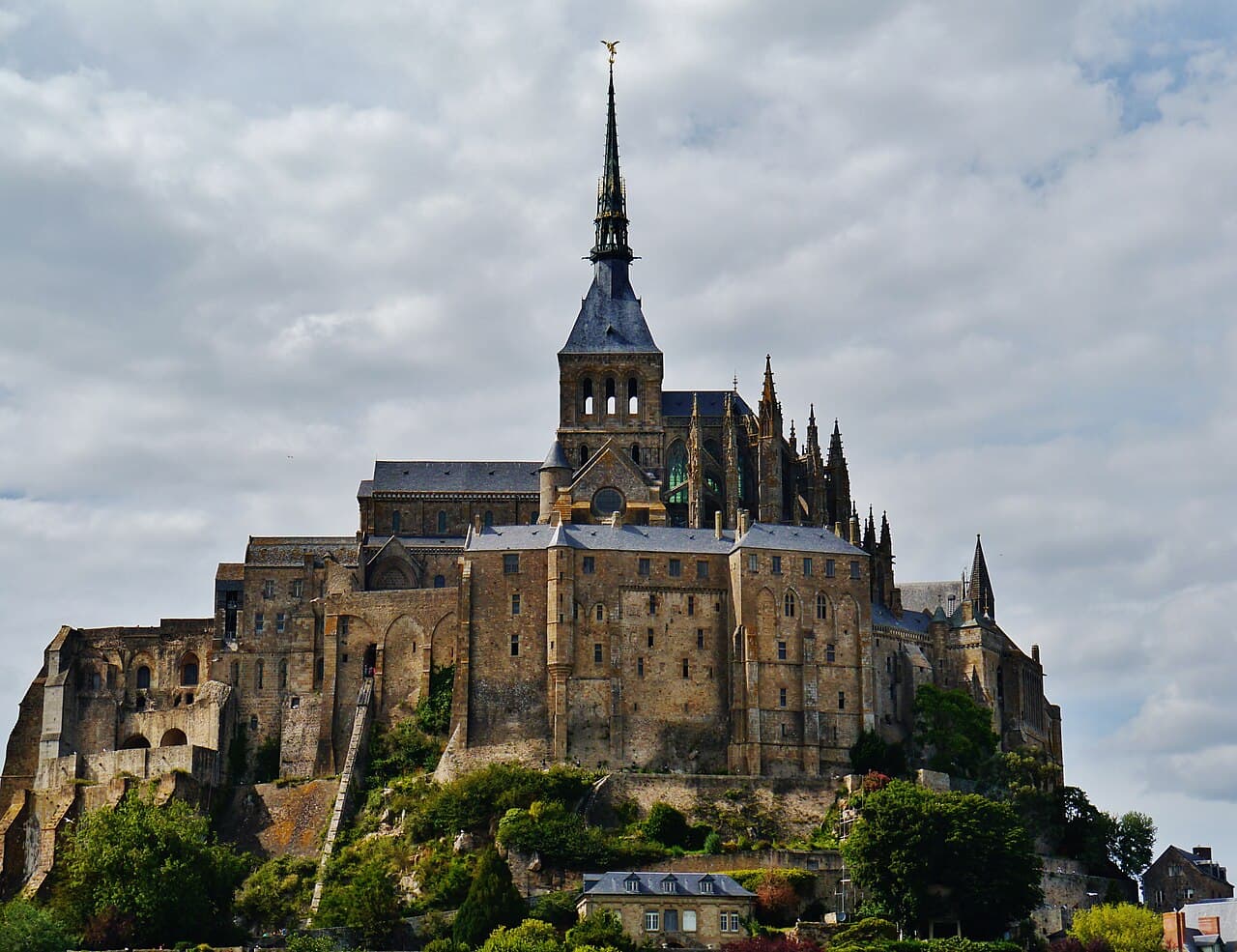
Mont Saint Michel
Mont Saint Michel is a breathtaking medieval abbey and fortress perched on a rocky tidal island in the Normandy region of France. Renowned for its dramatic setting amidst the largest tides in continental Europe, this iconic site has captivated visitors and pilgrims for centuries. It was designated a UNESCO World Heritage site in 1979 in recognition of its outstanding cultural and architectural significance.
Located approximately three hours from Paris, Mont Saint Michel stands at the boundary between Normandy and Brittany. Its unique position on a granite islet surrounded by vast sandbanks and powerful tidal waters has shaped its history, architecture, and strategic importance. The island's natural defenses made it a formidable stronghold during the Middle Ages, while its abbey served as a major religious center and pilgrimage destination.
The geological and geographical setting
The Mont rises dramatically from the bay on a rocky outcrop, which is accessible by a causeway that is periodically submerged by the sea. The bay experiences some of the highest tidal variations in Europe, with water levels that can change by up to 14 meters (46 feet). This natural phenomenon has contributed to the Mont's defense and mystique, as the island becomes completely isolated during high tide and accessible only at low tide.
The architectural evolution of Mont Saint Michel
Early foundations and Romanesque beginnings
The site originally hosted a small oratory established in the 8th century after the Archangel Michael reportedly appeared to Aubert, Bishop of Avranches. The first major construction was the Romanesque abbey church built in the 10th and 11th centuries. This early architecture features rounded arches, thick walls, and a fortress-like appearance, reflecting the need for defense as well as spiritual refuge.
Gothic expansions and fortifications
From the 13th to the 15th centuries, Mont Saint Michel underwent significant expansions in the Gothic architectural style. The abbey church was extended with soaring pointed arches, ribbed vaults, and flying buttresses that allowed for larger windows and more light. This period also saw the construction of extensive fortifications, including thick defensive walls, towers, and a gatehouse to protect against English invasions during the Hundred Years' War.
The abbey complex and monastic buildings
The abbey complex includes a variety of structures such as the cloister, refectory, chapter house, and monks' dormitories. These buildings are arranged vertically on the steep rock, with the church at the summit symbolizing spiritual ascent. The ingenious medieval architects adapted the design to the challenging topography, creating a harmonious blend of religious and military architecture.
Historical significance and cultural impact
Mont Saint Michel has played a crucial role in French history, serving both as a religious sanctuary and a military fortress. It resisted numerous sieges, notably during the Hundred Years' War, when English forces failed to capture it. Its reputation as an impregnable stronghold contributed to its nickname, "La Merveille" (the marvel), a term also used by Victor Hugo who famously compared it to the Great Pyramid of Egypt.
The site became a symbol of French national identity and resilience. Over the centuries, it attracted pilgrims from across Europe, drawn by its spiritual significance and the legend of the Archangel Michael. The abbey's religious function diminished after the French Revolution, when it was used as a prison for a time, but it was later restored as a cultural monument.
Modern preservation and tourism
Today, Mont Saint Michel is one of the most visited tourist destinations in France, attracting millions annually. Preservation efforts have focused on maintaining the delicate balance between protecting the historic fabric and accommodating modern visitors. The causeway was replaced by a bridge in 2014 to restore the island's insular character during high tide and prevent silting of the bay.
The site offers visitors a unique experience of medieval architecture, breathtaking views, and natural beauty. Guided tours, museums, and cultural events help interpret the rich history and architectural marvels of Mont Saint Michel. Its inclusion on the UNESCO list underscores its universal value as a masterpiece of human creativity and endurance.
Frequently asked questions (FAQ)
- When was Mont Saint Michel originally built?
- Mont Saint Michel's origins date back to the 8th century when a small oratory was established after the Archangel Michael appeared to Bishop Aubert. Major construction of the Romanesque abbey began in the 10th and 11th centuries.
- What architectural styles are represented at Mont Saint Michel?
- Mont Saint Michel showcases primarily Romanesque architecture in its early abbey church, with significant Gothic expansions including pointed arches, ribbed vaults, and flying buttresses added between the 13th and 15th centuries.
- Why is Mont Saint Michel called 'La Merveille'?
- Mont Saint Michel is nicknamed 'La Merveille' (the marvel) due to its stunning architecture, dramatic setting, and historical resilience, famously praised by Victor Hugo who compared it to the Great Pyramid of Egypt.
- Can visitors access Mont Saint Michel at all times?
- Access to Mont Saint Michel depends on the tides. The island is reachable by a causeway or bridge, but during high tide it becomes surrounded by water, limiting access. Visitors should check tide schedules before planning their visit.
- What makes Mont Saint Michel's location unique?
- Mont Saint Michel is uniquely situated on a rocky islet in a bay with some of Europe's highest tidal variations, creating a natural defensive barrier and a spectacular landscape that changes dramatically between high and low tides.
Photo gallery

Information
Current owner
State
Loading map...
Visitor reviews
No reviews yet. Been here? Write the first review and help other travelers!
Write the first reviewVisited this castle? Share your experience
Your review helps other travelers and adds first-hand knowledge to our encyclopedia.



