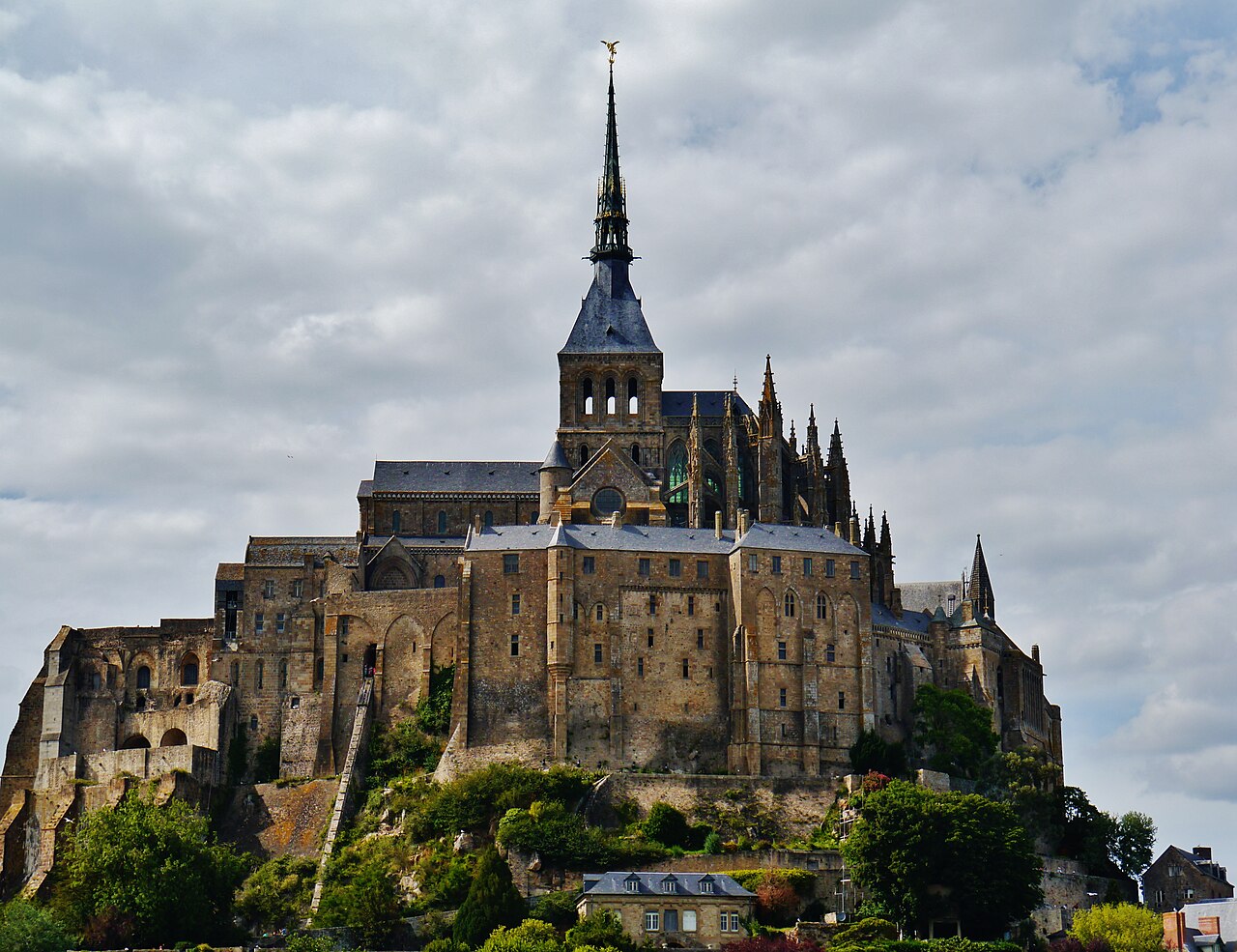
Avranches Castle
Avranches Castle, known locally as Château d'Avranches, is a historic Norman fortress situated in the town of Avranches in the Manche department of France. Perched on a rocky promontory at the confluence of the rivers Sée and Sélune, the castle commands sweeping views over the surrounding town and the bay of Mont-Saint-Michel. Its strategic location has made it a significant military and administrative site from antiquity through the medieval period and beyond.
The site of Avranches Castle has a rich history of occupation dating back to the 1st century when it was inhabited by the Abrincatui, a Celtic tribe. It later became a regional capital under Roman rule, with fortifications established to control the important river crossings and coastal approaches. Following the Roman era, the area was inhabited by Saxons until the Franks assumed control in 786, underscoring the site's enduring strategic importance over centuries.
In the mid-10th century, the Normans recognized the site's defensive value and constructed the first castle here. This early fortress was initiated by Ansfrid the Dane (also known as Onfroy le Dane), who built upon the remains of Roman fortifications to establish a stronghold against Breton incursions along the southwestern border of the Duchy of Normandy. This initial castle was among the earliest stone fortifications in Normandy, contemporaneous with other key defensive sites such as the towers of Rouen and Ivry-la-Bataille.
Medieval development and military significance
During the 11th century, the castle was rebuilt and expanded, reflecting the growing power of the Norman dukes. The rectangular keep that formed the castle's centerpiece was likely constructed by Henry I of England following his victory over his brother Robert Curthose at the Battle of Tinchebray in 1106. Henry I needed to secure the borders of the Duchy of Normandy, and Avranches was a crucial stronghold alongside other fortresses such as Domfront, Mortain, and Vire.
The castle and its surrounding town walls played an integral role in the defense of the region. In 1204, during the conflict between King Philip II of France and the Duchy of Normandy, the ruler of Brittany, Guy de Thouars, exploited the turmoil to attack the Avranchin region. He destroyed much of the town's defenses, including the castle, which was part of the town's fortifications. Subsequently, King Louis IX undertook reconstruction efforts around 1236, restoring the castle and strengthening the walls to reinforce the town's defenses.
Throughout the 14th and 15th centuries, the castle and town fortifications were further enhanced in response to ongoing military threats, including those posed by the Hundred Years' War. The fortress endured sieges and changed hands, notably surrendering in 1450 to Francis I, Duke of Brittany, and Arthur de Richemont, a prominent military leader. The castle also served as a residence for important figures such as Richard I of Normandy, William Rufus, Robert Curthose, and Henry I Beauclerc, highlighting its status as a seat of regional power.
Architectural features and surviving remains
The Château d'Avranches was constructed primarily from stone, characteristic of early Norman military architecture. It occupied a commanding position on a promontory overlooking the town and the meeting point of the Sée and Sélune rivers, with views extending towards the bay of Mont-Saint-Michel. The castle was integrated into a larger defensive system enclosing the medieval town, which included a fortified enceinte (town wall) with multiple gates and towers.
The original castle featured a square donjon or keep, positioned along the rampart behind the current town hall. Although the keep itself no longer survives, it formed the core of the castle's defensive structure. The medieval town was protected by a fortified wall with two main gates: the Porte Baudange and the Porte de Ponts, supplemented by a smaller postern gate near the cathedral for controlled access.
To bolster vulnerable sections of the defenses, the enclosure was supported by four towers, three of which—Arsenal, Promenoir, and Geôle—guarded the most exposed front between the main gates. Archaeological plans from 1775 reveal an additional line of ramparts, or lices, a narrow defensive walkway ahead of the main town wall, providing an extra layer of protection.
Several of these defensive structures partially survive today. A section of curtain wall near the south front by the former site of Saint-André cathedral remains visible. The Arsenal tower, also known as the Saint-Louis tower, located on rue de la Belle Andrine behind the town hall, is preserved and classified as a historic monument. The Promenoir tower and its connecting wall to the former donjon also endure, as does the Geôle tower situated on Place d'Estouteville. Unfortunately, the northern tower of the Porte de Ponts was destroyed during World War II bombings in 1944.
Decline and modern preservation
From the mid-18th century onward, Avranches Castle lost its military importance. By the 19th century, the castle and town walls were dismantled, with stones sold and repurposed for local habitation. The once-prominent square keep gradually fell into ruin and collapsed. In later 19th-century developments, the keep almost completely disappeared when a new road was constructed through its former site. Today, only partial walls of the keep remain on either side of the Rue de la Belle Andrine.
During World War II, the remains of the castle and town walls suffered damage from bombings in 1944. Subsequent efforts have been made to consolidate and rebuild some walls and towers, preserving the remnants of this historic fortress. Visitors can freely explore the remains, and from atop one of the surviving towers, enjoy panoramic views over the town, the surrounding countryside, and the iconic Mont-Saint-Michel on the horizon.
Historical significance and cultural heritage
Avranches Castle stands as a testament to the layered history of Normandy, reflecting the region's Celtic, Roman, Saxon, Frankish, and Norman pasts. Its strategic location at the crossroads of important waterways and near the border with Brittany made it a focal point for military and political power struggles over many centuries.
The castle's association with notable historical figures such as Henry I of England, Louis IX, and military leaders during the Hundred Years' War underscores its importance in the broader narrative of French and Norman history. Although much of the original structure has been lost, the surviving fortifications and archaeological remains provide valuable insights into medieval military architecture and urban defense systems.
Today, Avranches Castle is recognized as a cultural heritage site, attracting visitors interested in medieval history, architecture, and the dramatic landscapes of Normandy. Its proximity to Mont-Saint-Michel adds to its appeal, offering a unique combination of natural beauty and historical depth.
Visiting avranche castle
The remains of Avranches Castle are accessible to the public, with no entrance fee required. Visitors can explore the surviving towers, walls, and gates, gaining a tangible sense of the castle's former scale and significance. The site offers excellent photographic opportunities, particularly the views towards Mont-Saint-Michel and the surrounding Normandy countryside. Informational plaques and local guides provide context for the castle's history and architectural features.
Avranches town itself offers additional attractions, including the Avranches Scriptorial museum, which houses medieval manuscripts and artifacts related to the region's history. The combination of cultural sites and natural scenery makes a visit to Avranches Castle a rewarding experience for history enthusiasts and tourists alike.
Frequently asked questions (FAQ)
- When was Avranches Castle originally built?
- Avranches Castle was originally constructed in the mid-10th century by Ansfrid the Dane on the site of earlier Roman fortifications.
- What remains of Avranches Castle can be seen today?
- Today, visitors can see partial walls, several towers including the Arsenal (Saint-Louis) tower, Promenoir tower, and Geôle tower, as well as sections of the medieval town walls.
- Is Avranches Castle open to the public for visits?
- Yes, the remains of Avranches Castle are freely accessible to the public with no entrance fee, and visitors can explore the surviving fortifications and enjoy panoramic views.
- What architectural style characterizes Avranches Castle?
- Avranches Castle primarily features Romanesque architectural elements typical of early Norman military fortifications.
- How did World War II affect Avranches Castle?
- The castle suffered damage from bombings in 1944 during World War II, leading to the destruction of some towers and walls, but subsequent restoration efforts have helped preserve remaining structures.
- What is the best time to visit Avranches Castle?
- Avranches Castle can be visited year-round, with spring and summer offering the best weather for exploring the ruins and enjoying views of Mont-Saint-Michel.
Information
Opening hours
Open daily, free access
Ticket prices
Free
Current owner
Municipality
Address
Rue d'Islande, Avranches, Manche, Normandy, France
Loading map...
Visitor reviews
No reviews yet. Been here? Write the first review and help other travelers!
Write the first reviewVisited this castle? Share your experience
Your review helps other travelers and adds first-hand knowledge to our encyclopedia.