Monsaraz Castle
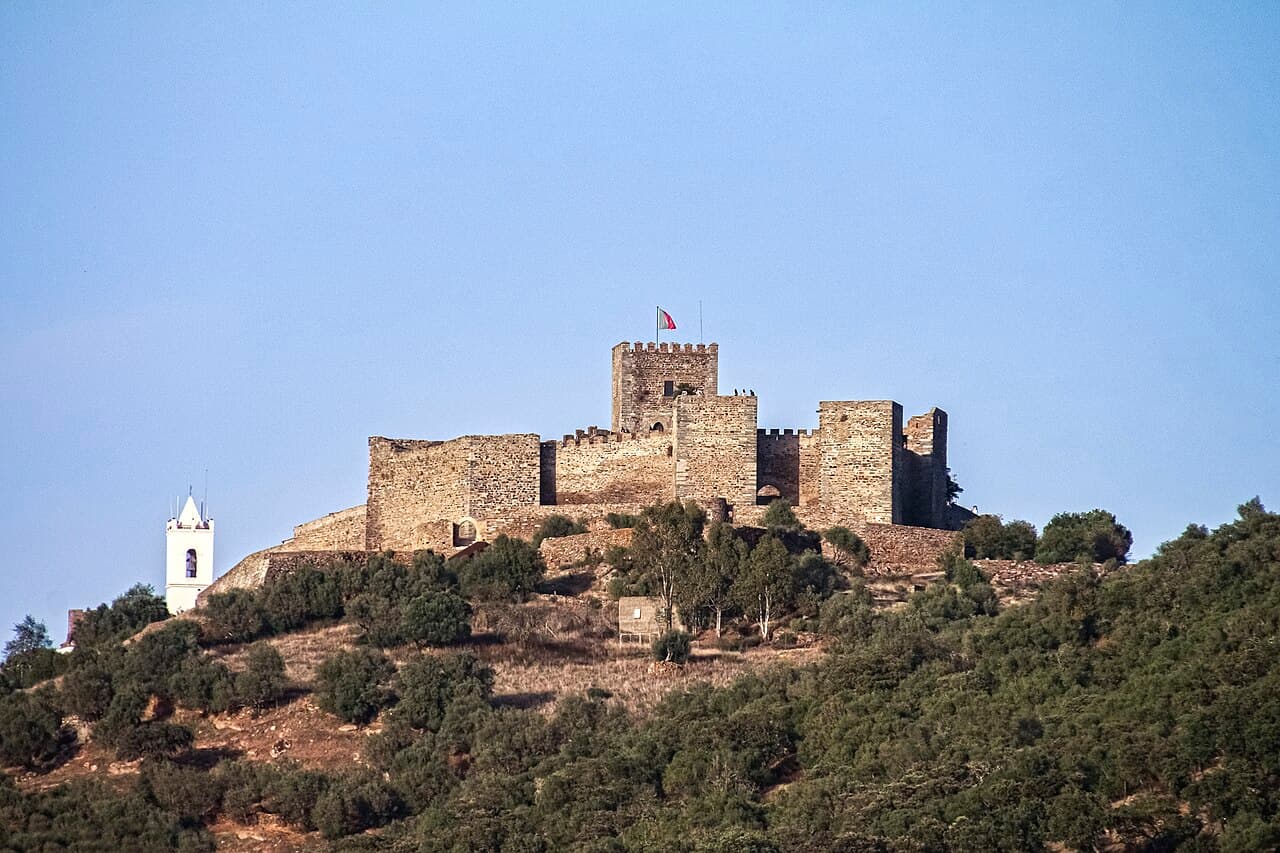
Monsaraz Castle, locally known as Castelo de Monsaraz, stands prominently on a narrow, elongated hill overlooking the right bank of the Guadiana River in Portugal's Alentejo Central region. This hill castle occupies a strategic vantage point that has been significant since prehistoric times, evidenced by successive layers of occupation including Roman, Visigothic, and Muslim settlements. The castle's location atop Monsaraz hill provided commanding views over the surrounding landscape, making it a critical defensive site throughout its long history.
The site’s name, "Monsaraz," is derived from the Arabic word "saris" or "sharish," referring to the abundant cistus plants that once flourished near the Guadiana River. This etymology reflects the region’s complex cultural heritage, shaped by centuries of diverse influences.
The early history and medieval origins
During the Christian Reconquista, Monsaraz changed hands multiple times. In 1167, the castle was first captured from Muslim control by the renowned Portuguese knight Geraldo Sem Pavor (Gerald the Fearless). However, this victory was short-lived as the Almohad Caliphate, led by Abu Yaqub Yusuf, recaptured the fortress in 1173. It was not until 1232 that King Sancho II of Portugal, with the aid of the Knights Templar, definitively reclaimed Monsaraz, marking a pivotal moment in the castle’s history.
Following the conquest, the lands were granted to the Knights Templar, who played a vital role in the castle’s early development. In 1276, King Afonso III issued a foral (town charter) to encourage repopulation and strengthen defenses. Construction of a new castle began around this time, likely initiated by the knight Martim Anes Zagallo, who also contributed to the establishment of the Church of Santa Maria de Lagoa.
Transition to the Order of Christ and 14th-century fortifications
After the dissolution of the Knights Templar in 1312 by Pope Clement V, their Portuguese assets, including Monsaraz, passed to the newly formed Order of Christ in 1319. Monsaraz became a commandery under their jurisdiction, subordinate to the headquarters at Castro Marim Castle.
The castle’s keep tower was rebuilt around 1310 under the reign of King Denis, who also expanded the town’s defensive walls. These medieval fortifications, characterized by robust stone curtain walls and strategically placed towers, largely define the castle’s enduring silhouette.
Military conflicts and noble ownership in the late medieval period
The late 14th century was marked by military turbulence during the 1383–1385 Portuguese interregnum, a dynastic crisis that saw Monsaraz briefly fall to Castilian forces in 1385. The castle was initially attacked by English troops led by Edmund of Langley, Earl of Cambridge, who had allied with Portugal against Castile but returned home after peace was brokered. Shortly thereafter, loyalist Portuguese forces under Nuno Álvares Pereira recaptured Monsaraz, securing it for the Portuguese Crown.
In 1412, the castle and town were donated to the House of Braganza, marking a shift from military to noble ownership. This transition influenced the castle’s role and maintenance in the centuries that followed.
Renaissance and early modern enhancements
During the reign of King Manuel I (1495–1521), Monsaraz received renewed attention. Around 1509, the castle and town were documented by the military engineer Duarte de Armas, and a new foral was issued in 1512 to regulate the settlement.
The castle’s strategic importance was reaffirmed during the Portuguese Restoration War (1640–1668), when Portugal regained independence from Spain. Due to its proximity to the Spanish border and the Guadiana River, Monsaraz’s defenses were modernized with the addition of bastioned fortifications in the Vauban style. These updates were overseen by French military engineer Nicolau de Langres and Jean Gillot, who designed the Fort of São Bento to complement the medieval castle.
Fort of São Bento and bastioned defenses
The Fort of São Bento is a star-shaped bastioned fortress constructed in the 17th century to enhance the castle’s defensive capabilities against artillery. It features three bastions, curtain walls, and a parapet, integrating with the older medieval walls to create a layered defense system. The fort also incorporates the Chapel of São Bento de Monsaraz, blending religious and military functions within the fortifications.
Decline and adaptive reuse in the 18th and 19th centuries
As the military significance of Monsaraz waned in the 18th century, the castle gradually fell into neglect. By the mid-19th century, many fortifications were abandoned, and the castle’s interior was repurposed as a bullring using stones from the courtyard. The municipal seat was moved to Reguengos de Monsaraz in 1840, reflecting the town’s declining prominence.
Despite this decline, the castle and the surrounding medieval walls were recognized as a National Monument in 1946, ensuring their preservation and protection as part of Portugal's cultural heritage.
Architectural features and current state
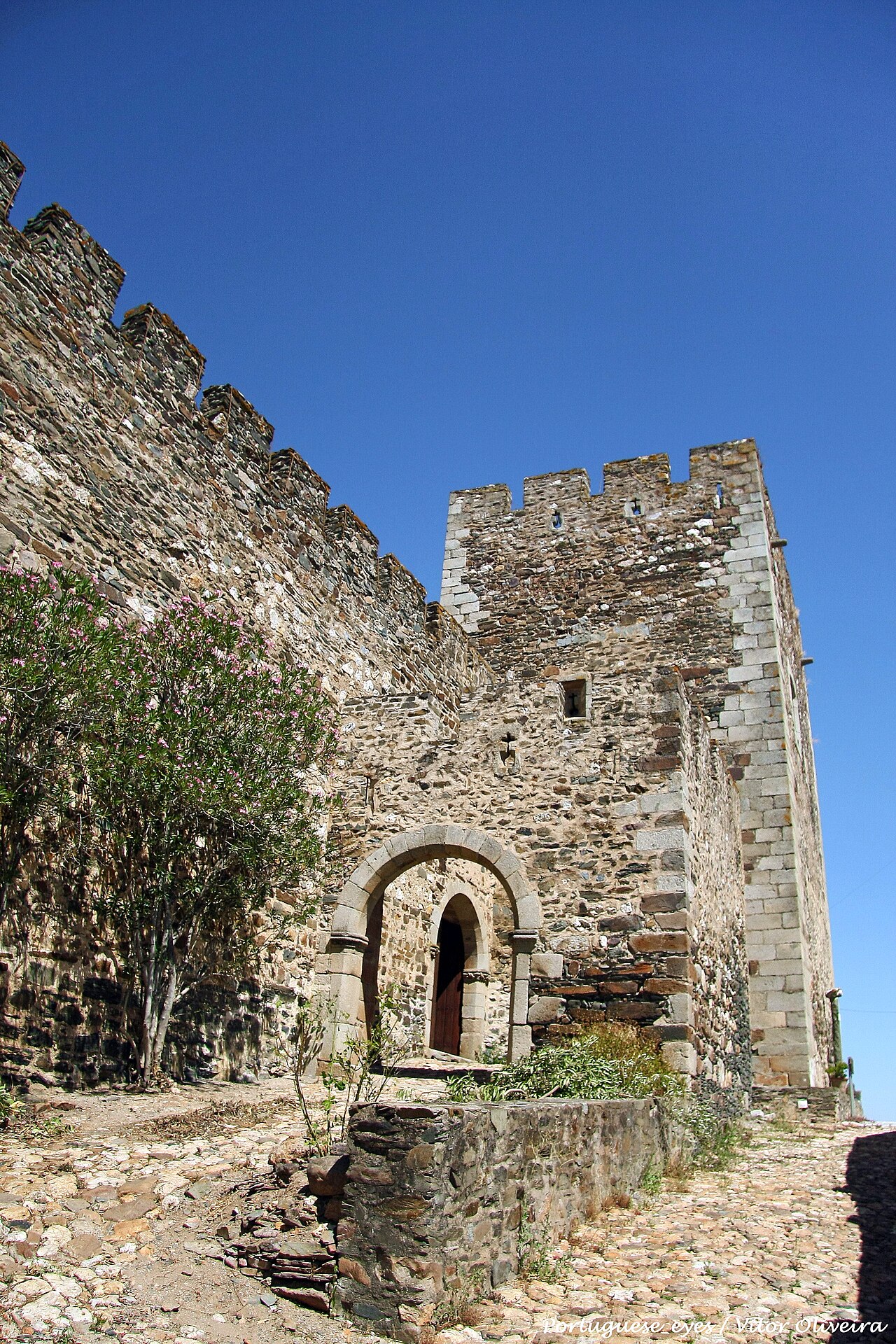
Monsaraz Castle occupies the highest point of Monsaraz hill and has a roughly quadrangular layout. The castle’s curtain walls are constructed mainly from schist stone bonded with lime, reinforced by towers that punctuate the perimeter. The main courtyard, or plaza de armas, contains the central citadel structures and the imposing keep tower.
The fortress is accessed through four primary gateways made of granite. The most notable entrance is the Porta da Vila (also known as the Évora Gate), distinguished by its ogival (pointed) arch typical of the Gothic period. This gate is flanked by two semi-cylindrical turrets, one topped by a bell tower with whitewashed walls. The ribbed vault ceiling of the gate houses a bell dated 1692, crafted by artisans Diogo de Abalde and Domingos de Lastra. A marble plaque above the arch commemorates the consecration of Portugal to the Immaculate Conception during the Restoration period. Intriguingly, medieval units of measurement such as the vara and côvado are inscribed on the gate’s jambs.
Other gates include the Porta da Cisterna (or Porta do Buraco) and the Porta da Alcoba, both featuring round arches. The enclosing walls form an oval perimeter around the town, constructed from a blend of local schist and granite stones bonded with red clay mortar and lime, showcasing traditional regional building methods.
Visitor experience and cultural significance
Today, Monsaraz Castle is freely accessible to visitors who can explore its extensive ruins and appreciate the layers of history embedded in its walls. The castle offers spectacular panoramic views over the surrounding Alentejo landscape and the Alqueva Reservoir, created by the damming of the Guadiana River around 2000. Notably, the castle maintains visual intervisibility with Mourão Castle across the river, highlighting its historical role in regional defense.
The castle and the walled town of Monsaraz together form a captivating historical ensemble that attracts tourists interested in medieval architecture, Portuguese history, and scenic vistas. The site’s preservation as a National Monument underscores its importance as a cultural landmark and a testament to the complex history of Portugal’s borderlands.
Frequently asked questions (FAQ)
- How do I get to Monsaraz Castle?
- Monsaraz Castle is located in the picturesque village of Monsaraz, Portugal. You can reach it by car from major cities like Évora or Beja, and there are also local bus services available. Parking is available near the castle, making it convenient for visitors.
- What is the historical significance of Monsaraz Castle?
- Monsaraz Castle dates back to the 12th century and played a crucial role in the defense against the Moors during the Reconquista. The castle is a testament to Portugal's medieval history and has been preserved as a historical monument. Its strategic position offers stunning views over the Alentejo region and the Alqueva dam.
- When was Monsaraz Castle built?
- Monsaraz Castle was originally constructed in the 12th century, with significant modifications and expansions occurring in the following centuries. The castle was part of a series of fortifications designed to protect the region during the Reconquista. Today, it stands as a remarkable example of medieval military architecture.
- Can I enter Monsaraz Castle?
- Yes, visitors can enter Monsaraz Castle and explore its historical grounds. The castle features walking paths along its walls and offers breathtaking views of the surrounding landscape. Be sure to check for any guided tours that may provide additional insights into its history.
- Why is Monsaraz Castle a popular tourist destination?
- Monsaraz Castle is popular for its stunning architecture, historical significance, and panoramic views. The charming village of Monsaraz, with its cobbled streets and whitewashed houses, adds to the appeal. Additionally, the proximity to the Alqueva Lake, a popular spot for water activities, enhances its attractiveness for tourists.
- Is it possible to visit Monsaraz Castle with children?
- Yes, Monsaraz Castle is family-friendly and suitable for children. The open spaces and walkable paths allow children to explore safely while learning about history. Parents should supervise their children near the castle walls, which can be steep in some areas.
- What are the opening hours of Monsaraz Castle?
- Monsaraz Castle is typically open to visitors daily, but hours may vary depending on the season. It is advisable to check the official website or contact local tourism offices for the most accurate information. Planning your visit earlier in the day can help you avoid crowds and enjoy a quieter experience.
- Are there any ticket prices for visiting Monsaraz Castle?
- Entry to Monsaraz Castle is generally free, which makes it an accessible destination for everyone. However, some guided tours may have a fee associated with them. Always confirm the current pricing and any special exhibitions before your visit.
- What is the best time to visit Monsaraz Castle?
- The best time to visit Monsaraz Castle is during the spring (March to May) and fall (September to November) when the weather is milder. These seasons also offer fewer crowds and beautiful scenery as the surrounding landscape blooms. Summer can be quite hot, so early morning or late afternoon visits are recommended during that time.
- What nearby attractions can I explore after visiting Monsaraz Castle?
- After visiting Monsaraz Castle, you can explore the nearby Alqueva Lake, which is perfect for water sports and relaxation. The village of Monsaraz itself is rich in history and offers charming shops and local cuisine. Additionally, the region is known for its vineyards, so wine tasting is another popular activity.
Photo gallery

Information
Address
Largo do Castelo, Monsaraz, Portugal
Loading map...
Visitor reviews
No reviews yet. Been here? Write the first review and help other travelers!
Write the first reviewVisited this castle? Share your experience
Your review helps other travelers and adds first-hand knowledge to our encyclopedia.