
Monea Castle
Monea Castle is a remarkable example of early 17th-century plantation architecture located in the rural countryside near the village of Monea, northwest of Enniskillen in County Fermanagh, Northern Ireland. Sitting atop a rocky bluff that overlooks a drained lake with a visible ancient crannog, the castle embodies the turbulent history and cultural exchanges of the Plantation of Ulster era. Constructed primarily between 1616 and 1622, it was commissioned by the Scottish clergyman Reverend Malcolm Hamilton, who held significant ecclesiastical positions such as Chancellor of Down and later Archbishop of Cashel. The castle represents the transplantation of Scottish architectural styles into Ireland during this period of colonization and settlement.
Historical context and significance
The site of Monea Castle originally belonged to the Irish Maguire clan, a dominant Gaelic family in Fermanagh. Prior to the castle's construction, the location was strategic, featuring an ancient crannog in the nearby lake, an artificial island dating back to approximately 600 AD and historically associated with Hugh Maguire, a notable clan chieftain. Following the confiscation of Maguire lands by King James I, the territory was granted to English and Scottish settlers as part of the Plantation policy aimed at establishing loyal Protestant communities in Ulster.
The castle's construction began in 1616 and was completed by 1622, marking it as a significant Renaissance-period fortified residence. It was built as a hill castle on a sandstone plateau, designed to provide both defense and domestic comfort. Its Scottish influence is evident in its architectural features, which distinguish it from many contemporary Irish castles.
Monea Castle witnessed key historical events, including its attack during the Irish Rebellion of 1641 led by Rory Maguire, who temporarily captured the castle. The structure was later reclaimed and refurbished by the Planters, reflecting the ongoing conflict between native Irish forces and colonial settlers. By 1688, the castle was owned by Gustavus Hamilton, Governor of Enniskillen, whose family faced financial difficulties after the Williamite Wars, eventually selling the estate in 1704.
The castle was severely damaged by fire around 1750, leading to its abandonment and gradual decline into ruin. In the 20th century, the castle ruins were briefly occupied by a woman named Beth McCabe before the state took over preservation efforts. Since 1954, Monea Castle has been maintained as a protected historic monument, highlighting its cultural and architectural importance within Northern Ireland's heritage.
Architectural features and layout
The fortified bawn and courtyard
Monea Castle is characterized by a fortified rectangular courtyard, or bawn, measuring approximately 30 square meters, constructed atop a sandstone plateau. The bawn walls rise to about four meters and are pierced with musket loops, narrow vertical slits designed for firearm defense, illustrating the adaptation of fortifications to gunpowder weaponry during the Renaissance period.
Two circular flankers, or towers, are positioned at the northern corners of the bawn. The northwest tower uniquely served a dual purpose as a dovecote, providing a source of meat and communication. The main entrance to the courtyard is located on the north side adjacent to this tower, accessible via a narrow raised approach from the marshy surrounding terrain.
The tower house and defensive design
The primary structure within the bawn is the three-story Scottish-style tower house, rectangular in plan and oriented westward. It is flanked by two round towers that protect the entrance, each supporting square chambers set diagonally at 45 degrees to the main rectangle. These chambers rest on stepped corbels, a distinctive feature in Scottish Renaissance architecture.
The castle's defensive elements include corbelled parapets with stepped gables crowning the towers, providing both aesthetic appeal and functional battlements for defenders. The ground floor housed the kitchen and storage rooms, essential for daily life and sustenance during sieges. The first floor contained a large hall with substantial windows and window seats along the southern wall, designed to maximize natural light and provide views of the surrounding landscape. Private chambers were located on the second floor, offering separation from the more public spaces below.
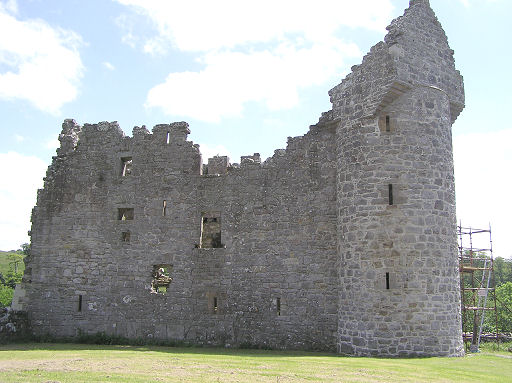
Photo by Kenneth Allen • CC BY-SA 2.0
Monea castle in the plantation era
The construction of Monea Castle was part of the broader Plantation of Ulster, a colonization effort by the English Crown to settle loyal Protestant subjects in confiscated Irish lands. The castle's Scottish architectural style reflects the origins of many settlers, including Malcolm Hamilton, who brought his cultural influences to the region.
The castle functioned both as a defensive stronghold and a residence, symbolizing the assertion of control over the newly acquired territory. Its location on a rocky bluff overlooking a lake and marshy landscape provided strategic advantages against potential attacks by native Irish forces resisting colonization.
Throughout the 17th century, Monea Castle remained a focal point in the conflicts that shaped Northern Ireland's history, from the Irish Rebellion of 1641 to the Williamite Wars later in the century. Its changing ownership and eventual decline mirror the political and social upheavals of the period.
Preservation and modern significance
Today, Monea Castle stands as a well-preserved ruin, accessible to the public without charge. Its preservation as a state-protected monument ensures that the castle's architectural and historical legacy endures. Visitors can explore the remains of the tower house, the fortified bawn, and the surrounding landscape that once played a crucial role in the Plantation era.
The castle's unique blend of Scottish Renaissance architecture and Irish historical context makes it a valuable site for understanding the cultural and military history of early 17th-century Ulster. Its remote and picturesque setting enhances its appeal as a destination for history enthusiasts and architectural scholars alike.
In addition to its architectural significance, the castle's location near the ancient crannog adds archaeological interest, linking it to Ireland's early medieval past and the Gaelic heritage of the Maguire clan.
Visitors to Monea Castle are encouraged to appreciate the intricate masonry, defensive features, and the story of cultural intersection embodied in this historic site. Its enduring presence offers insight into the complexities of colonization, conflict, and adaptation in Northern Ireland's history.
Frequently asked questions (FAQ)
- How do I get to Monea Castle?
- Monea Castle is located in Monea, Northern Ireland, easily accessible by car or public transport. If you're driving, it's just a short distance off the A4 road, and there is parking available nearby. For those using public transport, the nearest bus stop is within walking distance of the castle.
- What is the historical significance of Monea Castle?
- Monea Castle, built in the late 16th century, is an important example of Irish Renaissance architecture. It was constructed by the O'Donnell family and served as a strategic stronghold during turbulent times in Irish history. Today, it stands as a testament to the region's rich historical heritage and is a popular site for history enthusiasts.
- When was Monea Castle built?
- Monea Castle was constructed around 1610, during a period of significant political and social change in Ireland. The castle was designed to provide both defense and residence for its owners, reflecting the architectural styles of the time. Its construction marks an essential phase in the evolution of Irish castles.
- Can I visit Monea Castle year-round?
- Yes, Monea Castle is open to visitors year-round, although certain parts of the site may be closed during winter months for maintenance. It’s advisable to check the official website or local tourist information for specific opening hours. Planning your visit during the warmer months can enhance your experience with better weather.
- Why is Monea Castle a popular tourist attraction?
- Monea Castle attracts visitors due to its stunning architecture and rich history. The castle's scenic surroundings and intriguing stories about its past contribute to its appeal. Additionally, it offers visitors a chance to explore the beauty of Northern Ireland's landscape while stepping back in time.
- Is it possible to take guided tours of Monea Castle?
- Currently, Monea Castle does not offer formal guided tours, but visitors are welcome to explore the site at their own pace. Informational panels are available to provide insights into the castle's history and architecture. Local tourist guides may also provide informal tours in the area, enhancing your visit.
- What are the opening hours for Monea Castle?
- Monea Castle's opening hours vary by season, typically opening from 10 AM to 5 PM during peak tourist season. In the off-peak months, hours may be reduced, so it’s best to check ahead before planning your visit. Special events may affect the schedule, so keep an eye on announcements.
- Are there any nearby attractions to visit while at Monea Castle?
- Yes, there are several nearby attractions, including the scenic Lough Erne and the charming village of Enniskillen. Visitors can also explore other historical sites such as the nearby Florence Court and Castle Coole. These attractions make for a perfect day trip combined with your visit to Monea Castle.
- What are the ticket prices for Monea Castle?
- Admission to Monea Castle is generally free, allowing visitors to explore this historical site without any cost. However, donations are appreciated to help maintain the castle and its grounds. Special events or guided activities may have associated fees, so check in advance for any updates.
Photo gallery

Information
Website
Visit websiteSources & official resources
Verify the information above using these authoritative references.
Loading map...
Visitor reviews
No reviews yet. Been here? Write the first review and help other travelers!
Write the first reviewVisited this castle? Share your experience
Your review helps other travelers and adds first-hand knowledge to our encyclopedia.