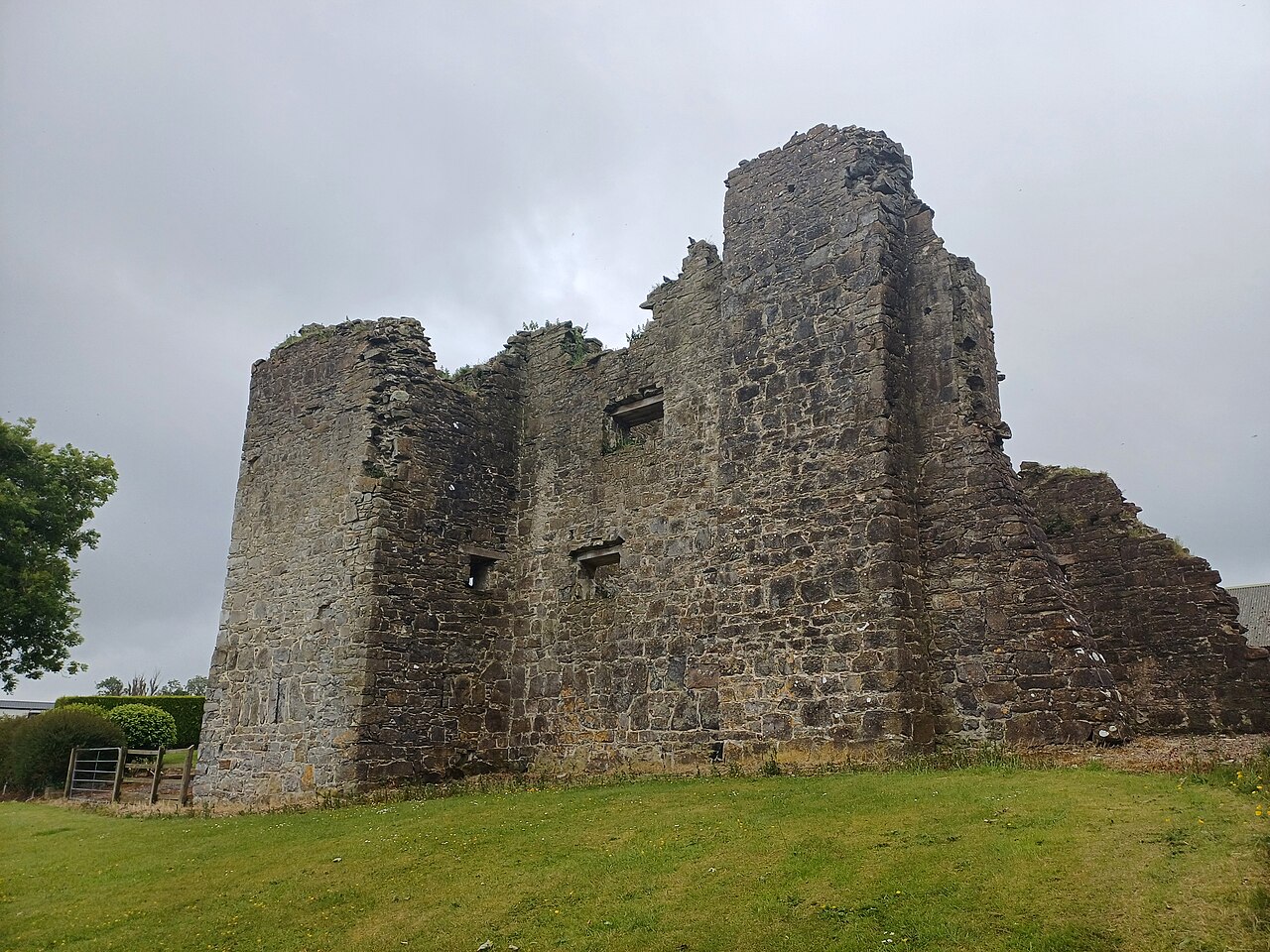
Tully Castle
Tully Castle is a notable example of a 17th-century plantation castle situated on a hill overlooking the west shore of Lower Lough Erne, north of the village of Derrygonnelly in County Fermanagh, Northern Ireland. Constructed between 1612 and 1615, the castle was built for Sir John Hume of North Berwick, a Scottish planter who was part of the wider effort to establish Protestant settlements during the Plantation of Ulster.
Architectural design and features
Tully Castle exemplifies the Scottish T-shaped plan characteristic of plantation castles of this period. The castle's layout includes a prominent square wing projecting from the center of the south side, which houses the main entrance and originally contained a scale-and-platt timber staircase. This stair design was typical of Scottish architecture, facilitating access between floors in a compact and efficient manner.
The interior arrangement placed the hall and parlor on the first floor, reflecting the social hierarchy and functional zoning common in early modern castles. Above these principal rooms were the attics, containing bedrooms accessed via a spiral stair located in a Scottish-style quarter-round turret projection. This turret not only provided vertical circulation but also added a distinctive architectural silhouette to the castle's exterior.
The ground floor was devoted to a large barrel-vaulted chamber serving as the kitchen and storeroom. This space featured a huge fireplace with cooking recesses, essential for food preparation and storage. Notably, the ground floor lacked windows, meaning illumination relied on the firelight and hanging lanterns, a common feature in fortified buildings designed for defense and temperature control.
The castle was originally topped with a thatched roof and surrounded by a bawn—a defensive enclosure typical of Irish plantation castles—equipped with four rectangular flankers at the corners. These flankers provided vantage points for defense and surveillance, enhancing the castle's security against attacks.
Historical context and the 1641 rebellion
Tully Castle is deeply intertwined with the turbulent history of the Plantation of Ulster and the subsequent Irish Rebellion of 1641. The castle was a symbol of the Scottish and English colonization efforts in Northern Ireland, which displaced many native Irish families.
During the rebellion, Rory Maguire, a member of the Gaelic Irish nobility seeking to reclaim ancestral lands, led an attack on the castle. On Christmas Eve 1641, Maguire's forces arrived at Tully Castle, which was then primarily occupied by women, children, and a small group of men, as many of the male defenders were absent.
Lady Mary Hume, acting in the absence of her husband, surrendered the castle under the assurance of safe conduct for all inhabitants. However, the following day, Christmas Day, the Maguire forces betrayed this agreement. They imprisoned the occupants in the castle's vaults and subsequently massacred approximately 60 women and children and 15 men, sparing only the Hume family. The castle was then plundered and set ablaze.
This tragic event marked the end of Tully Castle as a functional residence. The Hume family never returned, and the castle fell into ruin, symbolizing the violent upheavals of the period.
Post-rebellion status and preservation efforts
Following its destruction, Tully Castle remained an overgrown ruin for centuries. In 1974, the site was acquired by the Department of Environment, which undertook archaeological excavations revealing traces of the castle's 17th-century garden and other features of the original estate.
Consolidation works were carried out to stabilize the ruins and prevent further deterioration, making the site accessible to the public. Today, visitors can explore the remains of the castle, including the distinctive architectural elements and the surrounding landscape that once formed the castle's defensive and domestic environment.
A small exhibition housed in a cottage at the entrance to the castle grounds provides additional historical context and displays artifacts recovered during the excavations. The castle grounds are freely accessible during July and August, offering a scenic and educational experience for visitors interested in plantation history, castle architecture, and 17th-century Irish heritage.
The significance of tully castle in irish plantation history
Tully Castle stands as a poignant reminder of the complex and often violent history of the Ulster Plantation. Its architecture reflects the transplantation of Scottish building traditions to Ireland, adapted to local conditions and defensive needs.
The castle's tragic fate during the 1641 rebellion highlights the deep social and political conflicts that shaped Ireland in the early modern period. As a site of massacre and destruction, it embodies the human cost of colonial expansion and resistance.
Today, the castle is valued not only for its architectural features but also as a cultural heritage site that educates visitors about the plantation era, the conflicts it engendered, and the resilience of the communities involved.
Frequently asked questions (FAQ)
- How do I get to Tully Castle?
- Tully Castle is located on Lough Shore Road in County Fermanagh, Northern Ireland. It is accessible by car and local roads, with parking available nearby. The castle is situated on a hill overlooking Lower Lough Erne, offering scenic views during your visit.
- When can I visit Tully Castle?
- The castle grounds are freely accessible to the public during July and August. Outside these months, access may be restricted, so it's advisable to check ahead before planning your visit.
- What is the historical significance of Tully Castle?
- Tully Castle is significant as a 17th-century Scottish plantation castle and as the site of a tragic massacre during the Irish Rebellion of 1641. It exemplifies plantation architecture and reflects the turbulent history of Ulster during this period.
- Can I explore the interior of Tully Castle?
- As the castle is in ruins, only the exterior and remaining structural elements can be explored. There is a small exhibition at the entrance cottage that provides historical context and displays artifacts found during excavations.
- Is Tully Castle suitable for family visits?
- Yes, Tully Castle is suitable for families, especially during the open months of July and August. The site offers a combination of historical interest and scenic surroundings, making it a pleasant educational outing for visitors of all ages.
Information
Opening hours
Freely accessible during July and August
Ticket prices
Free
Current owner
Department of Environment
Address
Lough Shore Road, United Kingdom of Great Britain and Northern Ireland
Loading map...
Visitor reviews
No reviews yet. Been here? Write the first review and help other travelers!
Write the first reviewVisited this castle? Share your experience
Your review helps other travelers and adds first-hand knowledge to our encyclopedia.