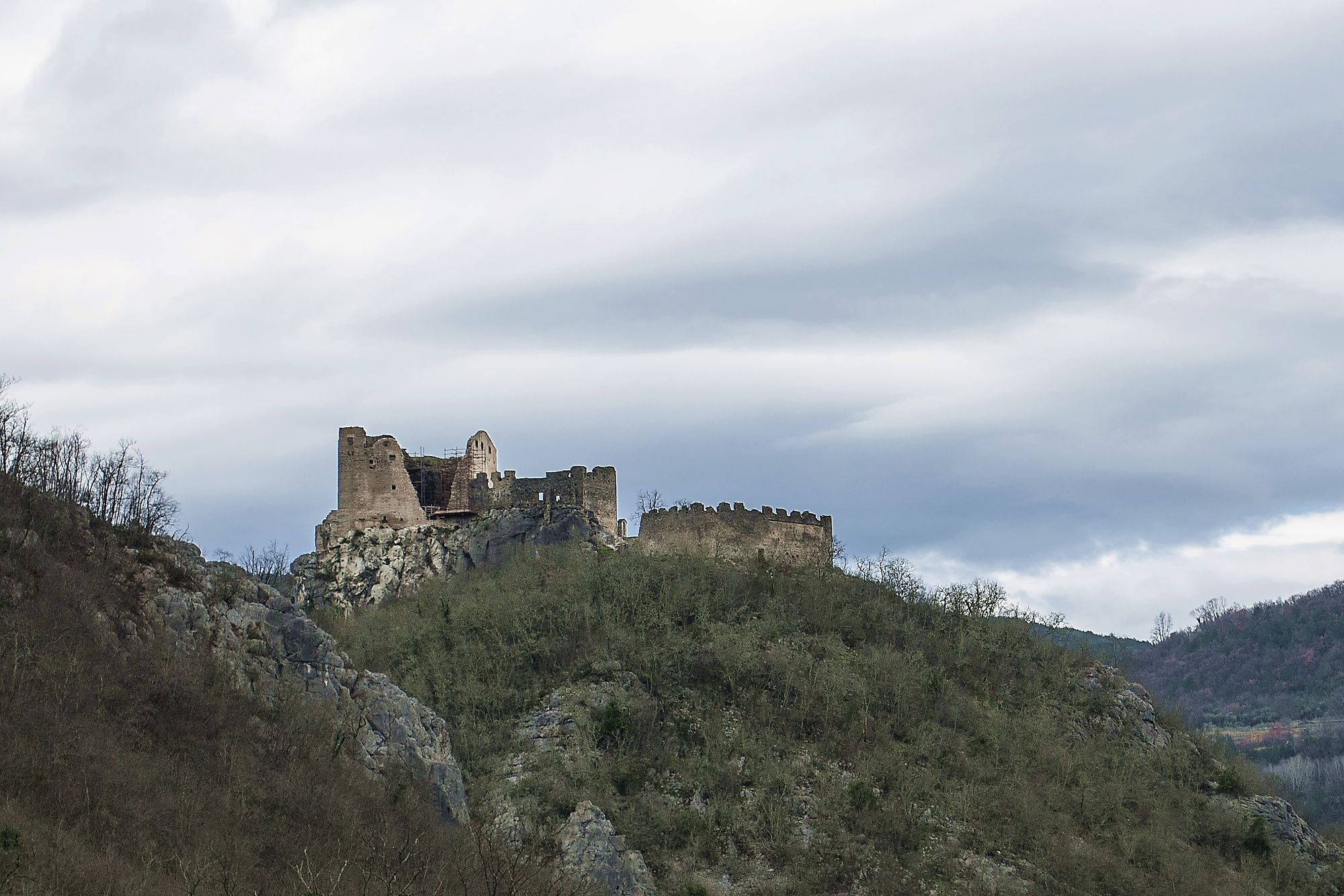
Momjan Castle
Momjan Castle stands as a remarkable testament to the medieval history and feudal power struggles of northern Istria. Perched on a rocky promontory at approximately 232 meters above sea level, the castle overlooks the Dragonja River valley, a natural border area between modern-day Croatia and Slovenia. Despite its current ruinous state, Momjan Castle's remains evoke the grandeur of a once strategically vital fortress and noble residence that shaped the region's history from the 11th century through the 19th century.
First mentioned in a 1035 imperial diploma by Emperor Henry IV, the settlement of Momjan (originally referred to as Mimiliano) quickly became an important feudal holding. The castle's construction began in earnest during the high medieval period, specifically in the first half of the 13th century, under the auspices of the Patriarchate of Aquileia and the influential Counts of Devin. The fortress was initially established by the noble family of Vošalk Devinski, whose descendants, the Momjan lords, expanded their dominion over numerous villages in Istria, the Karst region, and Friuli.
Historical significance and ownership
The castle's history is marked by frequent changes in ownership and shifting allegiances, reflecting the turbulent political landscape of medieval Istria. The Momjan lords were known for their political maneuvering, often switching sides between the Patriarchs of Aquileia and the Counts of Gorizia depending on their interests. Their influence was considerable, with members holding mayoral positions in important coastal towns and controlling an extensive network of villages.
One of the most dramatic episodes in the castle's history occurred in 1267 when Biakino Momjanski was murdered by rivals from the neighboring Pietrapelosa lordship, sparking a series of violent feuds. In the early 14th century, the castle's allegiance shifted towards the Venetian Republic, although this alliance was short-lived due to subsequent conflicts. The fortress was briefly seized by Venice and later granted as a fief to various noble families, including the Prampero family and the Counts of Gorizia.
Following the death of Albert IV, Count of Gorizia, in 1374, the castle and its lands came under Habsburg control. During this period, the fortress was held by the Chiara and Paradaiser families as imperial vassals. The barons Ravnak also maintained lordship until Venetian forces occupied the region in 1508. In 1510, the castle was incorporated into the jurisdiction of the town of Piran, which stationed a small garrison to oversee the area.
Architectural features and renovations
Momjan Castle was originally designed as a hill castle with defensive walls adapted to the natural rocky terrain. Its elevated position provided commanding views over the valley, a strategic advantage for surveillance and defense. The castle's layout included a trapezoidal shape with a prominent square tower, which was later converted into residential quarters by the Counts Rota in the 16th century.
The castle chapel dedicated to Saint Stephen is a notable architectural and historical feature, first mentioned in documents dating back to 1327. This chapel served as a private religious space for the feudal lords and was restored during the 16th century under the stewardship of Count Simon I Rota. The Rota family also constructed a new stone bridge and undertook significant renovations to reinforce the fortress, ensuring its continued use as a noble residence until the 19th century.
The reneissance transformation under the rota family
In 1548, the castle was purchased by Simone Rota, a member of the Rota family originally from Bergamo. The Rotas were instrumental in reshaping Momjan Castle, transforming it from a purely military fortress into a more comfortable residence. Their renovations included the addition of residential quarters within the square tower and the enhancement of the castle's defensive structures. The chapel of St. Stephen was refurbished, reflecting Renaissance architectural influences.
The Rota family maintained ownership of the castle until the early 19th century. However, in 1835, they abandoned the fortress in favor of a more modern manor house in the village of Momjan, leading to the castle's gradual decline into ruin. Despite its dilapidated condition today, the castle remains a significant cultural landmark, often referred to as Rota Castle in honor of its long-term owners.
Strategic location and natural surroundings
Situated above the abyss overlooking the Dragonja River and separated from the valley by the Poganja brook, Momjan Castle's location was chosen for its natural defensive advantages. The rocky promontory at 232 meters altitude provided a formidable position to control the surrounding territory and monitor movements along the river valley, a historically important route.
The castle's proximity to the border between Croatia and Slovenia adds to its historical significance as a frontier stronghold. Its commanding views over the Dragonja valley and the surrounding hills highlight its role in regional defense and administration throughout the medieval and early modern periods.
Current condition and cultural heritage
Today, Momjan Castle stands in a ruinous state, with ivy-covered walls and remnants of its former structures marking the site. While much of the fortress has deteriorated, the ruins continue to attract visitors interested in medieval history, feudal architecture, and the complex political history of Istria. The castle's chapel of St. Stephen, although partially ruined, remains a poignant reminder of the site's religious and cultural past.
The castle's historical importance is recognized within the broader context of Croatian and Istrian heritage. Efforts to preserve and study the site contribute to understanding the feudal dynamics and architectural developments of the region. Momjan Castle's legacy endures as a symbol of medieval power, noble ambition, and the shifting tides of history in northern Istria.
Visiting momjan castle
Visitors to Momjan Castle can explore the ruins and enjoy panoramic views of the Dragonja valley and surrounding landscapes. Although the site is in ruins, it offers a unique glimpse into medieval fortification architecture and the historical narrative of Istria. The castle is accessible from the nearby village of Momjan, which also features other historical landmarks and traditional Istrian culture.
Due to its condition, visitors should exercise caution while exploring the ruins. The site is ideal for history enthusiasts, photographers, and those interested in medieval architecture. Nearby attractions include the town of Piran and other castles in the region, making Momjan Castle a valuable part of a cultural itinerary in northern Croatia.
Frequently asked questions (FAQ)
- How do I get to Momjan Castle?
- Momjan Castle is located near the village of Momjan in Istria, Croatia. Visitors can reach it by car or local roads from nearby towns such as Buje or Poreč. The castle is situated on a hill, so be prepared for a short uphill walk to the ruins.
- What is the historical significance of Momjan Castle?
- Momjan Castle was a strategic medieval fortress controlling the Dragonja valley and played a key role in the feudal power struggles of northern Istria. It was owned by several noble families, including the Devinski, Counts of Gorizia, and the Rota family, reflecting the region's complex political history.
- Can I visit the interior of Momjan Castle?
- As Momjan Castle is currently in ruins, much of the interior structures are not intact or safe for extensive exploration. Visitors can walk around the ruins and view remaining walls and the chapel, but interior access is limited due to safety concerns.
- When was Momjan Castle built?
- The earliest references to Momjan date back to 1035, with the castle's construction beginning in the first half of the 13th century. It was developed as a feudal stronghold during the high medieval period.
- Why is Momjan Castle also called Rota Castle?
- The castle is often referred to as Rota Castle because it was owned by the Rota family from the mid-16th century until the 19th century. The Rotas renovated the fortress and used it as a noble residence before moving to a manor in the village.
Information
Sources & official resources
Verify the information above using these authoritative references.
Loading map...
Visitor reviews
No reviews yet. Been here? Write the first review and help other travelers!
Write the first reviewVisited this castle? Share your experience
Your review helps other travelers and adds first-hand knowledge to our encyclopedia.