Mold Castle
Mold Castle stands as a notable example of Norman military architecture in the town of Mold, located in modern-day Wales, United Kingdom. Established in the late 11th century, this castle reflects the Norman strategy of consolidating control over newly conquered territories through the construction of motte-and-bailey fortifications. The castle's origins trace back to around 1072, when it was likely founded under the direction of Robert de Montalt, a Norman nobleman serving Hugh d’Avranches, Earl of Chester. The site was strategically chosen atop an existing earthwork, adapted to form the motte, an artificial mound that served as the primary defensive position.
The Norman foundation and early history
The castle's design typifies the motte-and-bailey form, a common Norman fortification style featuring a raised mound (motte) topped by a wooden or stone keep, accompanied by an enclosed courtyard (bailey) surrounded by a protective ditch and palisade. The name "Mold" is believed to derive either from the Montalt family or from the Old French term "mont haut," meaning "high hill," referencing the castle's prominent elevated position.
During the 12th century, Mold Castle was a focal point in the turbulent border conflicts between Norman lords and Welsh princes. In 1146, the castle was captured by Owain Gwynedd, a leading Welsh ruler of the period. Control of the castle oscillated in the following decades amid ongoing power struggles. Later, under the reign of Llywelyn ab Iorwerth (Llywelyn the Great), Mold came under more stable Welsh dominion, continuing to serve as a defensive stronghold throughout the 13th century.
Architectural features and archaeological discoveries
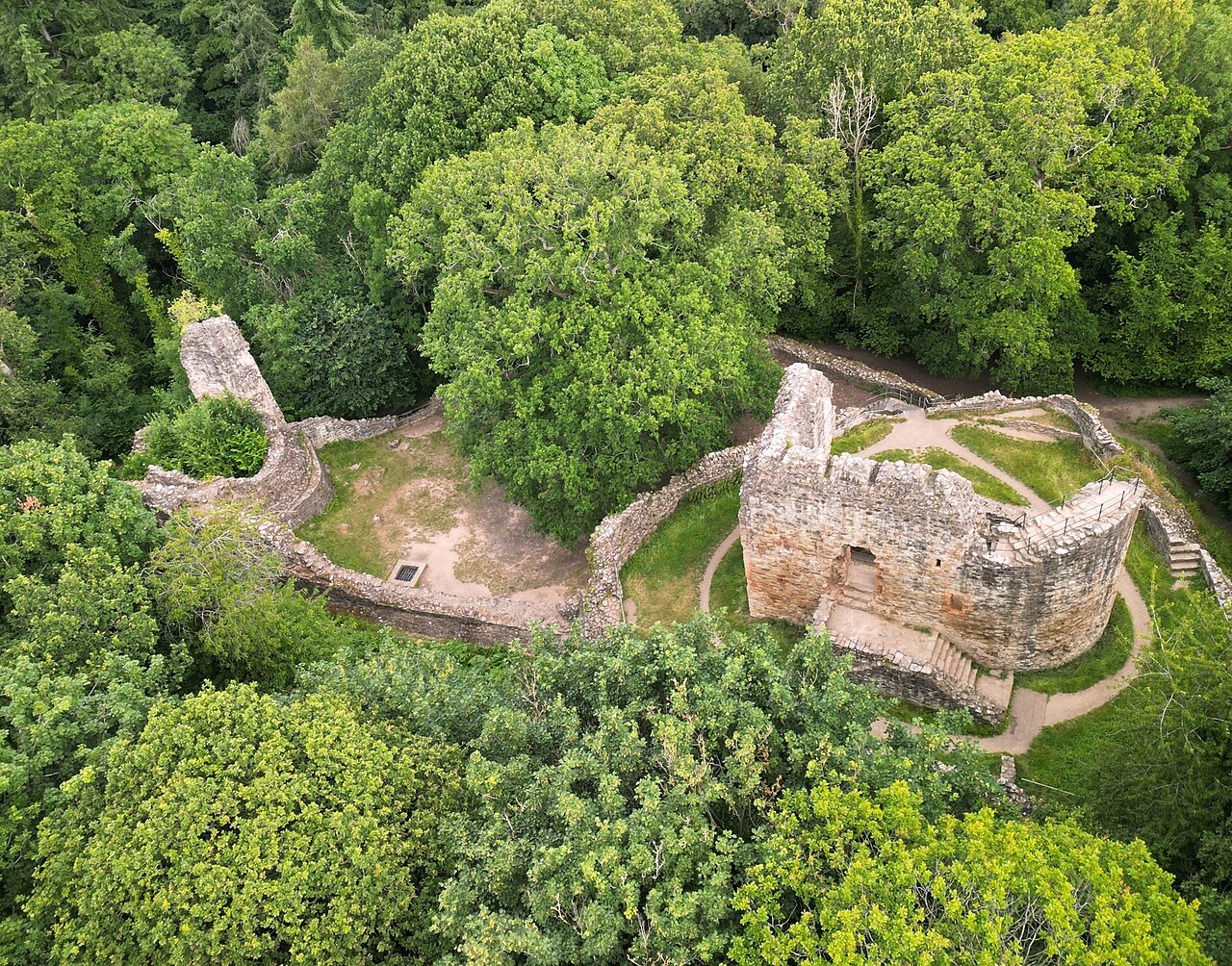
The surviving remains of Mold Castle primarily consist of the motte and the surrounding rectangular bailey. The motte is an artificial conical mound approximately 137 meters above sea level, situated near the town center and adjacent to the 15th-century St Mary’s parish church. This elevated position provided strategic oversight of the surrounding landscape.
Excavations by the Clwyd-Powys Archaeological Trust in 2020 revealed the presence of a substantial masonry wall along the inner bailey's edge. This discovery challenges earlier assumptions that the castle was primarily timber-built, indicating that stone fortifications or significant internal stone structures were part of the complex. The masonry remains suggest an evolution in the castle's defensive architecture, possibly reflecting adaptations to changing military technologies and threats.
The bailey would have housed essential buildings such as barracks, workshops, and storage facilities, protected by the defensive walls and ditches. The motte likely supported a wooden or stone keep, serving as the last refuge during attacks.
The castle's role in later historical events
Mold Castle witnessed renewed military significance during the English Civil War (1642–1651). Initially held by Parliamentarian forces, it was subsequently taken by Royalist supporters before ultimately being captured by troops loyal to Oliver Cromwell. This period marked the castle's final active military use before its decline.
Transformation into a landscape garden and public park
In the late 18th century, ownership passed to the Mostyn family, who repurposed the site from a defensive fortress into a landscaped garden. Around 1790, the motte was enclosed with a stone boundary wall, and trees were planted within the enclosure, creating a contemplative space that reflected contemporary tastes in garden design rather than military utility.
By the late 19th century, the local authorities acquired the property, and in 1890 it was incorporated into a memorial garden honoring soldiers from Mold who served in the First World War. Throughout the 20th century, the site evolved into a public park with recreational facilities including a bowling green within the inner bailey and tennis courts in the outer bailey, blending heritage preservation with community use.
Preservation and heritage significance
Today, the primary visible features of Mold Castle are the motte and the outline of the bailey, along with fragments of the stone wall discovered during archaeological investigations. The site is officially recorded in the National Monuments Record of Wales (NPRN 307119), underscoring its cultural and historical importance.
Recent restoration efforts have focused on enhancing public access and interpretive signage, allowing visitors to appreciate the castle's layered history from its Norman origins to its later adaptations. The site remains a valuable example of medieval fortification architecture and the changing uses of such sites over centuries.
Frequently asked questions (FAQ)
- When was Mold Castle originally built and by whom?
- Mold Castle was constructed around 1072, likely under the direction of Norman nobleman Robert de Montalt, acting for Hugh d’Avranches, Earl of Chester.
- What architectural style characterizes Mold Castle?
- Mold Castle is primarily a Norman motte-and-bailey fortress, featuring an artificial mound (motte) and an enclosed courtyard (bailey), with evidence of both timber and stone fortifications.
- Can visitors see remains of Mold Castle today?
- Yes, visitors can see the motte and the outline of the bailey, along with remnants of a stone wall discovered during archaeological excavations.
- How was Mold Castle used during the English Civil War?
- The castle was initially held by Parliamentarian forces, then taken by Royalists, and finally captured by Oliver Cromwell’s troops, marking its last military role.
- What changes were made to the castle site in the 18th and 19th centuries?
- The Mostyn family transformed the castle mound into a landscaped garden in the late 18th century, and later the site became a memorial garden and public park with recreational facilities.
Information
Website
Visit websiteSources & official resources
Verify the information above using these authoritative references.
Loading map...
Visitor reviews
No reviews yet. Been here? Write the first review and help other travelers!
Write the first reviewVisited this castle? Share your experience
Your review helps other travelers and adds first-hand knowledge to our encyclopedia.