
Mito Castle
Mito Castle, located in Mito, Japan, stands as a significant example of a hill castle with a rich history dating back to the early 13th century. Originally constructed in 1214 by Baba Sukemoto and initially known as Baba Castle, this fortress played a pivotal role in the region's feudal era. The Baba clan maintained control for approximately 200 years until the castle was conquered by the Edo clan, who expanded and renamed it Mito Castle.
The castle's strategic importance grew under the stewardship of Satake Yoshinobu, a retainer of Toyotomi Hideyoshi, who took possession of the castle in 1590. His tenure ended after the Battle of Sekigahara, when he was relocated to Kubota Castle in Akita Prefecture. Subsequently, Tokugawa Ieyasu's fifth son, Takeda Nobuyoshi, was appointed lord of Mito Castle, marking the beginning of the Tokugawa family's rule over the castle until the Meiji Restoration.
Architectural evolution and castle layout
The original castle constructed by Baba Sukemoto was a typical early medieval hilltop fortress designed for defense and control over the surrounding area. The Edo clan's enlargement introduced more extensive defensive features and residential quarters, transforming the castle into a more complex stronghold. The castle's layout included multiple baileys such as the sannomaru, ninomaru, and honmaru, which are typical components of Japanese castles, each serving distinct administrative and defensive purposes.
Despite extensive destruction during the Meiji Period, several structures have survived or been faithfully reconstructed in recent years. Originally, the castle featured a three-story yagura (turret) and the yakuimon gate, both of which were notable architectural elements. Unfortunately, the original yagura was destroyed by fire during World War II.
Recent reconstructions and preservation efforts
Since the early 2000s, Mito Castle has undergone significant restoration efforts aimed at reviving its historical presence. Key reconstructions include the Sakashita Gate and Sugiyama Gate in 2015, followed by the Otemon Gate in 2020 and the Ninomaru Sumiyagura turret in 2021. These restorations have enhanced the castle's visibility and appeal, making it a must-visit site for castle enthusiasts.
The Yakuimon Gate remains the symbol of Mito Castle, though it is not officially designated as a National Important Cultural Property. This is partly due to uncertainties about its original function and the replacement of its traditional thatched roof with a metal one. Nevertheless, the gate continues to represent the historical significance of the castle.
Historical significance and cultural legacy
Mito Castle's history reflects the broader political and military shifts in Japan from the early medieval period through the Tokugawa shogunate era. Its association with prominent figures such as Baba Sukemoto, Satake Yoshinobu, and members of the Tokugawa family underscores its importance as a regional power center.
The castle grounds have been adapted over time, with modern government buildings and educational institutions occupying parts of the former baileys. Notably, the Kodokan Mito Domain School is located within the sannomaru area, linking the site to the educational and cultural development of the domain.
Visitor experience and site layout
Visitors to Mito Castle today can explore the reconstructed gates and turrets, stroll along the preserved moats, and appreciate the castle's historical footprint despite urban encroachment. Informative signage throughout the grounds helps visitors understand the castle's original layout and historical context.
The castle's position on a hill provided natural defensive advantages, which were enhanced by man-made fortifications such as moats and stone walls. The surviving and reconstructed elements offer valuable insights into Japanese castle architecture and feudal history.
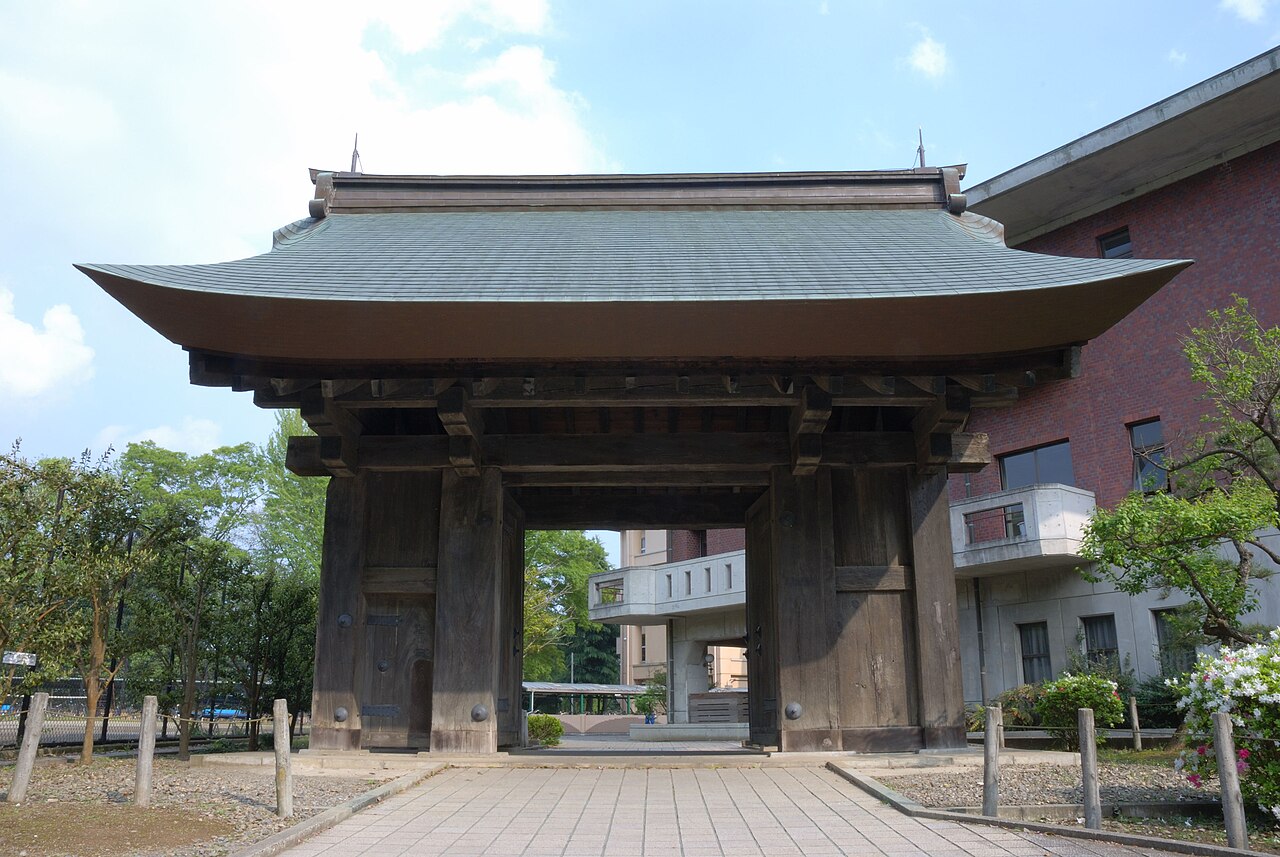
Photo by by Monado • CC BY-SA 2.5
Architectural style and classification
Mito Castle is classified as a hill castle, a common type of Japanese castle built on elevated terrain to maximize defensive capabilities. Its architectural style reflects the high medieval period of Japanese castle construction, characterized by wooden structures, stone foundations, and strategic use of natural topography.
The castle's design integrates multiple baileys and defensive gates, typical of the period's castle architecture. The reconstructed gates and turrets showcase traditional Japanese craftsmanship and castle-building techniques.
Current condition and preservation status
Today, Mito Castle is partially preserved, with several key structures reconstructed to approximate their historical appearance. The original three-story yagura no longer exists, having been lost during World War II, but the reconstructions provide a tangible connection to the castle's past.
The site remains an important cultural heritage location, attracting historians, architects, and tourists interested in Japan's feudal history and castle architecture.
Frequently asked questions (FAQ)
- How do I get to Mito Castle?
- Mito Castle is located in the city of Mito, Ibaraki Prefecture, and is accessible by public transportation including train and bus services. The castle grounds are within walking distance from Mito Station, making it convenient for visitors to reach.
- What are the opening hours of Mito Castle?
- The castle grounds and reconstructed gates are generally open to the public during daylight hours, though specific opening times may vary. Visitors are advised to check local tourism websites or contact the municipality for the latest information.
- Is there an admission fee to visit Mito Castle?
- Access to the castle grounds and the reconstructed gates is typically free of charge, allowing visitors to explore the historic site without an entrance fee. Special exhibitions or events may have separate charges.
- What remains of the original Mito Castle?
- Most original buildings of Mito Castle were destroyed during the Meiji Period and World War II. The original three-story yagura was lost to fire in WWII, but the Yakuimon Gate remains and several gates and turrets have been reconstructed to reflect the castle's historical layout.
- Can I visit the reconstructed gates and turrets?
- Yes, visitors can explore several reconstructed gates including the Sakashita Gate, Sugiyama Gate, Otemon Gate, and the Ninomaru Sumiyagura turret. These reconstructions offer insights into the castle's architectural style and defensive features.
- Why is Mito Castle historically important?
- Mito Castle played a crucial role in regional governance and military strategy from its construction in 1214 through the Tokugawa shogunate. It was associated with notable historical figures such as Baba Sukemoto, Satake Yoshinobu, and the Tokugawa family, reflecting Japan's feudal history.
- Is Mito Castle accessible for visitors with mobility issues?
- The castle grounds include some paved paths and open spaces, but certain areas may have uneven terrain or steps. Visitors with mobility concerns should plan accordingly and may contact local tourist information centers for accessibility details.
Photo gallery

Information
Opening hours
Sumiyagura is open 9:30-16:00, free; closed Dec. 29 - Jan. 3
Current owner
Municipality
Website
Visit websiteSources & official resources
Verify the information above using these authoritative references.
Loading map...
Visitor reviews
No reviews yet. Been here? Write the first review and help other travelers!
Write the first reviewVisited this castle? Share your experience
Your review helps other travelers and adds first-hand knowledge to our encyclopedia.