Mirabello Castle
Mirabello Castle is a historically significant fortress located in Mirabello di Pavia, within the area once known as the Parco Visconteo in northern Italy. This castle, originally constructed in the 14th century, served as the administrative center for the Captain of the Park, overseeing the extensive hunting grounds and agricultural lands of the Visconti family, one of the most powerful dynasties in medieval Lombardy. Although today only a wing of the original structure remains, Mirabello Castle offers a fascinating glimpse into the architectural and cultural developments of the late medieval and early Renaissance periods in northern Italy.
The site where Mirabello Castle stands has a layered history. Before the castle's construction, the area was occupied by a Cistercian monastery dating back to the 12th century. This religious presence marked the early significance of the location. Between 1325 and 1341, the affluent Fiamberti family of Pavia built the initial castle on this site, transforming the former monastic lands into a fortified noble residence.
The Visconti acquisition and the Parco Visconteo
In the 1360s, the castle and surrounding lands were acquired by Galeazzo II Visconti, who integrated Mirabello Castle into the expansive Parco Visconteo. This park was a vast hunting and leisure estate that connected the Visconti Castle in Pavia with the nearby Charterhouse of Pavia, founded by Gian Galeazzo Visconti at the end of the 14th century. Mirabello Castle became the seat of the Captain of the Park, an official appointed by the Visconti family to manage the park's resources, including its mills, vineyards, and game reserves.
Role and significance within the park
The castle's administrative function was crucial for maintaining the park's economic and recreational activities. It oversaw agricultural production and organized hunting expeditions, which were important for the social and political life of the Visconti court. The castle also hosted ducal officials and served as a symbol of the Visconti family's territorial control in the region.
Architectural evolution and expansions
During the early 15th century, under Filippo Maria Visconti, the castle underwent significant transformations. In 1425, a new ducal residence was constructed, replacing the deteriorated original structure from the 14th century. This redevelopment reflected the changing needs and tastes of the ruling family.
Later, in 1472, Galeazzo Maria Sforza expanded the castle to better accommodate formal ducal functions such as hunts and banquets. These enhancements elevated the castle's status as a noble residence and reinforced its role within the park.
Around 1491, the castle was gifted to Galeazzo Sanseverino, a prominent nobleman and military leader. Sanseverino undertook further modernization and expansion efforts, converting the castle into a refined country estate. These works continued intermittently until 1521, reflecting the evolving architectural styles and the owner's political prominence.
Architectural features of the surviving wing
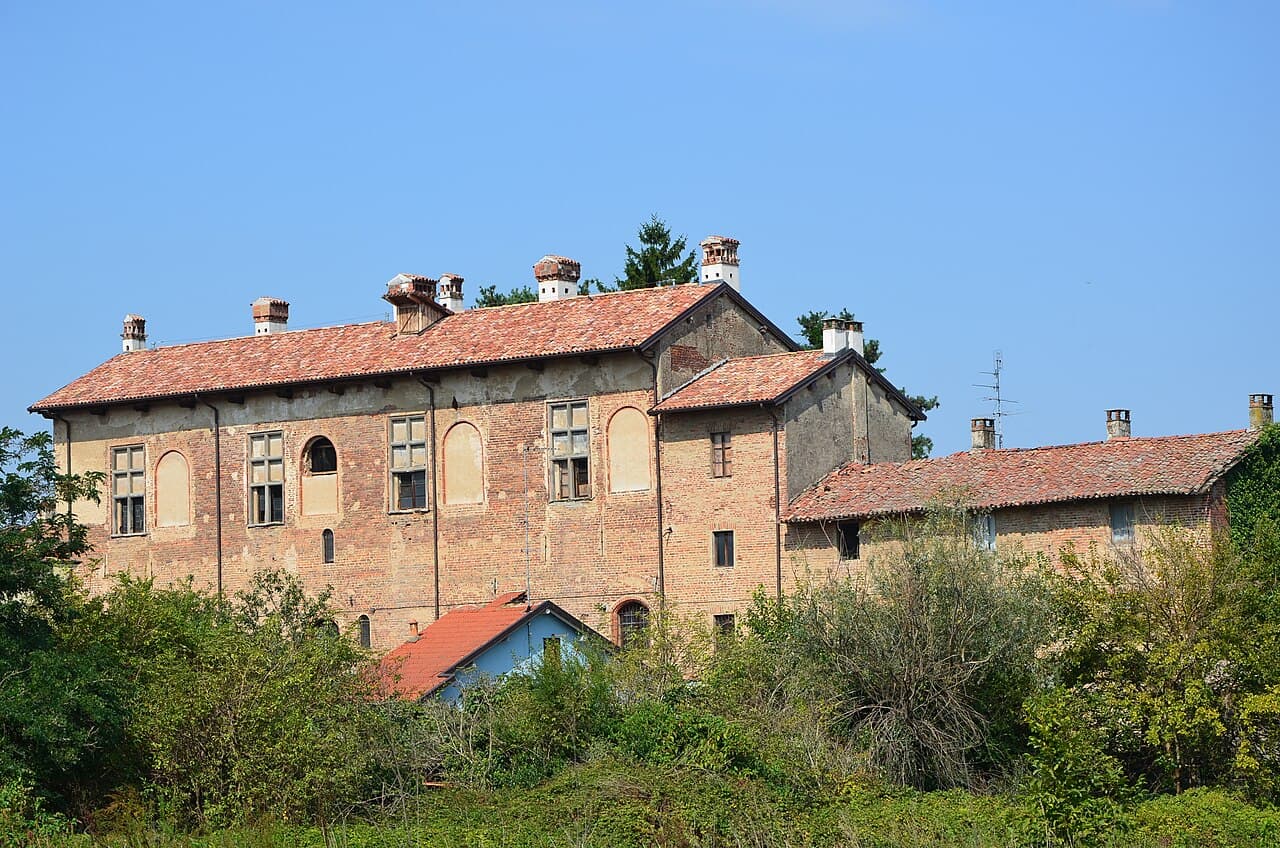
Today, only one wing of the original Mirabello Castle remains, showcasing a blend of late medieval and early Renaissance architectural elements. The internal facade features a balcony supported by shaped corbels, a design element also found in Milan's Castello Sforzesco and the Vigevano castle tower. This regional architectural language highlights the cultural exchanges within Lombardy during this period.
The surviving facades display rectangular windows framed in stone, arranged in a "double cross" pattern. These replaced earlier brick-arched openings typical of Lombard construction and show influences from late French Gothic styles, similar to the window designs at Issogne Castle in Italy.
On the noble floor, the castle features monumental chimney caps decorated with stucco motifs centered on the fleur-de-lis, a symbol associated with France. These chimney caps are framed by thick molded cornices, contrasting with the simpler Renaissance chimneys on the ground floor.
Inside, original frescoes remain mostly hidden beneath plaster layers. However, restoration uncovered a painted and engraved Sanseverino family coat of arms on the ground floor, emphasizing the castle's connection to its notable owners. Additional painted decoration survives on the first floor, including chiaroscuro bands beneath the ceilings depicting winged cherubs, crown-supporting cornucopias, spiral patterns, ceramics, and candelabras.
Historical events and later history
Mirabello Castle played a role in several significant historical events. During the early 16th century, it suffered damage in 1522 amid the French siege of Pavia. The castle also housed King Francis I of France during the pivotal Battle of Pavia in 1525. Galeazzo Sanseverino died fighting alongside the French in this battle, marking a dramatic moment in the castle's history.
After the battle, the castle remained under the jurisdiction of the Ducal Chamber and continued to be managed by appointed captains responsible for the upkeep of the park. In 1754, it was sold to the Milanese noble Antonio Giorgio Clerici, and later, in 1768, transferred to the San Matteo Hospital of Pavia. Under hospital ownership, the castle's function shifted from noble residence to utilitarian uses such as a farmhouse, tavern, school, and municipal offices.
Between 1854 and 1860, significant portions of the castle were demolished, removing about one-third of the original structure. In the 20th century, the remaining wing was adapted into eight single-family apartments, reflecting changing residential needs.
In 2002, the municipality of Pavia acquired the castle with plans to convert it into a museum dedicated to the Battle of Pavia, preserving its historical legacy and architectural heritage.
Architectural and cultural legacy
Originally, Mirabello Castle was enclosed within the fortified Parco Visconteo, which featured walls, towers, and a long tree-lined avenue called the Corso. This avenue connected the castle with the main Visconti Castle in Pavia and was used for horse racing and leisure activities associated with the hunting park.
The surviving wing of the castle displays heraldic symbols prominently, including two coats of arms featuring the French fleur-de-lis and the Sanseverino family emblems. These symbols serve as visible reminders of the castle's noble patrons and its position within the broader European cultural context.
Despite the loss of much of the original structure, Mirabello Castle remains an important architectural and historical site. It illustrates the evolution of noble residences in Lombardy from medieval fortifications to Renaissance country estates. The castle's connections to the Visconti and Sforza families, along with its role in regional history, make it a valuable subject for study and preservation.
Frequently asked questions (FAQ)
- How do I visit Mirabello Castle?
- Mirabello Castle is located in Mirabello di Pavia and can be visited by contacting the Municipality of Pavia for access information. It is part of the Parco Visconteo area, and visiting hours may vary depending on special events or museum openings.
- What is the historical significance of Mirabello Castle?
- Mirabello Castle was the administrative center for the Captain of the Park during the Visconti and Sforza periods. It played a role in the Battle of Pavia in 1525 and reflects the architectural evolution from medieval fortifications to Renaissance estates.
- Can I see original frescoes at Mirabello Castle?
- Some original frescoes remain beneath plaster layers, with restoration uncovering painted coats of arms and decorative bands. However, much of the interior decoration is not fully visible to the public.
- Is Mirabello Castle accessible for visitors with disabilities?
- Accessibility may be limited due to the castle's age and partial preservation. Visitors are advised to inquire in advance with the Municipality of Pavia regarding accommodations and access.
- When was Mirabello Castle built and by whom?
- The original castle was built between 1325 and 1341 by the Fiamberti family of Pavia on the site of a former Cistercian monastery.
Photo gallery

Information
Current owner
Municipality of Pavia
Loading map...
Visitor reviews
No reviews yet. Been here? Write the first review and help other travelers!
Write the first reviewVisited this castle? Share your experience
Your review helps other travelers and adds first-hand knowledge to our encyclopedia.