Mir Castle
Mir Castle, located in Hrodna, Belarus, stands as one of the most remarkable examples of a Renaissance hill castle in Eastern Europe. Its construction began at the end of the 15th century under the auspices of Duke Yuri Ilyinich, who initiated the fortress in a Gothic architectural style. Over the centuries, the castle evolved, incorporating Renaissance and later Baroque elements, reflecting the complex cultural and political history of the region.
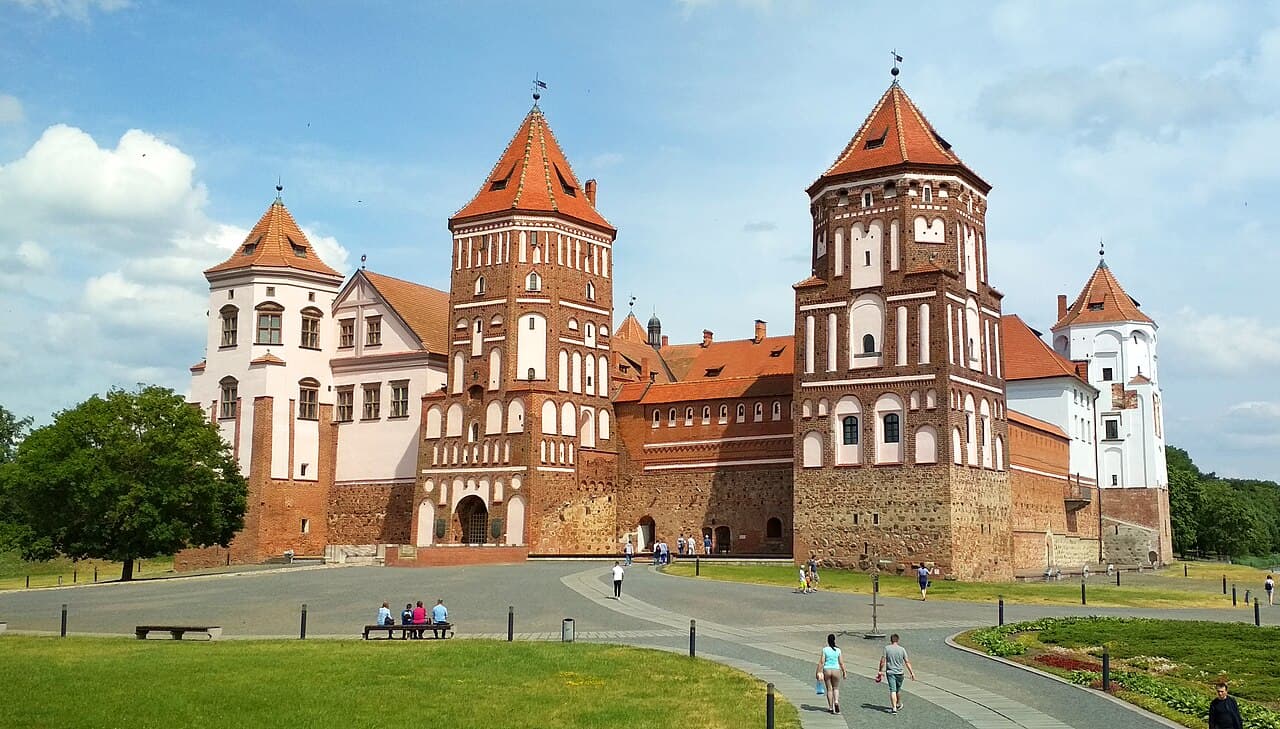
The castle’s nearly square layout, measuring approximately 75 meters on each side, is fortified by massive walls about 13 meters high and 3 meters thick. These walls are an impressive example of three-layer masonry, combining clinker bricks and rough boulders with a core of smaller stones bound by lime mortar. The exterior is adorned with intricate Gothic brick patterns, niches, pilasters, and decorative brick belts, highlighted by contrasting whitewashed sections.
Architectural features and fortifications
Defensive walls and towers
The castle is anchored by five massive towers, each rising between 25 and 27 meters tall. These towers feature a distinctive design, starting with a square base that transitions into an octagonal upper section. This form was a tactical innovation, allowing defenders to cover the curtain walls effectively with crossfire. The southwest tower remains particularly well-preserved, showcasing five floors with cannon openings, vaulted ceilings, and an early mechanical system resembling a castle lift using ropes and pulleys for moving supplies vertically.
The western gate tower
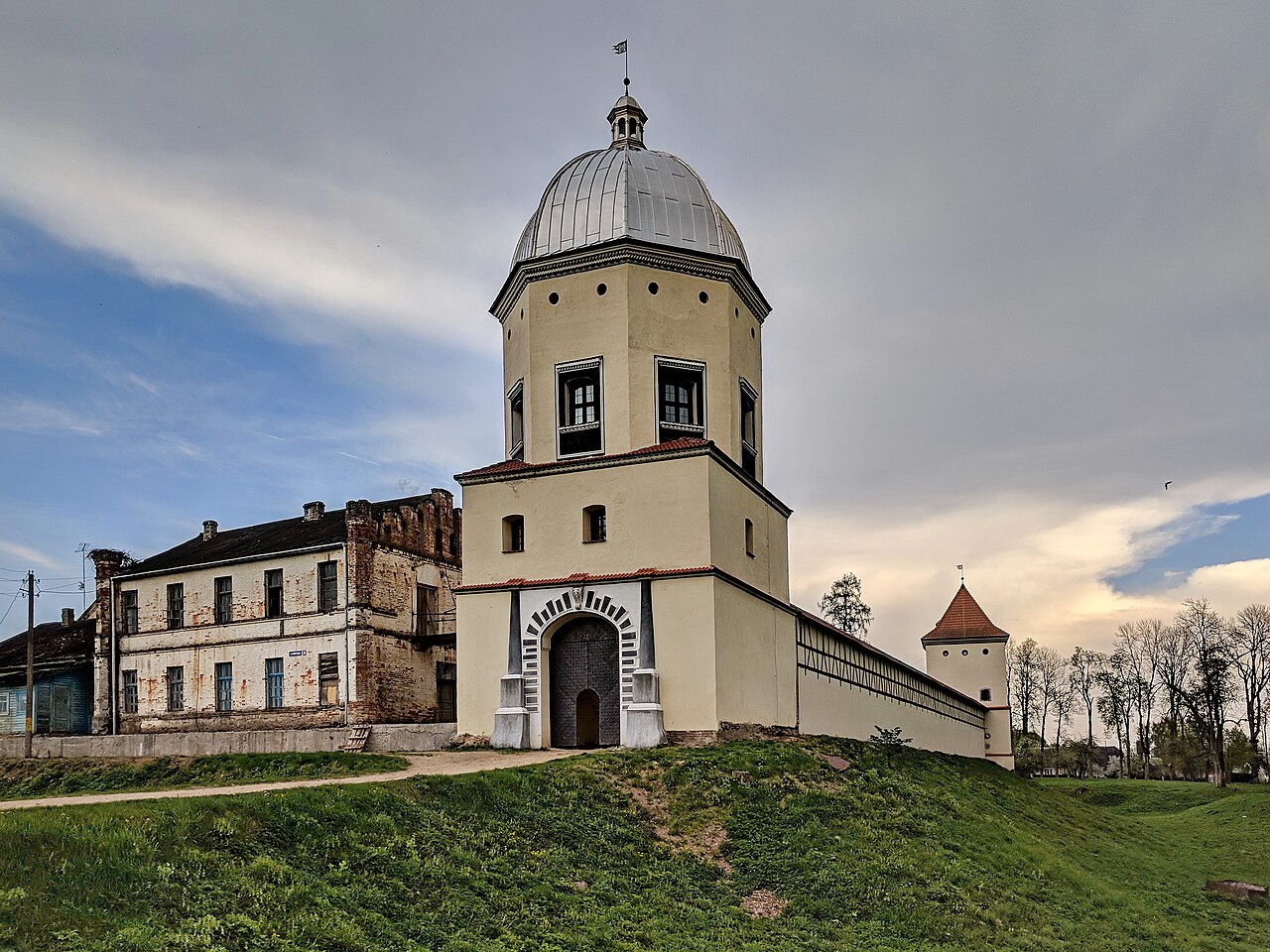
The western gate tower is the architectural centerpiece of Mir Castle. It stands six stories tall on a 12 by 12-meter foundation. The facade combines local stone and brick with Gothic and Renaissance motifs, including ornamental brick bands. Inside, it housed a chapel dedicated to St. Christopher on the second floor, and prison cells on the upper and lower levels. A large clock with an external dial decorates the third floor, symbolizing both the castle’s administrative importance and its role as a community landmark.
Interior buildings and courtyard
Within the fortress walls, residential and administrative buildings developed over time from simple one-story brick structures into elaborate three-story palaces. These buildings feature vaulted cellars, richly decorated rooms with parquet floors, gilded coffered ceilings, colorful painted friezes, glazed tile stoves, and intricately carved wooden doors framed by profiled stone surrounds. The upper floors served as private quarters for the castle’s owners, furnished with luxury and fine artworks, while the lower floors were used for administration and storage.
Historical context and ownership
Founding and early ownership
The castle was founded by Duke Yuri Ilyinich in the early 16th century, marking the first stone fortress privately owned in these lands. It remained under the Ilyinich family until 1568, when it passed to the powerful Radziwiłł family. The Radziwiłłs owned Mir Castle for nearly three centuries, during which time the castle saw numerous military conflicts, including the Russo-Polish War (1654–1667). The fortress endured significant attacks in 1665 and 1706 and suffered damage during the 1794 uprising.
19th and 20th centuries
In the 19th century, the castle played a role in the 1812 Patriotic War against Napoleon’s invasion, witnessing skirmishes near its walls. After the Radziwiłł family, ownership passed to the Wittgenstein family and later to the Svyatopolk-Mirsky princes. The castle was abandoned for a time and suffered damage during the Napoleonic wars. Restoration efforts began in the late 19th century under architect Teodor Bursze, commissioned by Prince Mikhail Svyatopolk-Mirsky.
During World War II, the castle was occupied by German forces and tragically used as a ghetto for the local Jewish population before their liquidation. Post-war, the castle was repurposed for housing and workshops, which led to interior damage. Comprehensive restorations resumed in the late 20th century, transforming Mir Castle into a museum and cultural center.
Landscape and additional structures
Defensive earthworks and moats
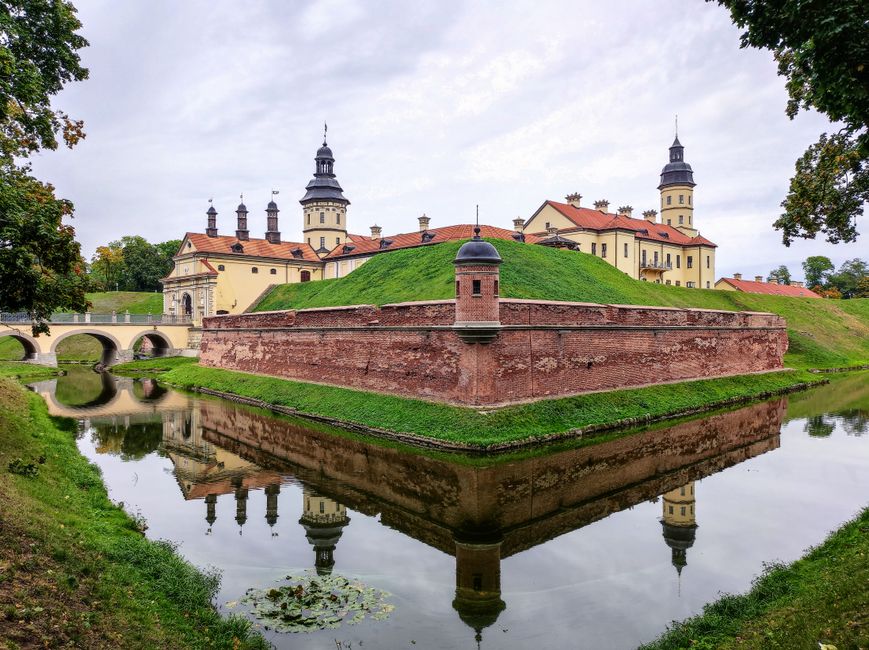
Surrounding the fortress is a system of defensive earthworks resembling Dutch-style bastions, constructed in the early 17th century. These ramparts rise about nine meters high and form angled bastions at the corners. A series of moats filled with water from the nearby Miranka River encircle the castle, creating ponds that served both defensive and practical purposes, including powering watermills.
Chapel-tomb and park
Approximately half a kilometer east of the castle lies the Svyatopolk-Mirsky family chapel-tomb, built between 1904 and 1910 in the Empire style. This chapel features a rectangular layout with a five-sided apse, a three-tier bell tower, and a richly decorated facade adorned with a multicolored mosaic of Christ Pantocrator and the family coat of arms. Nearby, a small roadside chapel commemorates Vladimir Zaslavsky, characterized by plastered whitewashed walls and a copper roof topped with a cross.
The castle grounds originally included Italian Renaissance-style gardens with alleys, basins, greenhouses, and ponds. These were later transformed into an English landscape park featuring native and exotic trees. Despite centuries of damage, portions of these historic gardens remain visible today.
Archaeological and restoration efforts
Excavations and findings
Archaeological investigations beginning in 1912 uncovered layers of occupation, including foundations of a former barbican and traces of 15th-century settlements destroyed by fire. Excavations revealed colorful polychrome tiles, fragments of stained glass, and structural components that have informed restoration and museum exhibits. Some foundations extend four to five meters below the surface, illustrating the site's long history.
Preservation and modern adaptations
Restoration efforts have focused on preserving the castle’s historic fabric while adapting parts of the upper floors into hotel accommodations without compromising interiors. Modern technical equipment is discreetly housed in underground annexes, and intelligent building systems have been integrated to ensure visitor comfort and conservation standards.
Today, Mir Castle stands as a testament to the region’s rich history, architectural evolution, and cultural heritage. Its harmonious blend of Gothic, Renaissance, and Baroque styles, combined with its strategic defensive features and noble lineage, make it a prominent monument in Belarus and a UNESCO World Heritage Site since 2000.
Frequently asked questions (FAQ)
- How do I get to Mir Castle?
- Mir Castle is located in Hrodna, Belarus, and can be accessed by car, public transport, or guided tours. The nearest major city is Minsk, which is approximately 150 kilometers away. Local bus services run regularly from Hrodna to the castle, making it convenient for visitors.
- What is the historical significance of Mir Castle?
- Mir Castle is a UNESCO World Heritage Site, recognized for its architectural and historical importance. Built in the 16th century, it showcases a blend of Gothic, Renaissance, and Baroque styles. The castle has served various purposes over the centuries, including as a fortress and a noble residence.
- When was Mir Castle built?
- Construction of Mir Castle began in the early 16th century, around 1522, and it was completed in the late 16th century. Its construction was commissioned by the Ilinich family, and it reflects the wealth and power of the Polish-Lithuanian nobility during that era. The castle has undergone several renovations since its initial completion.
- Can I take guided tours of Mir Castle?
- Yes, guided tours are available and highly recommended for a comprehensive understanding of the castle's history and architecture. Tours typically last around one hour and cover key areas, including the castle's interior and the surrounding grounds. Audio guides are also available for those who prefer to explore at their own pace.
- Why is Mir Castle considered a masterpiece of architecture?
- Mir Castle is celebrated for its unique architectural style, which combines elements from various periods, including Gothic, Renaissance, and Baroque influences. Its impressive towers, fortified walls, and intricate decorative details make it a prime example of Belarusian architecture. The castle's layout and design reflect the historical context of its construction and the artistic trends of its time.
- Is it possible to host events at Mir Castle?
- Yes, Mir Castle offers facilities for hosting various events, including weddings, conferences, and cultural activities. The picturesque setting and historical ambiance make it a popular choice for special occasions. Interested parties should contact the castle administration for more information on booking and services.
- What are the opening hours of Mir Castle?
- Mir Castle is open to visitors year-round, with varying hours depending on the season. Generally, the castle opens at 10 AM and closes at 6 PM, but it's advisable to check the official website for the most current hours and any seasonal changes. Special events may also affect regular opening times.
- What are the ticket prices for visiting Mir Castle?
- Ticket prices for Mir Castle vary depending on the type of tour and age of the visitor. Generally, adult tickets are around 10 Belarusian Rubles, while discounts are available for students and seniors. Be sure to check for any special promotions or group rates when planning your visit.
- When is the best time to visit Mir Castle?
- The best time to visit Mir Castle is during the spring and early autumn months when the weather is pleasant, and the surrounding gardens are in full bloom. Summer can also be a good option, but it tends to be busier with tourists. Visiting during weekdays is often less crowded, allowing for a more enjoyable experience.
- Are there any nearby attractions to visit after Mir Castle?
- Yes, there are several nearby attractions worth exploring, such as the village of Mir, which is rich in history and culture. You can also visit the nearby Nesvizh Castle, another UNESCO World Heritage Site, which is a short drive away. The beautiful landscapes and local parks offer great opportunities for relaxation and exploration.
Photo gallery

Information
Website
Visit websiteSources & official resources
Verify the information above using these authoritative references.
Loading map...
Visitor reviews
No reviews yet. Been here? Write the first review and help other travelers!
Write the first reviewVisited this castle? Share your experience
Your review helps other travelers and adds first-hand knowledge to our encyclopedia.