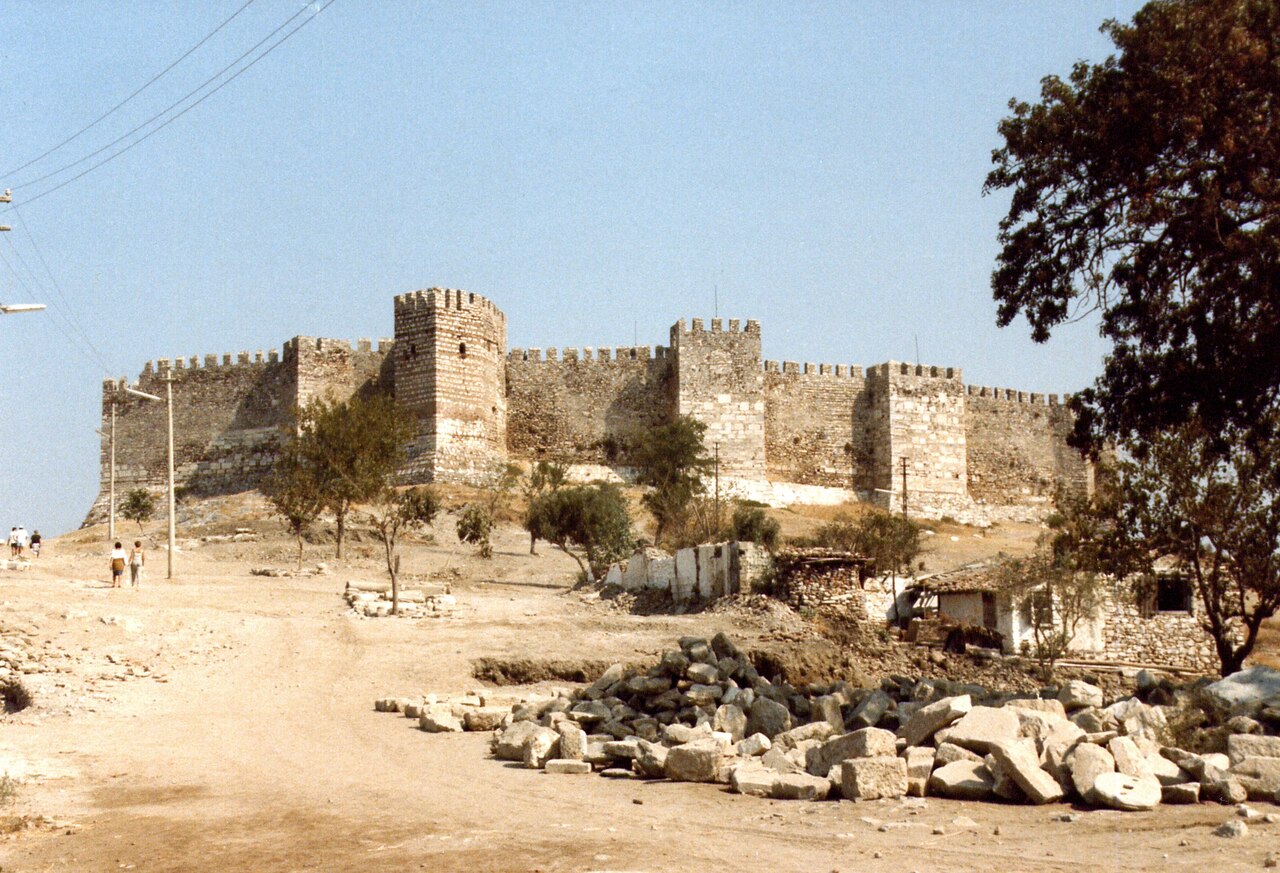
Metropolis Castle
Metropolis Castle, locally known as Metropolis Kalesi, is a historic fortress located on a hillside between the villages of Özbey and Yeniköy in the province of Izmir, Turkey. This castle is notable for its unique position atop the ruins of the ancient Greek city of Metropolis, blending Byzantine military architecture with the remnants of classical antiquity.
Historical context and strategic importance
The castle was constructed during the late medieval period, specifically in the 14th century, by the Byzantines as a defensive measure against frequent Arab raids into Byzantine territory. The location was strategically chosen on the old acropolis of the ancient city, which provided a natural defensive advantage. This site was part of a broader network of fortifications aimed at securing the western Anatolian coast and inland regions during a time of political fragmentation and external threats.
Architectural features and construction
Metropolis Castle was built primarily using rubble work masonry, a common technique in Byzantine fortifications, which involved the use of rough stones set in mortar. Importantly, the builders incorporated spolia—building materials quarried from the ruins of the ancient Greek city below—into the castle's walls. This reuse of materials not only provided structural resources but also connected the medieval fortress with the classical heritage of the site.
The castle's layout includes an upper bailey formed by the fortified acropolis of the ancient city. From this elevated position, two curtain walls descend the hillside, terminating in two square towers that flank a lower bailey. These towers were integral to the castle's defense, although today they are inaccessible to visitors. The entrance gate is uniquely situated on the remains of the ancient city's bouleuterion (council house), highlighting the integration of ancient civic structures into the medieval fortress design.
Reuse of ancient elements
The reuse of ancient architectural elements is a defining characteristic of Metropolis Castle. Notably, a nearly complete marble statue was discovered embedded within the southern curtain wall, illustrating the practice of spolia and the blending of cultural layers at the site. This statue was carefully removed for preservation, emphasizing the archaeological significance of the castle's fabric.
Transition to Beylik of Aydın control
In the 14th century, the castle and its surrounding area came under the control of Gazi Mehmed Bey, the founder of the Beylik of Aydın, a Turkish principality that emerged in western Anatolia following the decline of Byzantine authority. This political shift led to the depopulation of Metropolis, with the remaining inhabitants relocating to the nearby town of Torbalı. The castle's military role diminished as the region's political landscape evolved.
Current condition and archaeological significance
Today, the physical remains of Metropolis Castle are modest and may not impress those expecting grand medieval fortifications. The two square corner towers remain standing but are not accessible to visitors. However, the true value of the site lies in the visible integration of the castle with the underlying ancient city ruins, which form an archaeological park open to the public during daylight hours without an entrance fee.
The archaeological park surrounding the castle includes significant remains of the ancient Greek city, such as public buildings, streets, and other urban structures, offering a rare glimpse into the continuous occupation and adaptation of this site from antiquity through the medieval era.
Visiting Metropolis Castle and archaeological park
Visitors to Metropolis Castle can explore the hillside site, appreciating both the medieval fortifications and the ancient Greek ruins. The site is accessible during the daytime and entry is free, making it an attractive destination for those interested in Byzantine military architecture, ancient Greek urbanism, and the layered history of western Anatolia.
While the castle itself offers limited structural remains, the combined experience of the fortress and the archaeological park provides valuable insights into the region's historical transitions and architectural evolution.
Frequently asked questions (FAQ)
- What is the historical significance of Metropolis Castle?
- Metropolis Castle was built by the Byzantines in the 14th century as a defense against Arab raids, constructed over the ancient Greek city of Metropolis, reflecting a blend of medieval and classical heritage.
- Can I visit Metropolis Castle and the archaeological park?
- Yes, the archaeological park including Metropolis Castle is open during daylight hours and entry is free, allowing visitors to explore both the medieval fortress and ancient Greek ruins.
- What architectural features does Metropolis Castle have?
- The castle features an upper bailey on the ancient acropolis, two descending curtain walls ending in square towers, and a gate located on the remains of the ancient bouleuterion.
- Is it possible to enter the towers of Metropolis Castle?
- No, the two square corner towers of Metropolis Castle are not accessible to visitors due to their current condition.
- Who controlled Metropolis Castle after the Byzantines?
- In the 14th century, the castle was taken over by Gazi Mehmed Bey, founder of the Beylik of Aydın, marking a shift in regional power.
Information
Loading map...
Visitor reviews
No reviews yet. Been here? Write the first review and help other travelers!
Write the first reviewVisited this castle? Share your experience
Your review helps other travelers and adds first-hand knowledge to our encyclopedia.