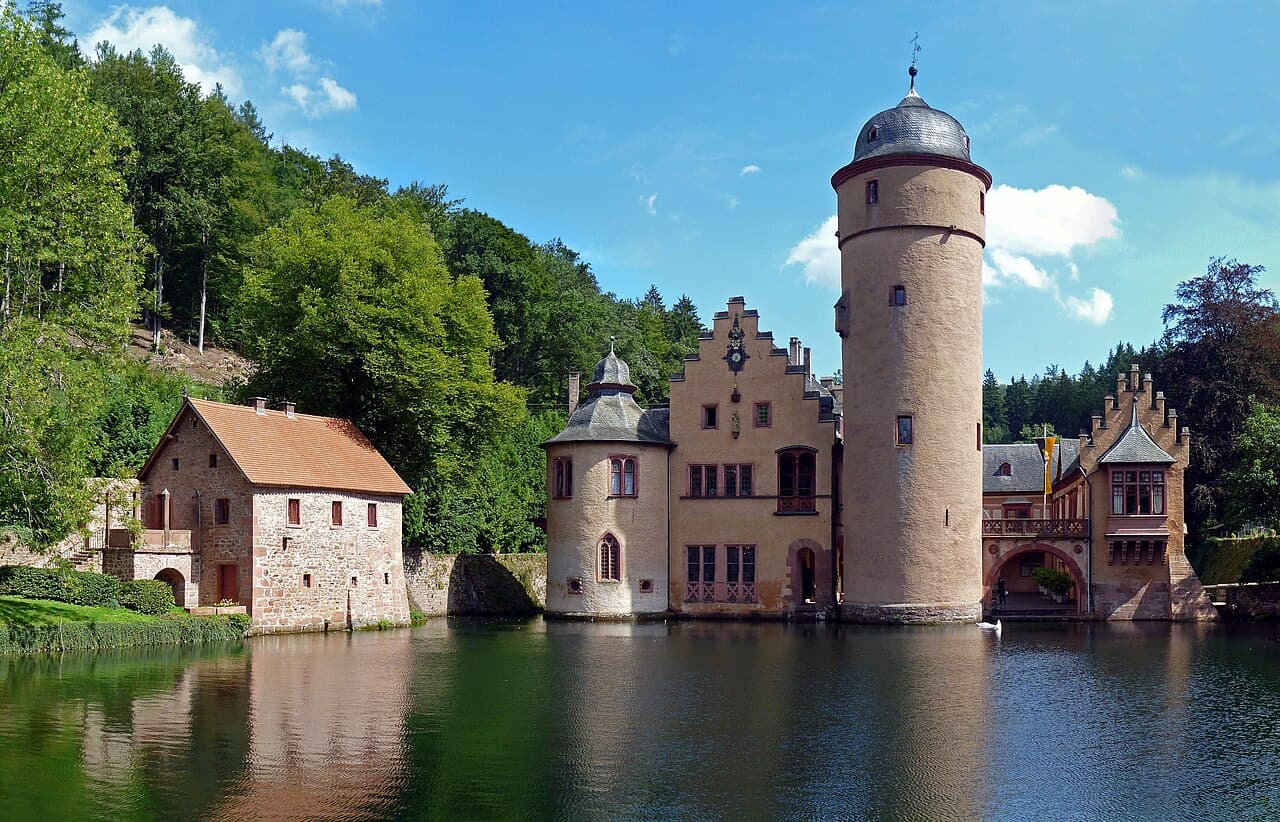
Mespelbrunn Castle
Mespelbrunn Castle, locally known as Schloss Mespelbrunn, is a remarkable example of a Renaissance water castle nestled in the secluded Spessart forest of Bavaria, Germany. Situated south of the village of Mespelbrunn in a tributary valley of the Elsava river, this castle is renowned for its picturesque moat and its well-preserved architectural heritage, making it a popular destination for visitors interested in medieval and Renaissance history.
The origins and early history of mespelbrunn castle
The site of Mespelbrunn Castle began as a simple, unfortified manor house built shortly after 1412 by Hamann Echter, a forest master and knight who served the Archbishop of Mainz. This initial structure was located next to a small lake in a wild and densely forested area that was known as a refuge for bandits and Hussite raiders. Due to the dangerous surroundings, Hamann's son transformed the manor into a fortified castle by 1427, adding defensive walls, towers, and a moat fed by the nearby water source. The only surviving element from this medieval phase is the imposing round bergfried tower, which served as a keep and lookout.
Strategic importance and feudal ties
In 1435, the castle was placed under the feudal tenure of the Archbishopric of Mainz, reflecting the political and military importance of controlling this region against rival noble families such as the Counts of Rieneck. The castle's remote location in the Spessart forest provided natural protection and helped it escape damage during later conflicts.
Renaissance transformation and architectural features
Between 1551 and 1569, Peter III Echter of Mespelbrunn and his wife Gertrud von Adelsheim undertook a comprehensive reconstruction of the castle, transforming it from a medieval fortress into a Renaissance-style noble residence. This renovation included the addition of two-story residential wings enclosing a courtyard on three sides and richly decorated facades featuring sculptural reliefs, coats of arms, and ornamental capitals with angel heads, masks, and rosettes. The northern wing, with its stepped gables and courtyard-facing loggia, exemplifies Renaissance aesthetics and craftsmanship.
Architectural layout and key structures
- The castle is built on an almost square plan on the eastern shore of a pond formed by the Krebsbach stream.
- The central feature is the round bergfried tower with a high entrance, dating to the 15th century.
- Two round towers at the northeastern and southwestern corners enhance the castle's fortified appearance.
- The southern wing, containing the main entrance, was extended with Baroque elements, including a large oriel window and stepped gable.
- A romantic arcade and tracery gallery connect the bergfried to the southern wing, creating an enchanting courtyard opening to the pond.
Historical significance and notable figures
Julius Echter von Mespelbrunn, born at the castle in 1545, was one of the most prominent members of the Echter family. As Prince-Bishop of Würzburg, he was a leading figure of the Counter-Reformation, founding the Juliusspital hospital in 1576 and re-founding the University of Würzburg in 1583. His legacy is closely tied to the castle and the region's religious and educational history.
Ownership transitions and preservation
The male line of the Echter family ended in 1665. Ownership passed through marriage in 1648 to the Ingelheim family, who combined their name with Echter by imperial permission, becoming the Counts of Ingelheim called Echter von und zu Mespelbrunn. The Ingelheim family has maintained ownership ever since and currently inhabits the southern wing of the castle.
Later modifications and cultural legacy
Throughout the 18th and 19th centuries, Mespelbrunn Castle underwent several restorations and changes. After a partial structural collapse, repairs were carried out between 1713 and 1717. Around 1840, the western wing adjacent to the bergfried was demolished, opening the courtyard to the pond and creating a romantic arcade. In 1875, a Romanesque Revival chapel was built overlooking the Elsava valley, serving as the burial site for the Ingelheim family.
Further restoration efforts occurred in the early 20th century, including work under architect Friedrich von Thiersch in 1904 commissioned by Count Philipp Rudolf von Ingelheim. The castle also gained cultural prominence as a filming location for the 1957 German film "Das Wirtshaus im Spessart" and was featured on a German postage stamp, highlighting its architectural and historical significance.
Current status and visitor experience
Today, Mespelbrunn Castle is a well-preserved example of a Renaissance moated castle with its original furnishings, including baroque armors displayed in the Knights' Hall and 17th-century Flemish paintings in the dining room. The castle's remote and forested location helped it avoid destruction during the Thirty Years' War and other conflicts.
The castle is open to the public for guided tours and special events such as weddings. Visitors can explore the northern wing and the picturesque courtyard while the southern wing remains a private residence of the owning family. Recent restorations completed in 2020 ensured the preservation of key structures like the bergfried and chapel towers, maintaining the castle's fairytale charm and historical integrity.
Architectural and cultural importance
Mespelbrunn Castle stands as one of Germany's most enchanting Renaissance residences, combining defensive medieval elements with elegant Renaissance design. Its water-surrounded setting, historical lineage, and continuous family ownership contribute to its unique status as a cultural and architectural landmark in Bavaria.
Frequently asked questions (FAQ)
- How do I visit Mespelbrunn Castle?
- Mespelbrunn Castle is open to visitors for guided tours, typically from spring to autumn. It is recommended to check the official website for current opening hours and ticket prices before planning your visit.
- What is the historical significance of Mespelbrunn Castle?
- Mespelbrunn Castle is a fine example of Renaissance architecture in Bavaria and was home to the influential Echter family, including Julius Echter, Prince-Bishop of Würzburg, a key figure in the Counter-Reformation.
- Can I see the original furnishings at Mespelbrunn Castle?
- Yes, the castle retains many original furnishings, including baroque armors in the Knights' Hall and 17th-century Flemish paintings in the dining room, offering visitors an authentic historical experience.
- Is Mespelbrunn Castle accessible for people with limited mobility?
- Due to its medieval structure and historic preservation, accessibility may be limited in some areas of the castle. Visitors with mobility concerns should inquire in advance about accommodations.
- When is the best time to visit Mespelbrunn Castle?
- The best time to visit is during the warmer months from late spring to early autumn when the castle's gardens and surrounding forest are at their most beautiful and guided tours are regularly available.
Photo gallery

Photo by Rainer Lippert, Edit by Muhammad Mahdi Karim•Public domain
Information
Sources & official resources
Verify the information above using these authoritative references.
Loading map...
Visitor reviews
No reviews yet. Been here? Write the first review and help other travelers!
Write the first reviewVisited this castle? Share your experience
Your review helps other travelers and adds first-hand knowledge to our encyclopedia.



