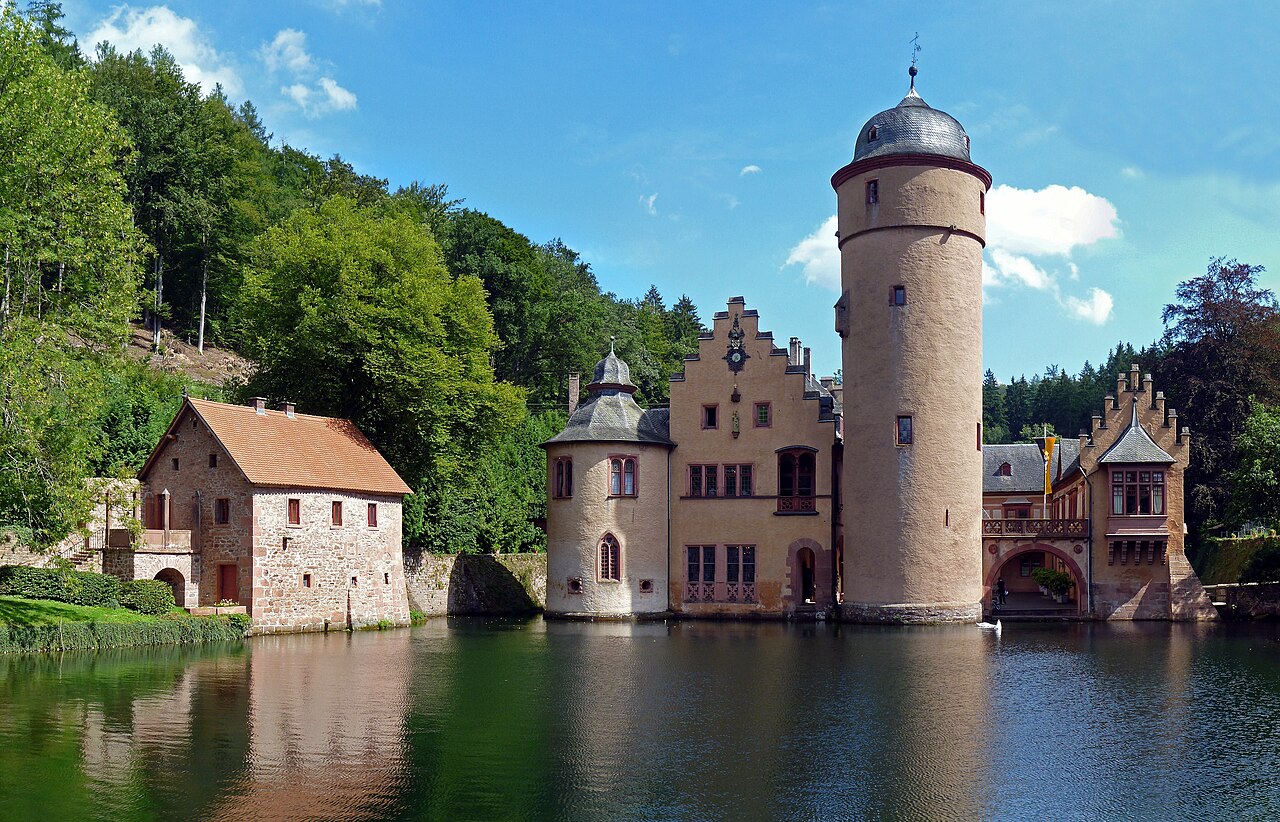
Johannisburg Palace
Schloss Johannisburg in Aschaffenburg, Germany, stands as a remarkable example of Renaissance architecture in the region. Constructed between 1605 and 1614 under the direction of architect Georg Ridinger, the palace was built for Johann Schweikhard von Kronberg, the Prince Bishop of Mainz. This grand residence incorporates a medieval keep from a 14th-century castle that previously occupied the site, making it the oldest surviving part of the complex. The palace served as the second residence of the Prince Bishop of Mainz until the dissolution of ecclesial principalities in 1803.
Architectural design and features
The palace is distinguished by its red sandstone construction sourced from the nearby quarries of the Spessart hills, lending the building its characteristic warm hue. Schloss Johannisburg is designed around a rectangular courtyard enclosed by four wings, each topped with octagonal towers at the corners. These towers are capped with onion-shaped domes, a feature that blends Renaissance aesthetics with regional stylistic elements. The structure’s symmetrical layout and balanced proportions reflect the ideals of the Renaissance movement, emphasizing harmony and clarity in architectural form.
Medieval keep integration
The inclusion of the 14th-century keep within the palace grounds provides a tangible link to the site's earlier defensive purpose. This keep was preserved and integrated into the new Renaissance design, serving both as a historical monument and a functional space within the palace complex.
Historical context and significance
The palace's history is closely tied to the political and religious shifts of the region. After the secularization of church territories in 1803, the principality of Mainz was dissolved. However, Karl Theodor von Dahlberg, the last Prince Bishop of Mainz, retained Aschaffenburg, which became the Principality of Aschaffenburg. This territory later became part of the Grand Duchy of Frankfurt from 1810 to 1813 before passing to the Kingdom of Bavaria.
During the reign of King Ludwig I of Bavaria, Schloss Johannisburg was used as a summer residence. Ludwig I also commissioned the construction of the Pompejanum, a Roman villa inspired by the ancient city of Pompeii, located within sight of the palace. This addition highlights the continued cultural importance of the site into the 19th century.
Interior design and collections
At the end of the 18th century, the palace interiors were remodeled in the Neoclassical style by architect Emanuel Herigoyen. This renovation introduced elegant furnishings and decorative elements that contrasted with the Renaissance exterior. Today, visitors can explore residential rooms furnished in this style, offering insight into the tastes of the period.
Schloss Johannisburg houses several museums, including a gallery of paintings featuring works by notable artists such as Lucas Cranach the Elder. The parament chamber displays ecclesiastical vestments from the former treasury of Mainz Cathedral, reflecting the palace's religious heritage. The municipal palace museum showcases arts and handicrafts, emphasizing the cultural history of Aschaffenburg and the surrounding region.
Unique cork architectural models
One of the palace's most distinctive collections is the world's largest assembly of architectural models made from cork. These intricate models were created after 1792 by court confectioner Carl May and his son. They provide a fascinating glimpse into architectural design and craftsmanship of the period, adding a unique dimension to the museum's offerings.
War damage and restoration
Schloss Johannisburg suffered near-total destruction during the final days of World War II. The extensive damage required a comprehensive restoration effort that lasted approximately twenty years. The reconstruction carefully preserved the palace's historical and architectural integrity, allowing it to regain its status as a cultural landmark.
Today, Schloss Johannisburg is one of the main attractions in Aschaffenburg and a symbol of the city's heritage. Its well-preserved Renaissance architecture, combined with Neoclassical interior elements and diverse museum collections, make it a significant destination for visitors interested in history, art, and architecture.
Frequently asked questions (FAQ)
- What is the historical significance of Johannisburg Palace?
- Johannisburg Palace is a remarkable example of Renaissance architecture and served as a residence for the Prince-Bishops of Würzburg. Built in the early 17th century, it played a crucial role in the region's political and cultural history, making it a key landmark in Aschaffenburg.
- When was Johannisburg Palace built?
- Construction of Johannisburg Palace began in 1605 and was completed in 1614. The palace was designed by the architect Georg Tullius, and it has since been admired for its impressive façade and grand interior.
- What are the opening hours for Johannisburg Palace?
- Johannisburg Palace is typically open to visitors from 10 AM to 5 PM, Tuesday through Sunday. However, it is advisable to check the official website for any seasonal changes or special holiday hours before planning your visit.
- Can I take photographs inside Johannisburg Palace?
- Yes, photography is allowed inside Johannisburg Palace, but flash photography may be restricted in certain areas to protect the artworks. Visitors are encouraged to capture the stunning architecture and beautiful interiors while being respectful of the space.
- Is it possible to access Johannisburg Palace by public transport?
- Absolutely! Johannisburg Palace is easily accessible via public transport, including buses and trains. The nearest station is Aschaffenburg Central Station, from which you can take a short walk to the palace.
- What are the ticket prices for Johannisburg Palace?
- Tickets to Johannisburg Palace typically cost around €6 for adults, with reduced rates for students and seniors. Children under 18 often enter for free, making it an affordable destination for families.
- When is the best time to visit Johannisburg Palace?
- The best time to visit Johannisburg Palace is during the spring and early autumn when the weather is pleasant, and the gardens are in full bloom. Additionally, visiting during weekdays can help you avoid larger crowds.
- What nearby attractions can I visit after Johannisburg Palace?
- After visiting Johannisburg Palace, you can explore the beautiful Schönbusch Park or the Pompejanum, a Roman-style villa overlooking the Main River. Both attractions are within a short distance and offer a delightful continuation of your cultural experience in Aschaffenburg.
- How do I plan a visit to Johannisburg Palace?
- To plan your visit, start by checking the official website for opening hours, ticket prices, and any special events. It’s also a good idea to consider guided tours for a more in-depth understanding of the palace's history and architecture.
Information
Loading map...
Visitor reviews
No reviews yet. Been here? Write the first review and help other travelers!
Write the first reviewVisited this castle? Share your experience
Your review helps other travelers and adds first-hand knowledge to our encyclopedia.