Melgund Castle
Melgund Castle stands approximately two kilometres east of Aberlemno in Angus, Scotland. This 16th-century L-plan hill castle has a complex history intertwined with notable Scottish families and figures. Originally, the land was held by the Cramond family before passing to the Clan Bethune (Beaton). The castle is often attributed to Cardinal David Beaton, Archbishop of St Andrews and Chancellor of Scotland, who is said to have commissioned the castle around 1543 as a residence for himself and his mistress, Margaret Ogilvie. However, architectural historian Charles McKean has argued that the work done in the 1540s was likely a remodeling of an earlier structure, suggesting that the current castle incorporates elements of a previous building on the site.
Historical background and ownership
There is some debate regarding the precise builder and date of Melgund Castle. Some sources suggest that the castle was constructed around 1560 by David Bethune, the son of Cardinal Beaton and Margaret Ogilvie. The castle later passed through marriage to the Earls of Minto, who were granted the title Viscount Melgund, a courtesy title still used by the heir to the earldom. The castle remained in the family until it was sold in 1990.
Architectural features and layout
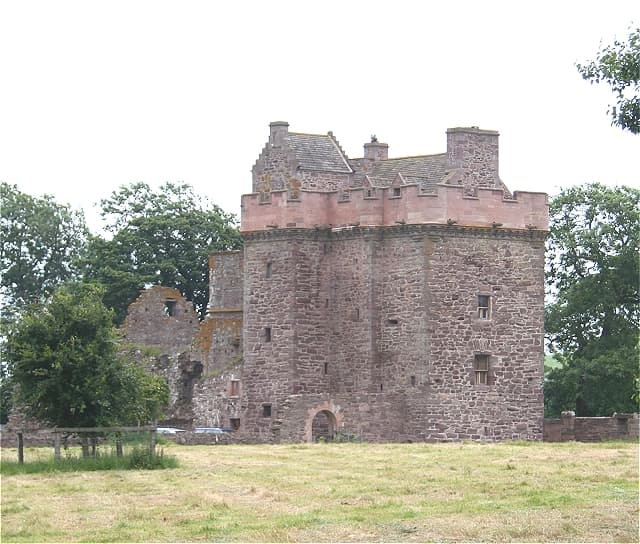
Melgund Castle is built in an L-plan, a common design in Scottish castles of the Renaissance period. The main structure comprises a four-storey keep with an attic and a stair tower that was likely raised to serve as a watchtower. To the east of the keep lies a two-storey domestic range featuring a round tower at the north-east corner. This domestic range has been preserved in a ruined state, contrasting with the restored keep.
Materials and restoration
The castle underwent extensive archaeological investigation between 1990 and 1996 in preparation for its partial conversion into a private residence. Restoration work was completed in August 2002, predominantly using local stone sourced from a nearby quarry that was specially re-opened for the project. The restoration focused on the keep, which received a new roof, while the domestic range was left largely as a ruin to preserve its historic character.
Defensive and domestic elements
The four-storey keep served as the primary defensive structure, with thick stone walls and limited access points typical of Scottish castles designed for protection during the turbulent 16th century. The raised stair tower provided an elevated vantage point for surveillance of the surrounding landscape. The attached domestic range would have housed living quarters and service rooms necessary for daily life, reflecting the dual purpose of the castle as both a fortress and a residence.
Scheduled monument status and cultural significance
In 1971, Melgund Castle was designated as a scheduled monument, recognizing its importance as a heritage site. This status helps protect the castle's architectural and historical integrity, ensuring that any work done respects its significance. The castle's association with Cardinal David Beaton, a key figure in Scottish history, and its connection to the Earls of Minto add to its cultural value.
Visiting and current use
Today, Melgund Castle is a private residence and is not generally open to the public. Its partial restoration allows it to serve as a home while preserving much of its historical fabric. The castle's location near Aberlemno places it within a region rich in Scottish history and heritage sites, making it a point of interest for those studying Renaissance Scottish architecture and noble lineages.
Nearby attractions
The surrounding area includes other historical sites such as the Aberlemno Sculptured Stones, famous Pictish stone monuments, which provide additional context to the region's long history. Visitors to Angus interested in Scotland's medieval and Renaissance past will find Melgund Castle's story intertwined with the broader narrative of Scottish nobility and ecclesiastical power.
Frequently asked questions (FAQ)
- How do I get to Melgund Castle?
- Melgund Castle is located in Aberlemno, Scotland, easily accessible by car from major cities like Dundee and Aberdeen. There are also public transport options available, with local bus services connecting to Aberlemno. Be sure to check local schedules for the most convenient routes.
- What is the historical significance of Melgund Castle?
- Melgund Castle, built in the 19th century, showcases the romantic architecture of the era and is a notable example of the region's historical estate homes. It was designed as a residence for the St. Clair family, and its construction reflects the social and cultural dynamics of Victorian Scotland. The castle has witnessed significant historical events and remains a symbol of the area's rich heritage.
- When was Melgund Castle built?
- Melgund Castle was constructed in 1850, designed by the architect David Bryce. It has since stood as a testament to the architectural trends of the mid-19th century, combining elements of Gothic and Scottish Baronial styles. The castle's enduring presence highlights its historical importance in the region.
- Can I visit Melgund Castle?
- Yes, Melgund Castle is open to visitors, but it is advisable to check in advance for specific visiting hours and any special events. Guided tours may be available, providing insights into the castle's history and architecture. Please ensure to respect the property and its surroundings during your visit.
- Why is Melgund Castle popular among tourists?
- Melgund Castle attracts tourists due to its striking architecture and picturesque setting in the Scottish countryside. Visitors appreciate its historical significance and the stories behind its construction and the St. Clair family. The castle's beautiful grounds also offer a serene environment for photography and exploration.
- Is it possible to host events at Melgund Castle?
- Yes, Melgund Castle can be rented for private events such as weddings and corporate functions. The stunning backdrop and elegant interiors make it a unique location for special occasions. Interested parties should contact the castle management for more information on availability and arrangements.
- What are the opening hours for Melgund Castle?
- Melgund Castle's opening hours vary depending on the season, so it's essential to check their official website or contact the management for the most accurate information. Generally, the castle is open to visitors during weekends and public holidays. It may also offer extended hours during peak tourist seasons.
- Are there ticket prices for visiting Melgund Castle?
- Yes, there are ticket prices for visiting Melgund Castle, which typically cover entry to the grounds and guided tours. Pricing may vary based on age groups, with discounts often available for children and seniors. It's recommended to check their official site or contact them for the latest pricing information before planning your visit.
- What are some nearby attractions to Melgund Castle?
- Nearby attractions include the picturesque village of Aberlemno, known for its ancient Pictish stones, and the stunning landscapes of the Angus countryside. The region is also home to several walking trails and historic sites, making it ideal for a full day of exploration. Visitors can enjoy a mix of history, nature, and local culture in the surrounding areas.
Photo gallery

Information
Loading map...
Visitor reviews
No reviews yet. Been here? Write the first review and help other travelers!
Write the first reviewVisited this castle? Share your experience
Your review helps other travelers and adds first-hand knowledge to our encyclopedia.