Melgaço Castle
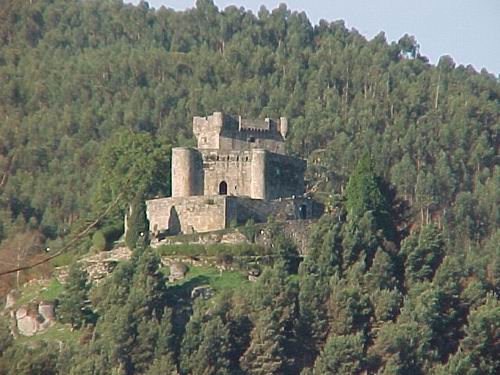
Melgaço Castle stands as a significant medieval fortress located in the municipality of Melgaço, in the northernmost part of Portugal. Constructed in 1170 under the order of King Afonso Henriques, the first monarch of Portugal, this hill castle was strategically positioned to defend the crossing over the Alto Minho river, marking the border with Galicia. Its location made it the most northern sentry point in Portugal from the twelfth century, serving as a vital military and administrative center throughout the Middle Ages.
The castle’s foundation coincided with the issuance of a Foral charter to the town, a royal document granting privileges that encouraged settlement and development. This early legal framework helped establish Melgaço as a fortified town with growing importance in border defense and trade control. The castle’s role expanded notably in 1361 when it was designated the exclusive crossing point between Portugal and Galicia, underscoring its strategic significance.
Historical development and military significance
Construction of Melgaço Castle began in the late twelfth century, likely completed between 1205 and 1212. It was built during a period of frequent border conflicts between Portugal and the neighboring Kingdom of León. The castle’s military importance is reflected in its role during the 1212 dispute involving King Afonso II and his sisters, as well as its involvement in the 1383-1385 Portuguese succession crisis. During this crisis, Melgaço initially supported Queen Beatriz and the Kingdom of Castile but was recaptured by Portuguese forces under John I after a prolonged siege in early 1387.
Melgaço’s governance and fortifications evolved under successive monarchs. King Afonso III granted a second Foral charter in 1258, promising privileges that further encouraged urban development. Between 1245 and 1263, the town’s defensive walls were constructed with support from local monasteries, solidifying Melgaço’s status as a fortified border town. The castle’s military command, or alcaidaria, was an important office, with the right to appoint the alcaide reclaimed by Afonso III during his reign.
In the late fifteenth century, Melgaço was one of only five Portuguese border towns authorized to receive Sephardic Jews expelled from Spain in 1492. This highlights the town’s continued role as a gateway and point of cultural exchange along the Iberian border.
Architectural features and layout
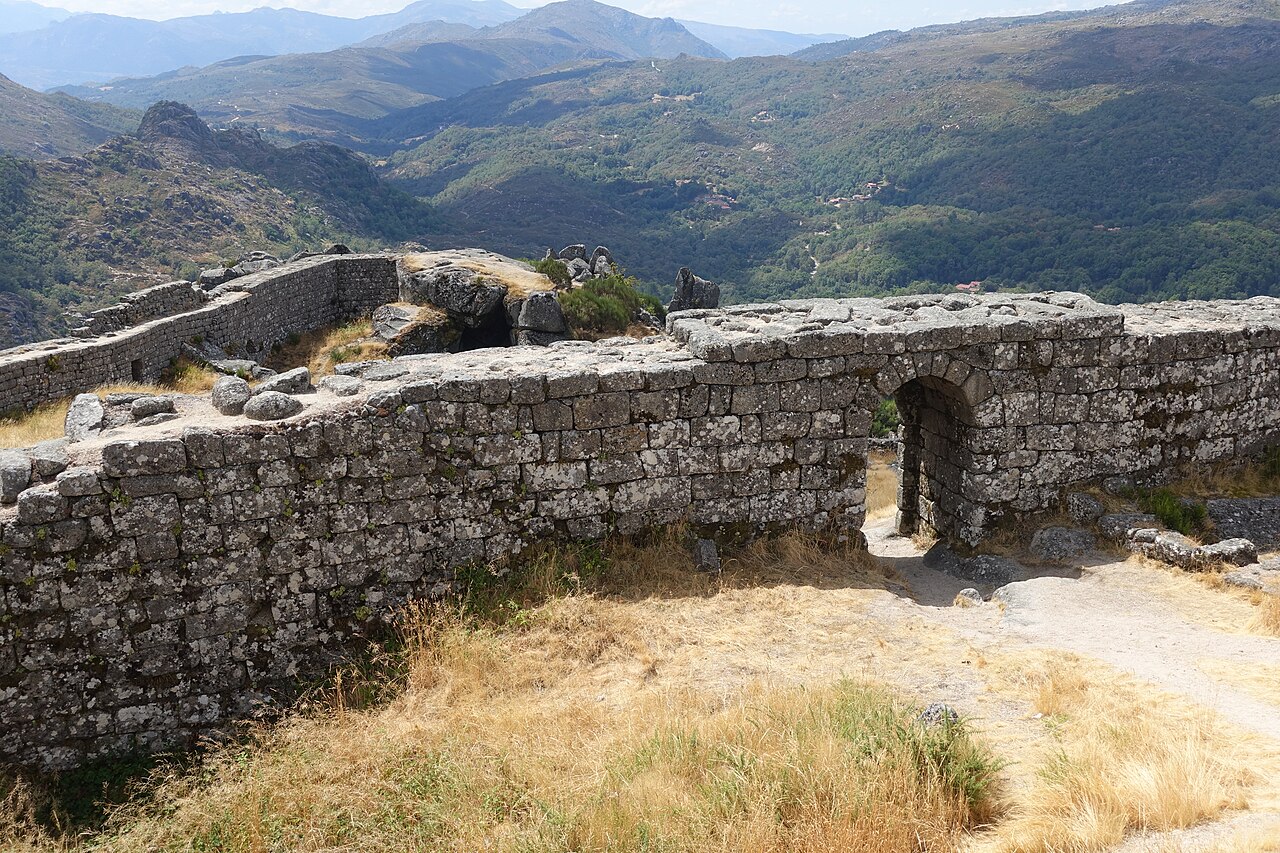
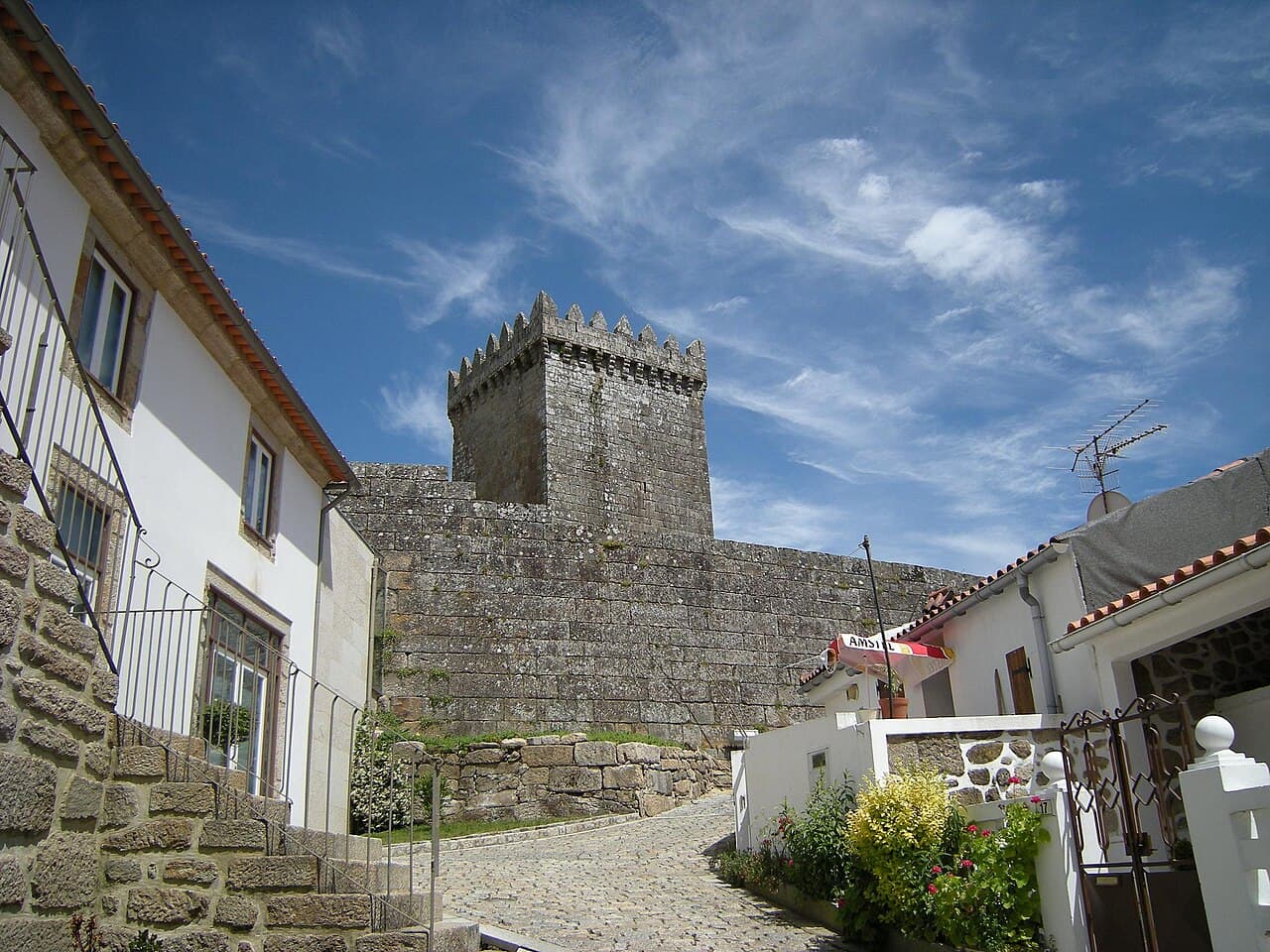
The castle is notable for its circular layout, a rare design among Portuguese fortifications. It is divided into three precincts enclosed by robust stone walls topped with prismatic battlements. These battlements, with their angular shapes, provided enhanced defensive capabilities. The walls are reinforced by three towers, the most prominent being a pentagonal tower oriented towards the urban core.
At the heart of the castle stands the keep, a large square tower isolated in the central courtyard. This keep was fully rebuilt but retains its original Romanesque design characterized by a solid, square plan typical of medieval military architecture. Internally, the keep has three floors illuminated by narrow vertical slits, once used as arrow loops. The battlemented crown of the keep now serves as a lookout point within the archaeological museum established in the tower’s dependencies.
The castle features two main gates: the main gate on the west side, leading to the parade ground with a cistern and the former residence of the castle commander, and a smaller betrayal gate on the north side, likely used as a secret or emergency exit. Remnants of a barbican protecting the main gate and flanking towers from the town’s walls survive, providing insight into the castle’s layered defenses.
Recent archaeological excavations have uncovered significant stretches of the original Gothic town walls, enabling a clearer understanding of the castle’s original design and the defensive strategies employed. These findings have been crucial in preserving Melgaço’s medieval heritage and informing restoration efforts.
Later history and preservation efforts
During the Portuguese Restoration War in the 17th century, Melgaço’s defenses were updated with bastioned fortifications to withstand artillery attacks, reflecting evolving military technology. The castle maintained its strategic role throughout the early modern period despite changes in warfare and political boundaries.
In the 20th century, Melgaço Castle was recognized as a National Monument in 1910, with the surrounding town walls receiving similar status in 1926. Restoration work began in the 1960s, focusing on preserving the castle’s structural integrity and historical features. Archaeological research has been ongoing, transforming the keep into a museum space that showcases artifacts and architectural elements uncovered during excavations.
Today, Melgaço Castle remains a well-preserved example of high medieval military architecture in Portugal. Its distinctive circular plan, robust towers, and historical significance as a border fortress make it a key cultural landmark in the Viana do Castelo district. Visitors can explore the castle’s walls, towers, and museum exhibits while appreciating its role in the complex history of Portuguese-Spanish relations.
Visitor information and cultural significance
The castle is located in the Vila parish of Melgaço, within the Viana do Castelo district of Portugal. It is accessible to the public, offering insights into medieval fortification design and border history. The archaeological museum housed in the keep provides educational displays on the castle’s construction, military use, and archaeological discoveries.
Melgaço Castle’s unique architectural features and rich historical background contribute to its importance as a heritage site. It represents centuries of military strategy, cultural exchange, and political shifts along Portugal’s northern frontier. The castle’s preservation allows for ongoing study and appreciation of medieval Iberian history.
Frequently asked questions (FAQ)
- What are the opening hours of Melgaço Castle?
- Melgaço Castle is generally open to visitors during daytime hours, typically from 9:00 AM to 6:00 PM, but it is advisable to check locally for seasonal variations and special closures.
- How do I get to Melgaço Castle?
- Melgaço Castle is located in the town of Melgaço in the Viana do Castelo district of Portugal. It can be reached by car or local transport from nearby cities such as Viana do Castelo.
- What is the historical significance of Melgaço Castle?
- Melgaço Castle was built in 1170 to defend Portugal's northern border with Galicia. It played a key role in medieval border conflicts and was a strategic crossing point between Portugal and Spain.
- Can visitors explore the keep and museum inside Melgaço Castle?
- Yes, the keep has been converted into an archaeological museum where visitors can learn about the castle's history and see artifacts discovered during excavations.
- Is Melgaço Castle accessible for people with limited mobility?
- Due to its medieval structure and terrain, some areas of Melgaço Castle may be challenging for visitors with limited mobility. It is recommended to inquire locally about accessibility options before visiting.
Photo gallery

Information
Sources & official resources
Verify the information above using these authoritative references.
Loading map...
Visitor reviews
No reviews yet. Been here? Write the first review and help other travelers!
Write the first reviewVisited this castle? Share your experience
Your review helps other travelers and adds first-hand knowledge to our encyclopedia.