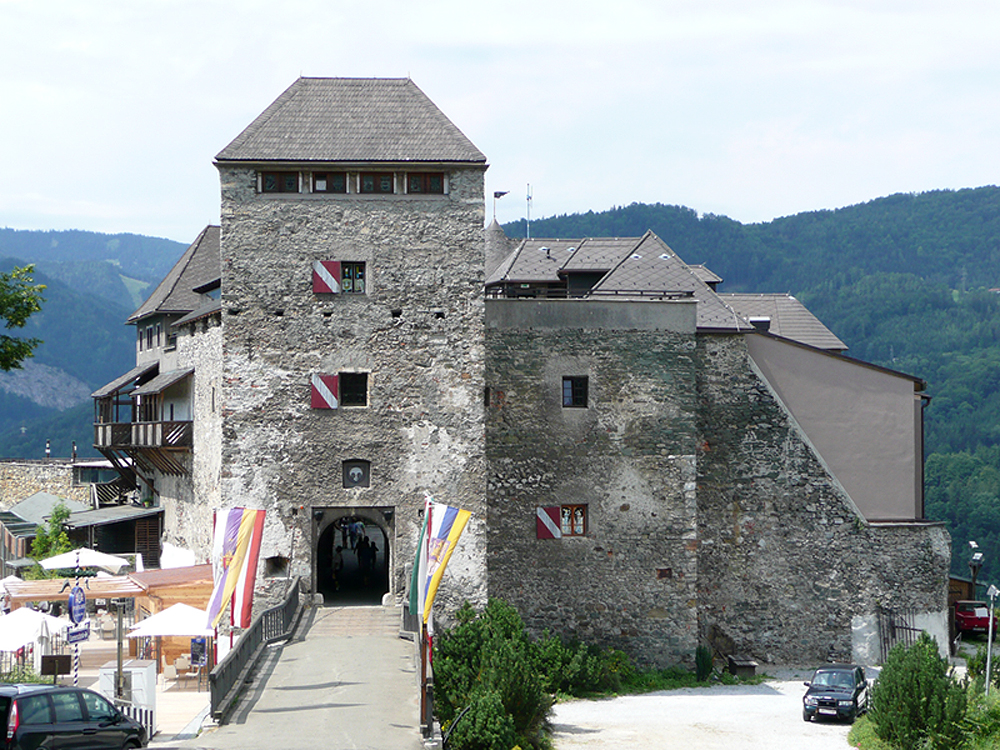
Massenburg
Massenburg castle stands as a significant hilltop medieval fortress located on the Maßenberg near the town of Leoben in Austria. Constructed in the late 13th century, this castle exemplifies the evolution of defensive architecture from simple wooden structures to complex stone fortifications that adapted to changing military and residential needs over several centuries. Its strategic position above the southern approach to Leoben, naturally protected by the Mur River on three sides, underscores its importance as a protective stronghold during the High and Late Medieval periods.
The origins of Massenburg date to shortly after 1260, following the relocation of Leoben by King Ottokar II. The initial construction phase focused on a robust hexagonal stone main tower, which served as the castle's core defensive element. Surrounding this tower were primarily wooden residential and functional buildings, reflecting typical medieval construction practices for early fortifications. The estate was granted to the Maßenberger family, a knightly lineage tied to the Timmersdorfer family, who played a key role in the castle's early history.
Architectural development and expansions
From the 14th to the 16th centuries, Massenburg castle underwent significant architectural transformations. The original wooden buildings west of the main tower were replaced by a sturdy stone longhouse, signifying a shift towards more permanent and defensible living quarters. This period also saw the castle adapting to the advent of gunpowder weaponry and evolving military tactics.
16th-century military enhancements
In the 16th century, under the ownership of Veit Zollner, who received the castle as a hereditary fief in 1528 for his services during the 1525 Peasants' War, the castle's defenses were notably strengthened. A cannon rondel was constructed on the south side of the main tower to accommodate artillery, reflecting the increasing importance of cannon in siege warfare. Adjacent to this, the prominent round gate tower known as the "Hundsbart" was built, enhancing the control and defense of the castle's main entrance.
The gate tower was complemented by a residential building featuring rounded corner turrets on its western side, combining defensive architecture with domestic functionality. This complex layout illustrates the castle's dual role as both a military fortification and a noble residence.
Castle layout and surviving structures
The current remains of Massenburg reveal a layered and complex layout that reflects its historical phases. The hexagonal stone main tower remains the focal point, with its eastern edge oriented towards the entrance. The foundations and partial walls of this tower are still visible, providing insight into the castle's original defensive core.
The stone longhouse to the west replaced earlier wooden buildings and served as more durable living quarters. To the south, the cannon rondel and the Hundsbart gate tower stand out as key defensive features from the 16th-century modifications. The gate tower controlled access to the castle and was part of a fortified entrance complex.
East of the gate tower lies an enclosed courtyard surrounded by a gatehouse, which is the only fully preserved building of the original castle complex. This gatehouse offers valuable insight into the castle's economic and functional spaces, highlighting the practical aspects of medieval castle life.
Additionally, a square-shaped western tower, adapted in modern times with an observation platform, provides visitors with elevated views of the surrounding landscape, emphasizing the castle's strategic location.
Historical ownership and decline
Throughout its history, Massenburg castle passed through the hands of various noble families, often held as a fief. Notable owners included Christof Hofmann zu Formbach in 1440, Hans von Malti in 1494, and Hans Haug in 1502, before the castle came under the possession of the Zollner family.
Financial difficulties in the mid-17th century led to the castle being pledged to Admont Abbey in 1658. Subsequent debts caused the property to fall under the control of the Styrian estates. Despite these challenges, the castle remained occupied until around 1820.
After abandonment, the castle gradually fell into ruin, with only foundations discernible by 1860. Archaeological excavations and restoration efforts in 1937 and 2000 have since stabilized the ruins, making the site accessible to visitors and preserving its historical legacy.
Cultural and heritage significance
Massenburg castle stands today as a testament to the layered history of medieval fortifications in Austria. Its transition from wooden structures to stone fortifications, incorporation of artillery defenses, and adaptation to changing military technologies reflect broader trends in castle architecture during the High and Late Middle Ages.
The castle's preservation and archaeological work have provided valuable insights into the living conditions, defensive strategies, and architectural evolution of hilltop castles in the region. The site, with its observation platform and accessible ruins, serves as an important cultural landmark for both historians and visitors interested in medieval military architecture and Austrian heritage.
Frequently asked questions (FAQ)
- How do I get to Massenburg castle near Leoben?
- Massenburg castle is located on the Maßenberg hill near Leoben, Austria. Visitors can reach the site by car or local transport to Leoben, then follow marked hiking trails leading up to the castle ruins.
- What is the historical significance of Massenburg castle?
- Massenburg castle played a vital role as a defensive hilltop fortress from the late 13th century, evolving through the High and Late Medieval periods. It reflects the adaptation of medieval fortifications to changing military technologies and noble residence needs.
- Can I visit the ruins of Massenburg castle?
- Yes, the ruins of Massenburg castle are accessible to the public. Restoration efforts have stabilized the site, and an observation platform on the western tower offers panoramic views of the surrounding landscape.
- When was Massenburg castle built?
- Massenburg castle was constructed in the late 13th century, shortly after 1260, following the relocation of Leoben by King Ottokar II.
- What architectural features are notable at Massenburg castle?
- Notable features include the hexagonal stone main tower, the 16th-century cannon rondel designed for artillery defense, the round gate tower known as the Hundsbart, and the fully preserved gatehouse surrounding the courtyard.
Information
Loading map...
Visitor reviews
No reviews yet. Been here? Write the first review and help other travelers!
Write the first reviewVisited this castle? Share your experience
Your review helps other travelers and adds first-hand knowledge to our encyclopedia.