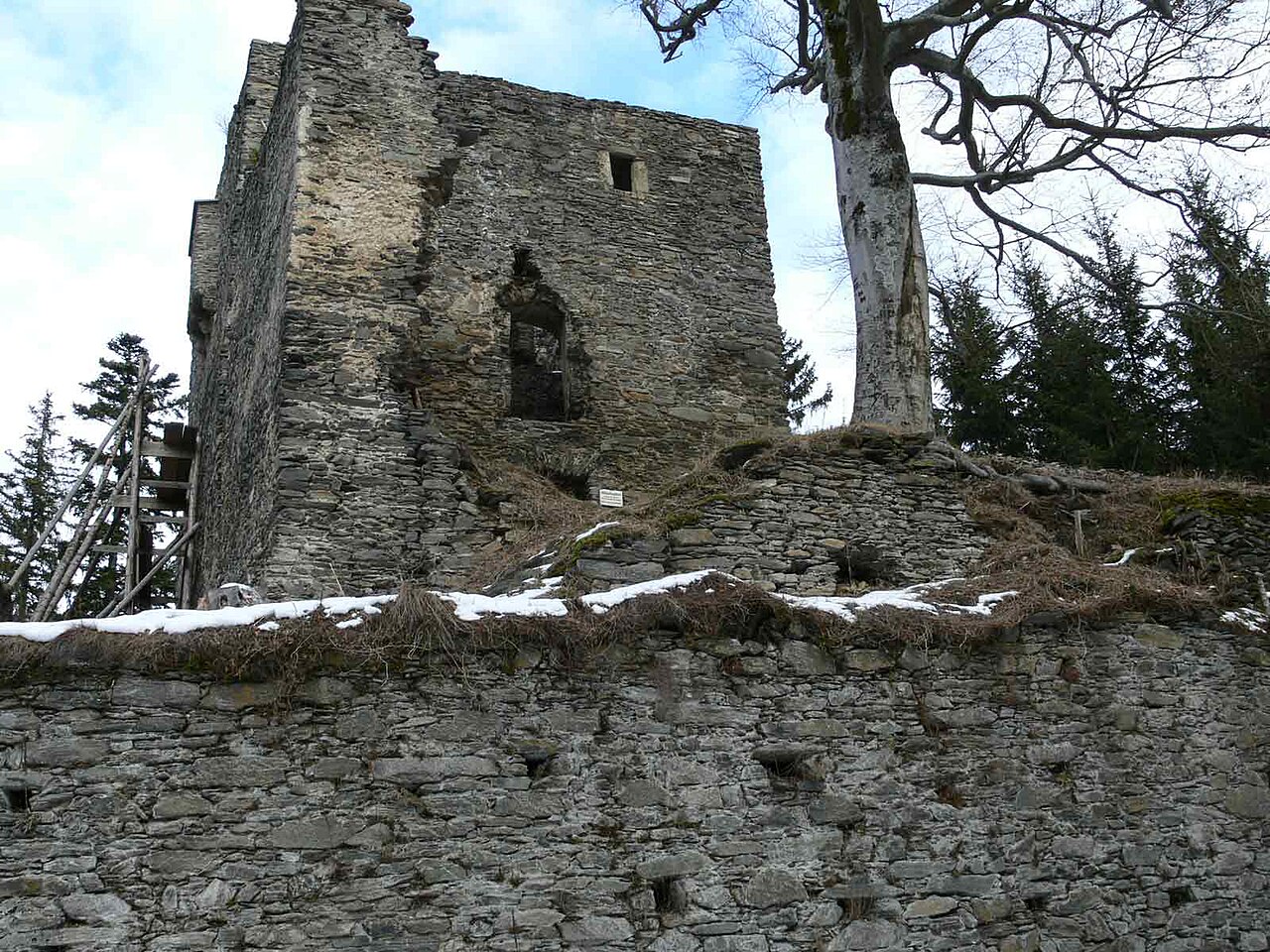
Burg Kammerstein
Burg Kammerstein is a notable medieval hill castle located in the municipality of Kammern im Liesingtal, Austria. Constructed in the 12th century, this castle stands as a testament to the region's feudal history and the architectural practices of the High Middle Ages. Positioned atop a rocky promontory at an elevation of 996 meters, it overlooks the scenic Liesing valley, providing both strategic defense and commanding views.
Historical background and ownership
The earliest documented mention of the site dates back to 1150, referencing the noble family known as the Hochfreien von Kammern. While their direct connection to Burg Kammerstein remains uncertain, they were influential in the surrounding area and associated with nearby fortifications such as Ober-Kammern and Ehrenfels. From the 13th century, the castle came under the control of the Ehrenfelser family, who served as ministeriales—a class of service nobility responsible for managing estates and administering lands on behalf of the Styrian territorial lords.
The Ehrenfelsers maintained ownership of Burg Kammerstein until the early 15th century, after which the castle changed hands. In 1513, Siegmund von Dietrichstein acquired the property with intentions to expand and improve it. However, these plans were curtailed due to the influence of his father-in-law, Emperor Maximilian I. Despite this, some repairs were undertaken, including plastering the bergfried and painting its corner stones, reflecting an effort to enhance the castle's appearance beyond mere functionality.
By 1542, Burg Kammerstein was already described as deteriorating, and by 1681, cartographer Georg Vischer depicted it as a ruin. Since then, it has remained in a state of decay, preserving the remnants of its former grandeur and serving as a historical landmark in the region.
Architectural features and layout
The castle's footprint covers an area approximately 70 by 40 meters, adapted to the natural contours of the rocky outcrop it occupies within the Schlossgraben area. Its construction primarily utilized locally sourced stone, resulting in robust defensive walls that blend with the rugged terrain.
The bergfried
The most prominent surviving structure is the bergfried, a tall main tower rising four to five stories. This tower served dual purposes: as a defensive stronghold and a residential space typical of medieval keeps. The early 16th-century plastering and painted corner stones on the bergfried indicate a period when aesthetic considerations complemented practical defense needs.
Gatehouse and palas
Near the bergfried lie the remains of the gatehouse, which controlled access to the castle's interior. Although only fragments survive, its strategic location near the entrance highlights its role in defense and visitor monitoring. Adjacent to this is the palas, the main residential building used for living quarters and administrative functions. The palas, along with other enclosing walls, still stands to heights of about six meters, outlining the former courtyard and living spaces.
Strategic significance and surroundings
Burg Kammerstein's location on a rocky promontory provided a natural defensive advantage, making it a formidable fortress in its time. Its proximity to other medieval fortifications like Ober-Kammern underscores a network of castles that secured the region. The castle's commanding views over the Liesing valley allowed its occupants to monitor movement and defend against potential threats effectively.
Current condition and cultural heritage
Today, Burg Kammerstein remains a ruined hill castle, its remnants offering valuable insights into medieval fortification architecture and noble life in Austria. The ruins attract historians, archaeologists, and visitors interested in exploring Austria's feudal past. Preservation efforts focus on maintaining the structural remains, particularly the bergfried and curtain walls, to ensure that this historical monument continues to convey its story to future generations.
The castle's enduring silhouette against the landscape serves as a cultural symbol of the region's medieval heritage and the evolution of defensive architecture through the centuries.
Frequently asked questions (FAQ)
- When was Burg Kammerstein built?
- Burg Kammerstein was constructed in the 12th century, during the High Medieval period, reflecting typical medieval fortification styles of that era.
- What is the architectural style of Burg Kammerstein?
- While the castle primarily reflects medieval defensive architecture, specific stylistic classifications are not well documented, but it features a typical hill castle layout with stone walls adapted to rocky terrain.
- Can visitors access Burg Kammerstein today?
- Yes, although Burg Kammerstein is in ruins, visitors can explore the site and enjoy panoramic views of the Liesing valley from its elevated position.
- What are the main features to see at Burg Kammerstein?
- Visitors can observe the remains of the bergfried, gatehouse, palas, and defensive walls, which together illustrate the castle's historical defensive and residential functions.
- Why did Burg Kammerstein fall into ruin?
- The castle fell into disrepair after the early 16th century due to halted expansion plans and subsequent neglect, as documented by its ruined state in the late 17th century.
Information
Loading map...
Visitor reviews
No reviews yet. Been here? Write the first review and help other travelers!
Write the first reviewVisited this castle? Share your experience
Your review helps other travelers and adds first-hand knowledge to our encyclopedia.