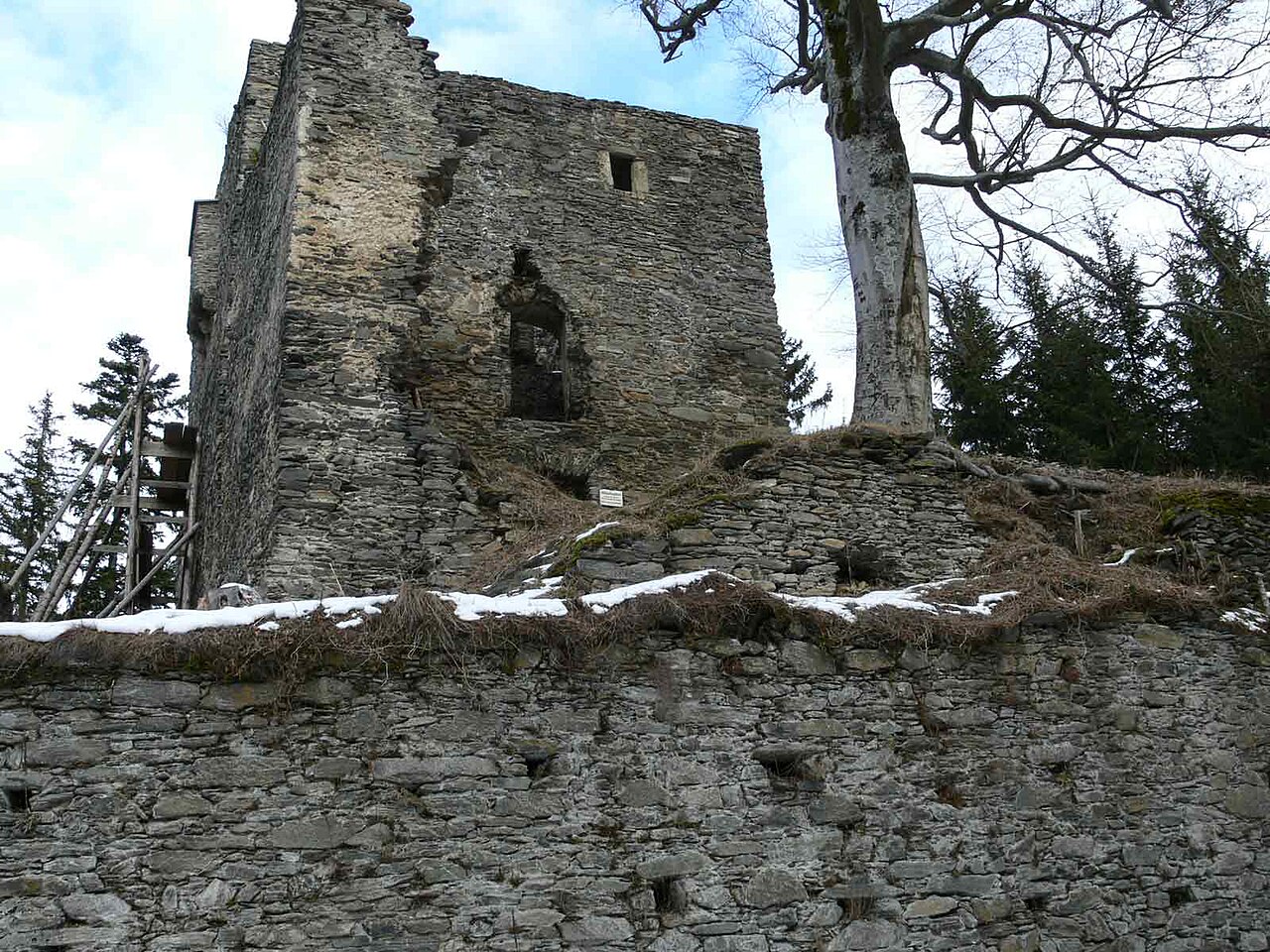
Burg Ehrenfels
Burg Ehrenfels is a notable hilltop castle ruin situated near the municipality of Kammern im Liesingtal in Austria. Perched at an elevation of approximately 1150 meters on the rocky outcrop known as the Gföhler Wand, this castle exemplifies the strategic medieval practice of building fortifications in naturally defensible locations. Its commanding position atop steep cliffs and nearly vertical slopes made it a formidable stronghold in the region.
The castle was originally established by the Ehrenfels family, a noble lineage with origins in the Swiss canton of Graubünden. The earliest documented mention of Burg Ehrenfels dates back to 1229, identifying it as the ancestral home of this family. The Ehrenfels were vassals to the Hochstift Bamberg, an influential ecclesiastical principality, highlighting the intertwined nature of secular and religious power in the High Medieval period.
Medieval origins and family influence
The castle's history is deeply connected to the political and religious dynamics of the 13th and 14th centuries. In 1292, members of the Ehrenfels family participated in the Landsberger Bund uprising against Duke Albrecht I. After their defeat, they were forced to make reparations to the monastery of Admont by transferring properties, illustrating the complex feudal relationships and the power struggles of the era.
Between 1356 and 1362, Wulfing von Ehrenfels served as an administrator and deputy for Bamberg’s interests in St. Leonhard im Lavanttal. His four sons notably expanded the family residence into a more robustly fortified castle. However, two of these sons gained notoriety as highwaymen when they captured Bishop Albert of Passau and demanded ransom. This act of defiance led to their excommunication and intervention by Duke Albrecht II, underscoring the tension between noble families and ecclesiastical authorities.
Ecclesiastical prominence
Despite some family members’ rebellious actions, the Ehrenfels maintained significant influence within church hierarchies. Wolfhard von Ehrenfels held important ecclesiastical offices, serving as bishop of Basel from 1381 and later as bishop of Lavant from 1411. This dual role reflects the family's enduring prominence in both secular and religious spheres during the late medieval period.
Decline and abandonment
The Ehrenfels family line came to an end in 1422. By 1439, the castle was referenced as "Veste Ernvels" and around 1500 as "oberes Gsloss" or "upper castle." Historical records suggest that after this period, Burg Ehrenfels was likely abandoned and ceased functioning as a residence or military fortress. The reasons for its decline may be linked to changing political circumstances and the evolution of military architecture, which rendered such hilltop castles less strategically vital.
Architectural features and current remains
Burg Ehrenfels was constructed primarily as a hill castle, utilizing the natural topography for defense. The most prominent surviving structure is the bergfried, or main tower, which served as the central stronghold within the fortress. This tower functioned both as a refuge during sieges and as a lookout point over the surrounding landscape.
Today, the castle exists predominantly in ruins, with only portions of the bergfried's stonework still intact. The site is accessible only by a narrow, steep path connecting it to the nearby Burg Kamerstein, emphasizing its isolated and defensible location. The surrounding cliffs and slopes provided natural fortifications, making direct assaults difficult.
There are no recorded decorative elements, inscriptions, or detailed archaeological findings at Burg Ehrenfels that shed light on its construction phases or later modifications. The surviving evidence primarily illustrates the medieval architectural approach to fortifying noble residences in challenging terrain.
Historical significance and legacy
Burg Ehrenfels stands as a testament to the medieval nobility's strategic use of natural landscapes for defensive purposes. Its history reflects the complex interplay of feudal loyalties, ecclesiastical power, and regional conflicts in medieval Austria. The family's involvement in significant uprisings and ecclesiastical offices highlights the castle's role as both a military and administrative center.
Although now a ruin, Burg Ehrenfels remains an important cultural heritage site, offering insight into the medieval hill castle typology and the turbulent history of noble families in the region. Its preservation as a ruin allows visitors and historians to appreciate the challenges of medieval fortification and the historical narratives embedded in its stones.
Visitor experience
Access to the castle ruins requires traversing a steep and narrow path, which may limit accessibility for some visitors but rewards with spectacular views and a palpable sense of medieval history. The rugged terrain and the castle's elevated position provide a unique opportunity to explore the remnants of a once-powerful noble family's stronghold.
Frequently asked questions (FAQ)
- How do I get to Burg Ehrenfels?
- Burg Ehrenfels is accessible via a narrow and steep path from the nearby Burg Kamerstein, located near Kammern im Liesingtal in Austria. Visitors should be prepared for a challenging hike through rugged terrain.
- What is the historical significance of Burg Ehrenfels?
- Burg Ehrenfels was the ancestral home of the noble Ehrenfels family, who played significant roles in regional politics and ecclesiastical hierarchies during the High Medieval period. The castle's history reflects feudal conflicts and church relations.
- What remains of Burg Ehrenfels can I see today?
- Today, visitors can see the ruins of the bergfried, the main tower of the castle, along with remnants of stone walls. The natural cliffs and slopes surrounding the site highlight its strategic defensive location.
- Is Burg Ehrenfels suitable for families with children?
- Due to the steep and narrow access path, Burg Ehrenfels may not be suitable for families with very young children or those with mobility issues. Visitors should exercise caution and wear appropriate footwear.
- When is the best time to visit Burg Ehrenfels?
- The best time to visit Burg Ehrenfels is during the warmer months when the path is safer and the weather is more favorable for hiking. Spring through early autumn offers the most comfortable conditions.
Information
Loading map...
Visitor reviews
No reviews yet. Been here? Write the first review and help other travelers!
Write the first reviewVisited this castle? Share your experience
Your review helps other travelers and adds first-hand knowledge to our encyclopedia.