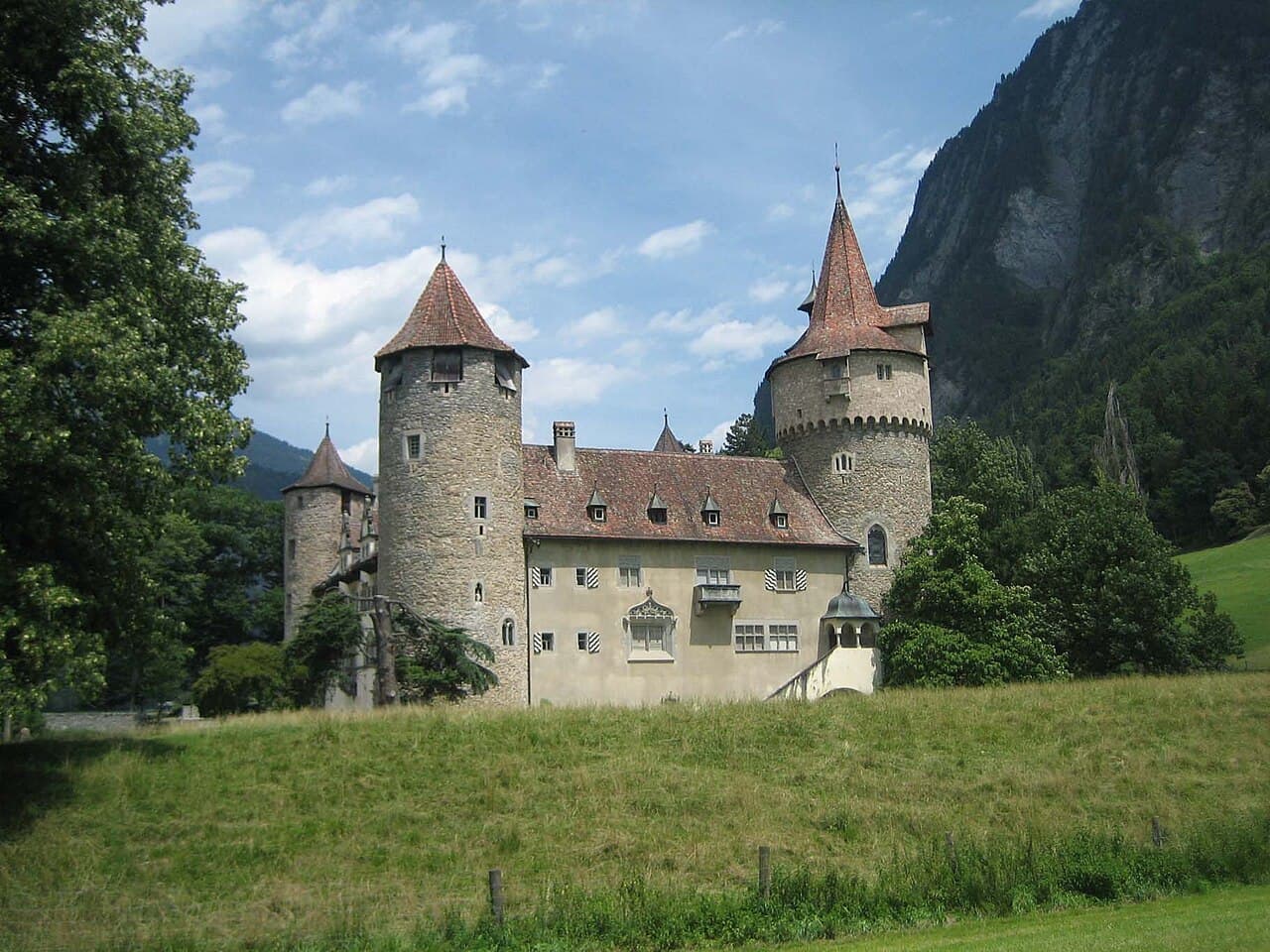
Marschlins Castle
Marschlins Castle stands as a remarkable example of medieval fortification in the canton of Graubünden, Switzerland. This Swiss heritage site is renowned for its unique Savoyard architectural style, a rarity in the region, and its complex history involving prominent noble families and ecclesiastical powers. Though the exact origins of the castle remain uncertain, it is widely accepted that the current structure dates back to the 13th century, with possible earlier fortifications from the 11th or 12th centuries and local legends suggesting a connection to the Carolingian era.
The castle’s strategic location in Igis, near the city of Chur, allowed it to play a significant role in the regional power struggles of medieval Switzerland. Its construction is believed to have been commissioned by the Bishop of Chur, reflecting the ecclesiastical influence over the territory at the time. The castle’s design, characterized by a square layout with four round corner towers and a dominant donjon or keep, exemplifies the Savoyard style imported from the neighboring region of Savoy, though the exact means of this architectural transmission remain a subject of scholarly discussion.
Historical background and ownership
Early history and construction
The first documented mention of Marschlins Castle dates to 12 May 1324, recorded as the place where the knight Jacob von Marmels died. The castle’s early history is marked by its association with the Bishop of Chur and various noble families. Between 1233 and 1237, the Bishop of Chur was Ulrich IV of Kyburg, whose brother was married to a member of the Savoy family, possibly explaining the castle’s architectural style.
Conflicts and transfers of ownership
Throughout the 14th and 15th centuries, the castle changed hands multiple times due to political conflicts and feudal arrangements. In 1336, a dispute over the castle between the Bishop of Chur and Count Ulrich von Montfort was resolved in favor of the Bishop. However, the following year, the castle was granted as a fief to Duke Albert II of Austria, who subsequently granted it to his knights. Later, in 1354, the castle was transferred to the Counts of Toggenburg in exchange for their support against Zürich and the Old Swiss Confederation.
After the death of the last Count of Toggenburg, Frederick VII, in 1436, the estate reverted to Austrian control and was granted to the Brandis family to hold for the Bishop of Chur. The castle’s ownership became entangled when it was used as collateral for a loan to Heinrich von Sigberg in 1442, leading to disputes over repair costs after a fire in 1460 damaged the structure. A mediator from the Three Leagues adjudicated the dispute, requiring shared repair costs and loan repayment by the Brandis family.
Architectural features and renovations
Savoyard style and defensive elements
Marschlins Castle is a rectangular fortress measuring approximately 34 by 39 meters, surrounded by two moats that were originally filled with water and spanned by a drawbridge, later replaced by a stone bridge in the 17th century. Each corner of the castle features a round tower, with the southern tower serving as the main donjon and measuring about 11 meters in diameter. The other three towers are slightly smaller, each about 8.7 meters in diameter.
The castle’s layout and fortifications reflect the typical Savoyard military architecture of the period, designed to provide strong defensive capabilities while also accommodating residential and administrative functions. The oldest residential building is located on the northern side, and the main gate, originally positioned further south, was relocated to the center of the western wall, featuring a triumphal arch design.
Post-medieval modifications and interior decoration
In the early 17th century, the castle’s moat was drained, signaling a shift from military fortification to more residential and aesthetic purposes. The Salis family, who acquired the castle in 1633, initiated significant renovations under Ulysses Salis, transforming Marschlins into an elegant residence with a French garden and refined interior spaces.
The castle boasts three richly decorated rooms from the 17th century, showcasing exquisite craftsmanship. The Marschallstübli, built around 1633, features intricately carved wood paneling with inlaid marquetry and a coffered ceiling. The tile stove, crafted in 1638 by the Pfau workshop, and cabinets adorned with the alliance arms of Heinrich Hirzel and Yolanda von Salis from 1674 add to the room’s historical charm.
The Offiziersstube, completed in 1638, is paneled in stone pine and decorated with a carved Salis coat of arms on the coffered ceiling. A Steckborn oven from the early 18th century provided warmth. The Goldene Stübli, located in the northeast tower and completed around 1670, is notable for its painted hunting scenes on the carved paneling and a ceiling decorated with 43 constellations and the four winds. This room also houses a collection of Gothic sculptures.
The castle chapel, built in the main tower in 1771, features interior paintings of the Four Evangelists and stained glass windows from the mid-17th century, reflecting the religious heritage of the site.
Marschlins castle in modern times
Throughout its history, Marschlins Castle has served various functions beyond its original defensive role. In the late 18th century, it operated as a philanthropinist school from 1771 to 1777. Later, it was adapted for industrial uses, including a tobacco factory and a silk spinning mill.
During the French invasion of Switzerland in the late 18th century, the castle was repurposed as an army camp, hosting approximately 10,000 soldiers and 3,000 horses between March 1799 and December 1800. This military use underscores the castle’s continued strategic importance even in modern times.
In the early 20th century, the Salis family commissioned architect Eugen Probst to rebuild the castle in 1905. Probst, a founder of the Schweizerischer Burgenverein, controversially altered the castle by adding an extra floor to the tower and increasing the number of windows, significantly changing its medieval appearance.
Today, Marschlins Castle remains privately owned and is recognized as a significant cultural landmark. Visitors can admire its well-preserved medieval fortifications, elegant interior rooms, and the surrounding landscape that reflects centuries of architectural evolution and historical events.
Frequently asked questions (FAQ)
- How do I get to Marschlins Castle?
- Marschlins Castle is located in Igis, Switzerland, and can be reached by car or public transportation. The nearest train station is in Chur, from where you can take a bus or taxi to the castle. There are also well-marked hiking trails that lead to the castle, making it accessible for those who enjoy walking.
- What is the historical significance of Marschlins Castle?
- Marschlins Castle dates back to the 13th century and has played a crucial role in the region's history. It served as a fortress to protect the local area and has witnessed various historical events over the centuries. Today, it stands as a testament to medieval architecture and the rich heritage of the Graubünden region.
- Can I visit Marschlins Castle year-round?
- Yes, Marschlins Castle is open to visitors year-round, although the best time to visit is during the spring and summer months when the weather is pleasant. Guided tours are available, providing insights into the castle's history and architecture. However, be sure to check for any seasonal events or maintenance closures before planning your visit.
- What are the opening hours for Marschlins Castle?
- Marschlins Castle typically opens to visitors from 10 AM to 5 PM, with extended hours during the peak tourist season. It is advisable to check the official website for any changes in hours or special events. Guided tours may have specific timings, so booking in advance is recommended.
- Is there an entry fee to visit Marschlins Castle?
- Yes, there is a nominal entry fee to access Marschlins Castle, which helps maintain the site and fund preservation efforts. Ticket prices are generally affordable, with discounts available for children and families. Visitors can purchase tickets on-site or through the castle's official website.
- What architectural features can I expect to see at Marschlins Castle?
- Marschlins Castle showcases classic medieval architecture, including robust stone walls, narrow windows, and a distinctive round tower. The castle's layout reflects its defensive purpose, while the interior features beautifully preserved rooms that provide a glimpse into life during the medieval period. Don’t miss the panoramic views from the castle's vantage point, which enhance its historical charm.
- Are there any nearby attractions to visit while at Marschlins Castle?
- Yes, there are several nearby attractions that complement a visit to Marschlins Castle. The historic town of Chur offers charming streets, shops, and cafes, while the stunning landscapes of the Rhine Gorge are perfect for hiking and outdoor activities. Additionally, the picturesque village of Malans, known for its vineyards, is just a short drive away.
- Why is the best time to visit Marschlins Castle during the summer?
- Visiting Marschlins Castle during the summer allows you to enjoy the beautiful surrounding landscapes and favorable weather conditions. The longer days provide ample time for exploration, and many cultural events take place during this season. Additionally, the lush greenery and blooming flowers create a picturesque setting that enhances the castle's medieval charm.
Photo gallery

Information
Website
Visit websiteSources & official resources
Verify the information above using these authoritative references.
Loading map...
Visitor reviews
No reviews yet. Been here? Write the first review and help other travelers!
Write the first reviewVisited this castle? Share your experience
Your review helps other travelers and adds first-hand knowledge to our encyclopedia.



