Marmaris Castle
Marmaris Castle stands as a remarkable hill castle overlooking the coastal town of Marmaris in southwestern Turkey. Its strategic location between the Aegean and Mediterranean seas has made it a vital military and cultural stronghold for millennia, reflecting the diverse civilizations that have shaped the region.
The site’s history extends back to approximately 3000 BCE, with early defensive walls documented by the ancient historian Herodotus. These fortifications underscore the longstanding significance of this natural harbor and its surroundings as a maritime crossroads and a contested frontier throughout antiquity.
Ancient origins and ionian influences
The foundations of the castle itself date to the second millennium BCE, with a notable construction phase around 1044 BCE during the Ionian period. The Ionians, Greek settlers who established colonies along the Anatolian coast, contributed to the early fortifications and urban development of the site. This era marked the castle’s emergence as a defensive bastion protecting local settlements and controlling maritime routes.
Following the conquests of Alexander the Great in the late 4th century BCE, the fortress underwent repairs and enhancements to maintain its military relevance. Alexander’s campaigns brought Hellenistic cultural and architectural influences to the region, which are subtly reflected in the castle’s structural adaptations.
Ottoman reconstruction and military significance
Centuries later, the castle assumed renewed importance during the Ottoman era. In the 16th century, Sultan Suleiman I ordered extensive reconstruction of the fortress as part of preparations for his campaign against the island of Rhodes. This renovation transformed Marmaris Castle into a robust military base, equipped to support naval operations and regional defense. The 17th-century Ottoman traveler Evliya Çelebi provides the only written account of this pivotal rebuilding phase.
The castle’s fortifications were tested during the First World War, when it sustained damage from French naval shelling. Despite this, Marmaris Castle endured and survived natural disasters such as the devastating 1957 earthquake that affected nearby areas.
Architectural features and museum collections
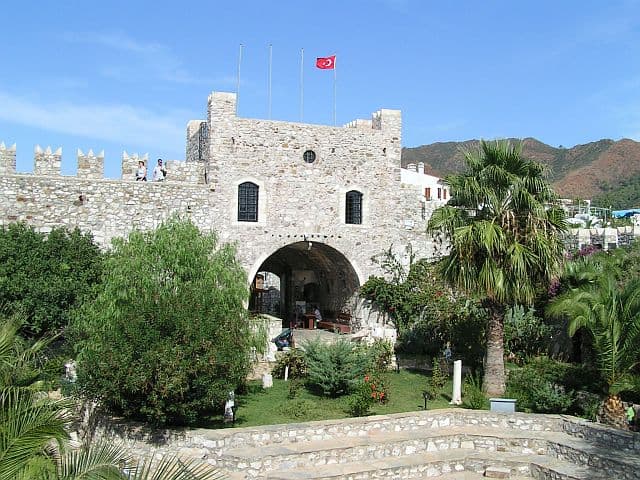
Marmaris Castle occupies a commanding hilltop position, enclosed by stone masonry walls that reveal multiple construction phases spanning several millennia. The fortress complex includes eighteen rooms arranged around central courtyards, with seven enclosed chambers serving various functions. Among these are halls dedicated to archaeological displays and an ethnography hall, which exhibit artifacts illuminating the castle’s rich history.
Essential features of the castle include a fountain and a cistern, critical for water supply during sieges and dry periods, reflecting sophisticated medieval engineering adapted to the site’s needs.
The museum housed within the castle contains a diverse collection of artifacts from the Hellenistic, Roman, and Byzantine periods. Items such as amphorae, pottery shards, glassware, coins, and decorative objects were excavated from nearby ancient sites including Knidos, Burgazada, and Hisarönü. These collections highlight the extensive cultural exchanges and economic activity that have characterized the region over centuries.
Ethnographic exhibits focus on the Ottoman period, displaying tools, household items, and everyday equipment that provide insight into the castle’s more recent civilian and military uses. Restoration efforts from the late 20th century have preserved the castle’s structural integrity, ensuring it remains a stable and accessible cultural heritage site.
Cultural heritage and modern significance
Today, Marmaris Castle stands as a well-preserved monument that encapsulates the layered history of southwestern Anatolia. It functions as the Marmaris Archaeology Museum, offering visitors a comprehensive glimpse into the architectural evolution, military history, and cultural heritage of the region.
The castle’s location provides panoramic views of the city of Marmaris and the surrounding seas, enhancing its appeal as a tourist destination. Its enduring presence reflects the resilience and historical importance of this ancient fortress, bridging past and present through its preserved walls and curated collections.
Visitors can explore the castle’s courtyards, halls, and exhibitions to gain a deep understanding of the strategic role Marmaris Castle played across different historical epochs, from ancient Ionian settlers to the Ottoman Empire and beyond.
Frequently asked questions (FAQ)
- What is the historical significance of Marmaris Castle?
- Marmaris Castle dates back to the 16th century and played a crucial role in the defense of the region against invasions. It was built by the Ottoman Sultan Suleiman the Magnificent and has served various military purposes throughout its history, making it an important symbol of the area's rich heritage.
- When was Marmaris Castle built?
- The current structure of Marmaris Castle was completed in 1545, although the site has seen fortifications since ancient times. The castle's strategic location overlooking the harbor made it vital for maritime defense during the Ottoman Empire.
- Can I visit Marmaris Castle?
- Yes, Marmaris Castle is open to visitors who wish to explore its historical significance and stunning architecture. It offers a unique opportunity to learn about the region's past while enjoying picturesque views of Marmaris and the surrounding sea.
- What are the opening hours of Marmaris Castle?
- Marmaris Castle is typically open for visitors daily from 8:30 AM to 7:00 PM in the summer months and may close earlier during the winter. It's advisable to check for any seasonal changes in opening hours before planning your visit.
- Is there an entrance fee for Marmaris Castle?
- Yes, there is a nominal entrance fee to visit Marmaris Castle, which helps maintain the site and support its preservation. The ticket prices are generally reasonable, making it accessible for both locals and tourists alike.
- What is the best time to visit Marmaris Castle?
- The best time to visit Marmaris Castle is during the spring (April to June) and autumn (September to October) when the weather is pleasant and the tourist crowds are smaller. This allows for a more enjoyable experience as you explore the castle and its surroundings.
- How accessible is Marmaris Castle?
- Marmaris Castle is situated on a hill, so visitors should be prepared for some uphill walking. However, the path is well-maintained, and there are seating areas along the way to rest, making it manageable for most visitors.
- What nearby attractions can I visit while at Marmaris Castle?
- While visiting Marmaris Castle, you can also explore the charming Old Town, enjoy the beautiful Marmaris Marina, and visit the nearby archaeological museum. These attractions complement your castle visit and provide a richer understanding of the region's history.
Photo gallery

Photo by Dave.Dunford at English Wikipedia•Public domain
Information
Loading map...
Visitor reviews
No reviews yet. Been here? Write the first review and help other travelers!
Write the first reviewVisited this castle? Share your experience
Your review helps other travelers and adds first-hand knowledge to our encyclopedia.