Fortifications of Rhodes
The fortifications of Rhodes form an extensive and imposing defensive system encircling the medieval town of Rhodes, Greece. These fortifications represent one of the most significant and well-preserved examples of a bastioned fortress in the Mediterranean region, reflecting the military architecture developed during the Late Medieval period. Constructed primarily by the Knights Hospitaller of Saint John following their capture of the island in 1309, the walls were built to enhance and replace earlier Byzantine defenses, transforming Rhodes into a formidable stronghold against both land and sea attacks.
Architectural design and defensive features
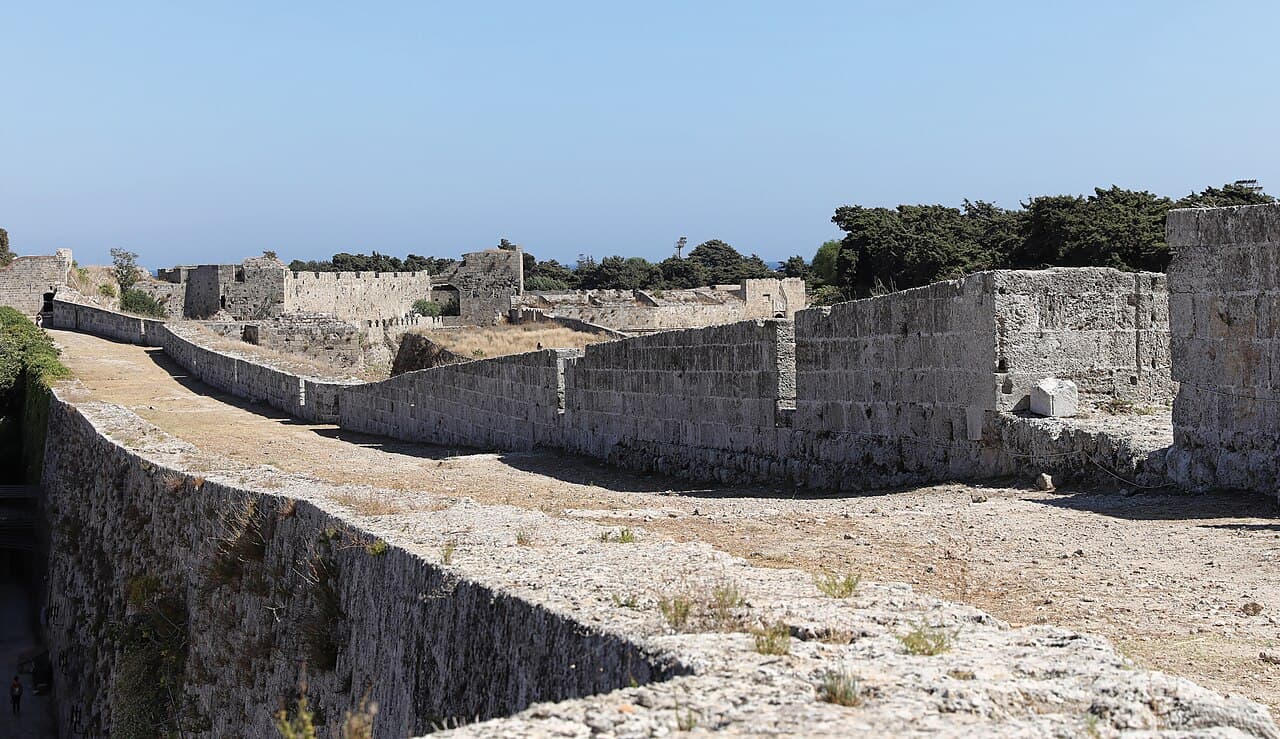
The fortifications are characterized by a massive curved wall that follows the natural crescent shape of the harbor, creating a protective barrier around the old town. The main structure consists of a huge embankment encased in stone, designed to absorb and deflect artillery fire. This embankment is reinforced with a scarp (steep inner wall), a glacis (sloping outer earthwork), and a counterscarp (outer ditch wall), all integral to the fortress's layered defense system.
The walls are punctuated by numerous bastions, which are angular projections allowing defenders to cover adjacent walls with crossfire, a hallmark of bastioned fortifications designed to resist cannon fire and sieges. These bastions, along with terrepleins (flat platforms on bastions for artillery), are named after the different Langues (or tongues) of the Knights Hospitaller who were responsible for their defense. For example, the Bastion of Italy and the terreplein of Spain reflect the multinational composition of the Knights.
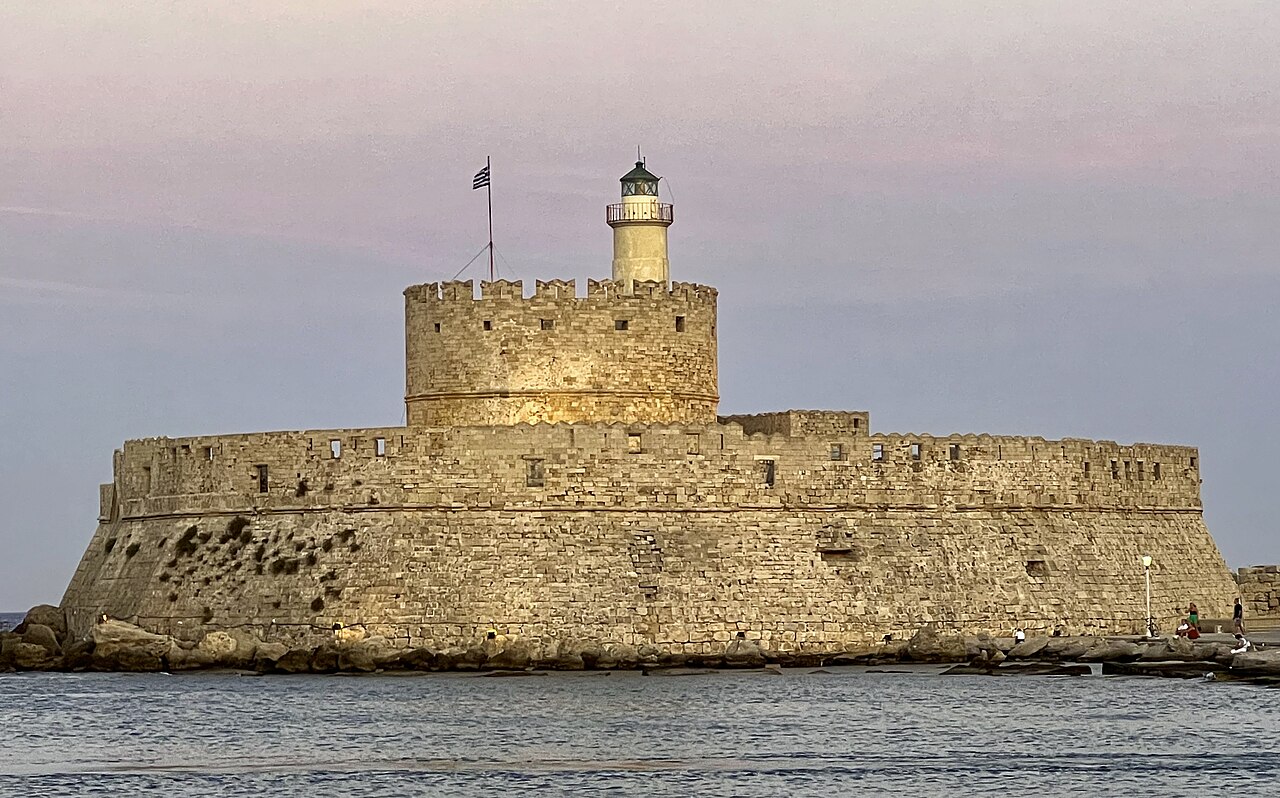
Facing the harbor, the fortifications take the form of a crenellated wall, providing a defensive line against naval threats. On the harbor moles, there are additional towers and defensive forts that further enhanced the fortress's control over maritime access.
Construction techniques and materials
The walls were constructed using a technique known as rubble masonry, which involved building a thick mass of irregular stones and mortar, faced externally with smooth stone blocks. This method provided both strength and resilience, enabling the walls to withstand the increasingly powerful artillery of the time. The smooth outer faces also served to prevent attackers from gaining a foothold for scaling the walls.
The construction process was a monumental effort that spanned several decades, reflecting the strategic importance of Rhodes as a bastion of Christian defense against Ottoman expansion and pirate raids in the eastern Mediterranean.
Historical context and the role of the knights hospitaller
The Knights Hospitaller, a military and religious order, took possession of Rhodes after a prolonged three-year siege ending in 1309. Their arrival marked a new era of fortification and military preparedness on the island. The order systematically upgraded the existing Byzantine walls, incorporating the latest advances in military architecture to create a fortress capable of resisting both medieval siege engines and early gunpowder artillery.
The division of the fortress's defense among the different Langues of the Knights was a unique organizational feature. Each Langue was responsible for maintaining and defending specific bastions and sections of the walls, reflecting the multinational nature of the order. The Grand Master controlled the northern face, while the western and southern defenses were held by the Langues of France and Auvergne, Spain (including Portuguese knights), Germany (including English knights), and Italy.
Strategic importance and legacy
The fortifications of Rhodes successfully resisted several sieges, most notably the famous Siege of Rhodes in 1522 by the Ottoman Empire. Despite eventually succumbing to the Ottomans, the fortress's design and construction delayed their conquest for many years, demonstrating the effectiveness of the bastioned fortification system.
Today, the walls and bastions remain largely intact and form a major cultural and historical landmark. They provide insight into the military engineering of the Late Medieval period and the strategic role Rhodes played in the defense of Christendom in the eastern Mediterranean.
The fortifications are a UNESCO World Heritage Site, attracting visitors interested in medieval military architecture and the history of the Knights Hospitaller. The preservation of the walls, bastions, moats, and towers allows for a comprehensive understanding of the fortress's defensive capabilities and the complex organization of its defenders.
Notable architectural elements and visitor experience
Visitors to Rhodes can explore the extensive circuit of walls that include imposing bastions with artillery platforms, deep moats that once hindered attackers, and well-preserved gates that controlled access to the city. The fortress's design reflects a transition from medieval to early modern military architecture, incorporating features specifically intended to counter the threat of cannon fire.
The walls offer panoramic views of the harbor and the Aegean Sea, highlighting the fortress's strategic maritime position. Several towers and forts along the harbor moles provide additional points of interest, illustrating the layered defense system that protected the island from naval assault.
Frequently asked questions (FAQ)
- How do I get to the fortifications of Rhodes?
- The fortifications are located in the medieval town of Rhodes, accessible by foot from the town center. The island of Rhodes is served by an international airport and ferry connections from mainland Greece and nearby islands.
- What is the best time to visit the fortifications of Rhodes?
- The best time to visit is during the spring and autumn months when the weather is mild and the site is less crowded. Summer can be very hot and busy with tourists.
- Can I walk along the walls of the fortifications?
- Yes, visitors can walk along parts of the walls and bastions to enjoy views of the harbor and town. Some sections are open to the public, while others may be restricted for preservation reasons.
- Are there guided tours available at the fortifications?
- Guided tours are available and recommended to fully appreciate the history and architectural features of the fortifications. Tours can be booked through local agencies or at the visitor center.
- What is the historical significance of the fortifications?
- The fortifications represent a major example of Late Medieval bastioned military architecture and were key in defending Rhodes against Ottoman sieges. They illustrate the strategic role of the Knights Hospitaller in the eastern Mediterranean.
Photo gallery

Information
Opening hours
8:00-20:00, daily
Ticket prices
€10 adult, €5 child
Current owner
Greek Ministry of Culture
Loading map...
Visitor reviews
No reviews yet. Been here? Write the first review and help other travelers!
Write the first reviewVisited this castle? Share your experience
Your review helps other travelers and adds first-hand knowledge to our encyclopedia.