Marksburg — Germany castle

Marksburg

Marksburg Castle in Braubach, Germany
Braubach, Germany
High Medieval (11th–13th c.)
Well Preserved

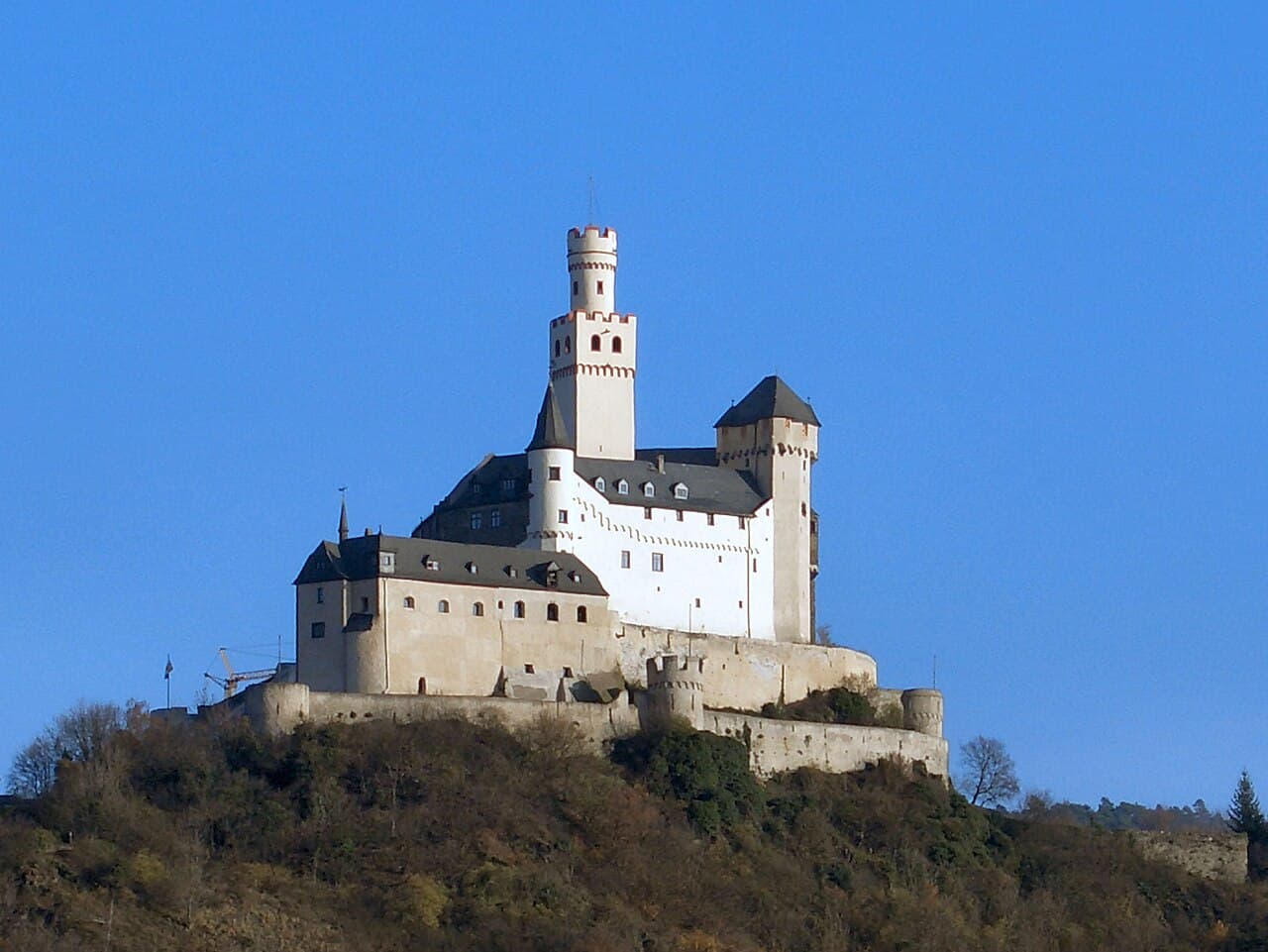
Marksburg Castle stands prominently above the town of Braubach in Germany, overlooking the majestic Rhine River. As a key monument within the Rhine Gorge UNESCO World Heritage Site, it is celebrated for its exceptional preservation and historical significance. Unlike many castles in the region, Marksburg was primarily built for defense and never served as a royal residence, emphasizing its military importance throughout the High Medieval period.

Constructed in the 12th century, Marksburg Castle is a quintessential example of a hill castle, strategically positioned to oversee and control river traffic along the Rhine. The castle's enduring structure provides invaluable insight into medieval fortification techniques and castle life. Remarkably, it is the only one among approximately 40 hill castles between Bingen am Rhein and Koblenz that has never been destroyed or significantly damaged, preserving its original medieval fabric.

Architectural features and layout

The butter-churn tower keep

One of the most distinctive architectural elements of Marksburg Castle is its keep, designed in the form of a butter-churn tower. This type of tower features a cylindrical base with a narrower upper section, resembling a traditional butter churn. The keep served as the last line of defense and a lookout point, providing commanding views over the surrounding landscape and the Rhine River valley.

Defensive walls and gatehouses

The castle is surrounded by robust curtain walls and multiple defensive layers, including battlements and fortified gatehouses. These features were carefully designed to repel attackers and control access. The walls incorporate arrow slits and machicolations, allowing defenders to launch projectiles while remaining protected.

Inner courtyards and functional buildings

Within the castle walls lie several courtyards that organized the space for various purposes, including storage, workshops, and living quarters for the garrison. The castle complex includes a well-preserved chapel, armory, and storerooms, reflecting the self-sufficient nature of the fortress during sieges.

Historical significance and preservation

Military role and strategic importance

Marksburg Castle played a vital role in controlling the Rhine, one of Europe's most important trade and transportation routes during the Middle Ages. Its location allowed it to monitor river traffic and collect tolls, contributing to the economic and military power of its owners. The castle's defensive design reflects the turbulent times of the High Medieval period, when regional lords fortified their holdings against rivals and invaders.

Survival through centuries

Unlike many castles in the Rhine region, Marksburg was never destroyed by war or fire. This remarkable preservation is due in part to its continuous use and maintenance, including adaptations in later centuries to meet changing military needs. Its survival provides a rare, authentic glimpse into medieval castle architecture and defensive strategies.

Modern conservation and tourism

Today, Marksburg Castle is managed as a museum and cultural site, attracting visitors interested in medieval history and architecture. The castle offers guided tours that showcase its defensive features, living quarters, and historical artifacts. Its status as part of the Rhine Gorge UNESCO World Heritage Site underscores its cultural and historical value.

Architectural style and construction

The castle embodies characteristics of High Medieval military architecture, with robust stone construction, functional defensive elements, and minimal ornamental features. Its design prioritizes practicality and defense, typical of castles built during the 12th century to withstand sieges and attacks.

The use of local stone and traditional masonry techniques contributes to the castle's imposing and enduring presence. The layout reflects a well-planned fortification, with concentric defensive zones and clear lines of sight for archers and guards.

Visiting marksburg castle

Visitors to Marksburg Castle can explore its extensive grounds, climb the butter-churn tower for panoramic views, and learn about medieval life through detailed exhibits. The site is accessible year-round, with guided tours available in multiple languages.

The castle's location in Braubach makes it a convenient stop for travelers exploring the Rhine Valley and its many historic castles. Nearby amenities and transportation options enhance the visitor experience.

Frequently asked questions

  • When was Marksburg Castle built? Marksburg Castle was constructed in the 12th century during the High Medieval period, serving as a strategic defensive fortress.
  • What is the butter-churn tower? The butter-churn tower is the castle's distinctive keep, characterized by its cylindrical base and narrower upper section, resembling a traditional butter churn.
  • Is Marksburg Castle open to visitors? Yes, the castle operates as a museum and cultural site, offering guided tours throughout the year.
  • Why is Marksburg Castle significant? It is the only hill castle between Bingen am Rhein and Koblenz that has never been destroyed, providing an authentic example of medieval fortification.
  • How can I get to Marksburg Castle? The castle is located in Braubach, Germany, accessible by road and public transportation from nearby cities along the Rhine.

Frequently asked questions (FAQ)

How do I get to Marksburg Castle?
Marksburg Castle is located in Braubach, Germany, and can be accessed by car or public transport. The nearest train station is in Braubach, which is about a 20-minute walk to the castle. There are also boat services along the Rhine River that offer scenic views and direct access to the castle.
What is the historical significance of Marksburg Castle?
Marksburg Castle is one of the few castles along the Rhine River that has never been destroyed. It dates back to the 12th century and served as a stronghold for the Counts of Katzenelnbogen. Today, it represents medieval defensive architecture and offers insights into the region's rich history.
When was Marksburg Castle built?
Marksburg Castle was constructed around 1210, making it over 800 years old. Throughout its history, it has been expanded and renovated, preserving its original medieval character. The castle has been well-maintained and remains a prime example of medieval military architecture.
Can I take guided tours of Marksburg Castle?
Yes, Marksburg Castle offers guided tours in multiple languages. These tours provide visitors with in-depth knowledge of the castle's history, architecture, and artifacts. It's advisable to check the schedule in advance, especially during peak tourist seasons.
Why is Marksburg Castle a popular tourist destination?
Marksburg Castle is popular due to its stunning views of the Rhine River and its well-preserved medieval architecture. It offers a glimpse into the past with its historical exhibits and impressive towers. The picturesque setting and rich history make it a must-visit for tourists in the region.
Is it possible to host events at Marksburg Castle?
Yes, Marksburg Castle can be rented for private events, including weddings and corporate gatherings. The castle's unique atmosphere and breathtaking views provide a memorable backdrop for any occasion. It's recommended to contact the castle administration for details on availability and booking.
What are the opening hours for Marksburg Castle?
Marksburg Castle is typically open to visitors from March to November, with varying hours depending on the season. During peak months, the castle may open earlier and close later to accommodate more visitors. Always check the official website for the most current hours before your visit.
What are the ticket prices for visiting Marksburg Castle?
Ticket prices for Marksburg Castle vary depending on age and group size, with discounts for children and families. As of now, standard adult tickets are reasonably priced, and children under a certain age may enter for free. It's a good idea to verify the prices on the castle's official website prior to your visit.
What nearby attractions can I explore after visiting Marksburg Castle?
After visiting Marksburg Castle, you can explore the charming town of Braubach, known for its half-timbered houses and scenic riverside views. Additionally, you can visit other nearby castles along the Rhine, such as Rheinfels and Stolzenfels, or enjoy a river cruise to take in the beautiful landscape. The region is rich in cultural attractions and natural beauty.

Photo gallery

Marksburg
Click to view

Photo by Holger Weinandt•CC BY-SA 3.0

1 photo • Click any image to view in full screen

Information

Hill Castle

Sources & official resources

Verify the information above using these authoritative references.

Loading map...

Visitor reviews

No reviews yet. Been here? Write the first review and help other travelers!

Write the first review

Visited this castle? Share your experience

Your review helps other travelers and adds first-hand knowledge to our encyclopedia.

Write a review

(5/5)

0/2000 characters

Your review will be visible after admin approval

Nearby castles

0.4 km

Marksburg Castle

Braubach, Germany

Marksburg castle stands as an exceptional example of medieval fortification perched on a steep slate hill above the town of Braubach in Rhineland-Palatinate, Germany. It is renowned as the only medieval castle in the Middle Rhine Valley that has never been destroyed, preserving its original defensive structures and architectural heritage remarkably intact through over eight centuries. This hill castle embodies the evolution of castle architecture from the High Medieval period through the late Gothic era, reflecting the strategic importance of the Rhine River corridor and the political power of its successive noble owners. The castle's origins trace back to around 1117, when the noble freemen of Brubach likely constructed the initial keep on the site. The first documented mention of the castle itself dates from 1231, identifying it as a fortified seat under the control of the influential Lords of Eppstein. The Eppsteins were a powerful family in the region, producing several archbishops and electors of Mainz and Trier during the 13th century, which contributed to the castle's prominence and early development. The architectural evolution of Marksburg castle Romanesque foundations and Staufer influence The castle's original design reflects the Romanesque architectural style typical of the Staufer era, characterized by its roughly triangular layout adapted to the natural topography of the 160-meter-high slate cone. The oldest surviving structure is the north wing, a two-story palas or main residential hall featuring double-arched window arcades and thick stone walls. This wing served as the primary living quarters during the early medieval period. Gothic expansions under the Katzenelnbogen counts In 1283, ownership passed to the Counts of Katzenelnbogen, a wealthy and influential family who extensively remodeled the castle in the Gothic style during the 14th and 15th centuries. They added significant defensive and residential elements, including the raising of the keep around 1468 by Philipp I of Katzenelnbogen, who added the distinctive four-story "Butterfass" turret with its octagonal upper section, battlements, and covered walkway. The chapel tower (Kapellenturm) was also enhanced during this period, featuring a chapel dedicated to Saint Markus on its third floor, which gave the castle its current name, Marksburg, replacing the original name Burg Brubach. The chapel contains a remarkable 13th-century ten-part rib vault and frescoes depicting New Testament scenes added in the early 20th century. Fortifications and adaptations for gunpowder warfare By the 14th century, the castle was surrounded by a ring wall with zwingers—outer wards designed to trap and expose attackers. In the 16th and 17th centuries, the castle was further fortified with artillery bastions, ramparts, and batteries to adapt to the advent of gunpowder weaponry. These additions were overseen notably by John "the Belligerent" of Hesse, who transformed Marksburg into a formidable hill fortress. Historical significance and ownership From noble residence to fortress and prison Marksburg served primarily to protect the citizens and the strategic Rhine crossing near Braubach. After the Katzenelnbogen line ended in 1479, the castle passed by marriage to the Landgraves of Hesse. Although it became a widow's residence for a time, the construction of the nearby Philippsburg in the late 16th century diminished its residential importance. During the Thirty Years' War, the castle was repaired and maintained as a defensive site but ceased to function as a noble residence. In the Napoleonic era, it was repurposed as a hospital for invalid soldiers and a state prison, with prison cells installed in the Gothic hall that were later removed in 1901. Preservation by the German Castles Association Following a period of military use and neglect under Prussian administration after 1866, the castle was in danger of decay. In 1900, with support from Kaiser Wilhelm II and the initiative of architect Bodo Ebhardt, the German Castles Association (Deutsche Burgenvereinigung) purchased Marksburg for a symbolic price of 1,000 gold marks. Extensive restoration efforts were undertaken to preserve its medieval character, including the reconstruction of the Butterfass turret in 1905. Marksburg remains the headquarters of the German Castles Association, which maintains a specialist library and archives on castle history. The castle is open to the public year-round and serves as a museum showcasing medieval life and architecture. Architectural features and castle grounds The keep and defensive towers The 40-meter-high keep (Bergfried) is the castle’s dominant feature, originally a three-story square tower built around 1237 and heightened in the late 15th century. The Butterfass turret at its summit is a unique architectural element symbolizing the castle’s adaptation to changing military needs. Other towers include the Kapellenturm, with its chapel and seven floors, and a four-story corner tower west of the palas, all integrated into the castle’s defensive system with battlements and arrow slits. Residential and functional buildings The castle houses a Gothic two-story hall measuring six by twenty-four meters, used historically for feasts and assemblies. Nearby stands a timber-framed bakery with a vaulted cellar, illustrating the self-sufficiency of the castle community. Inside, visitors can explore reconstructed medieval rooms including a kitchen with a hearth, a wine press dated 1767, a small heated chamber called a Kemenate, and a knights’ hall with an adjacent garderobe (toilet). The castle also contains a torture chamber and a smithy featuring an anvil from 1865. Defensive walls and outer wards The castle’s ring wall with its zwingers, including the Inner Zwinger and the Rheinzwinger (outer ward), feature bastions and artillery batteries added in the early modern period. Fortified gates such as the Schartentor and Fuchstor have covered battlements to protect defenders. Gardens and preservation efforts A herb garden was established in 1969 within the former zwinger area, cultivating about 170 medieval herbs and medicinal plants, enhancing the historical ambiance of the castle grounds. Starting in 1987, the castle’s exterior walls were restored with new white plaster to maintain its late medieval appearance. Marksburg castle in the modern era Despite suffering artillery damage in March 1945 during World War II, which partially destroyed the Butterfass turret and several roofs, the castle was meticulously restored by 1980. Today, Marksburg is one of the best-preserved medieval castles in Germany and a significant cultural landmark. Since 2002, it has been part of the UNESCO World Heritage Site Upper Middle Rhine Valley, protected under German and international heritage laws. The castle’s preservation exemplifies successful heritage conservation, allowing visitors to experience an authentic medieval fortress that has survived the vicissitudes of history largely intact. Marksburg’s combination of Romanesque foundations, Gothic enhancements, and early modern fortifications offers a comprehensive insight into castle architecture and military evolution from the High Middle Ages through the Renaissance and beyond. Its continuous occupation, adaptive reuse, and dedicated restoration efforts make it a unique monument in the Rhine region and a must-visit destination for enthusiasts of medieval history and architecture.

High Medieval (11th–13th c.)
Details
4.1 km

Martinsburg Castle

Lahnstein, Germany

Martinsburg Castle in Lahnstein, Germany, stands as a notable example of a late medieval toll castle constructed around 1324. Strategically positioned on the Rhine bank in Oberlahnstein, this fortress was built primarily to control and collect tolls from river traffic, a common practice among powerful regional authorities in the Middle Ages. The castle was part of the Electorate of Mainz's efforts to secure economic and military influence along the Rhine, one of Europe's most important waterways. Historical context and purpose The castle's foundation in the early 14th century coincided with a period of increasing territorial consolidation and economic regulation within the Holy Roman Empire. Martinsburg Castle functioned as a toll station, which was a critical source of revenue and control. Its location in Oberlahnstein allowed the Electorate of Mainz to monitor river traffic effectively, ensuring tolls were collected from passing merchants and travelers. The castle was integrated with the town's fortifications, reflecting its dual military and administrative roles. Architectural features and layout The hexagonal tower The most striking architectural feature of Martinsburg Castle is its powerful hexagonal tower, which dominates the structure. This tower was designed for both defense and surveillance, providing a commanding view of the Rhine and surrounding areas. Its shape is unusual for the period, as most towers were circular or rectangular, highlighting the castle's unique design tailored to its specific strategic needs. Gate and emblematic details The pointed gate located in the east wall is notable for its intricate cast iron oriel bearing an emblem dated to 1395. This decorative feature combines functional and symbolic elements, serving as both an entrance and a display of authority. The oriel's craftsmanship reflects the Gothic style prevalent in the region during the late medieval period. Wings and residential quarters The castle's north wing likely housed the main living quarters, providing space for the castle's administrators and guards. The apartment tower in the northwest, originally built in the 14th century, underwent modifications in the 18th century, indicating continued use and adaptation over several centuries. The south wing also exhibits Gothic architectural elements, consistent with the castle's original construction period. Baroque additions Between 1719 and 1721, Archbishop Franz Lothar von Schönborn commissioned significant expansions, adding the southwest and west wings. These additions incorporated Baroque elements, blending with the existing Gothic structure. The main tower, dating from the late 14th century, features small console stones outside its windows designed for fold-down wooden shutters, a practical defensive feature. The roof, dating from the 18th century, reflects the architectural updates from this period. Preservation and current status Today, Martinsburg Castle is well preserved, retaining much of its late medieval and Baroque character. Its combination of defensive and residential architecture offers valuable insights into the evolution of castle design in the Rhineland region. The castle remains a significant cultural landmark in Lahnstein, attracting visitors interested in medieval history and architecture. Architectural significance and style The castle exemplifies Gothic architectural style with later Baroque modifications. Its robust defensive features, including the hexagonal tower and fortified walls, illustrate military architectural trends of the late medieval period. The Baroque wings reflect the tastes and functional needs of the early 18th century, demonstrating how castles were adapted over time to changing political and social circumstances. Visiting Martinsburg Castle Visitors to Martinsburg Castle can explore its historic structures and learn about its role in the region's medieval and early modern history. The castle's location on the Rhine offers scenic views and a tangible connection to the river's historical importance as a commercial artery. Interpretive materials and guided tours help contextualize the castle's architecture and historical function.

Late Medieval (14th–15th c.)
Details
4.1 km
Lahneck Castle — Germany castle

Lahneck Castle

Lahnstein, Germany

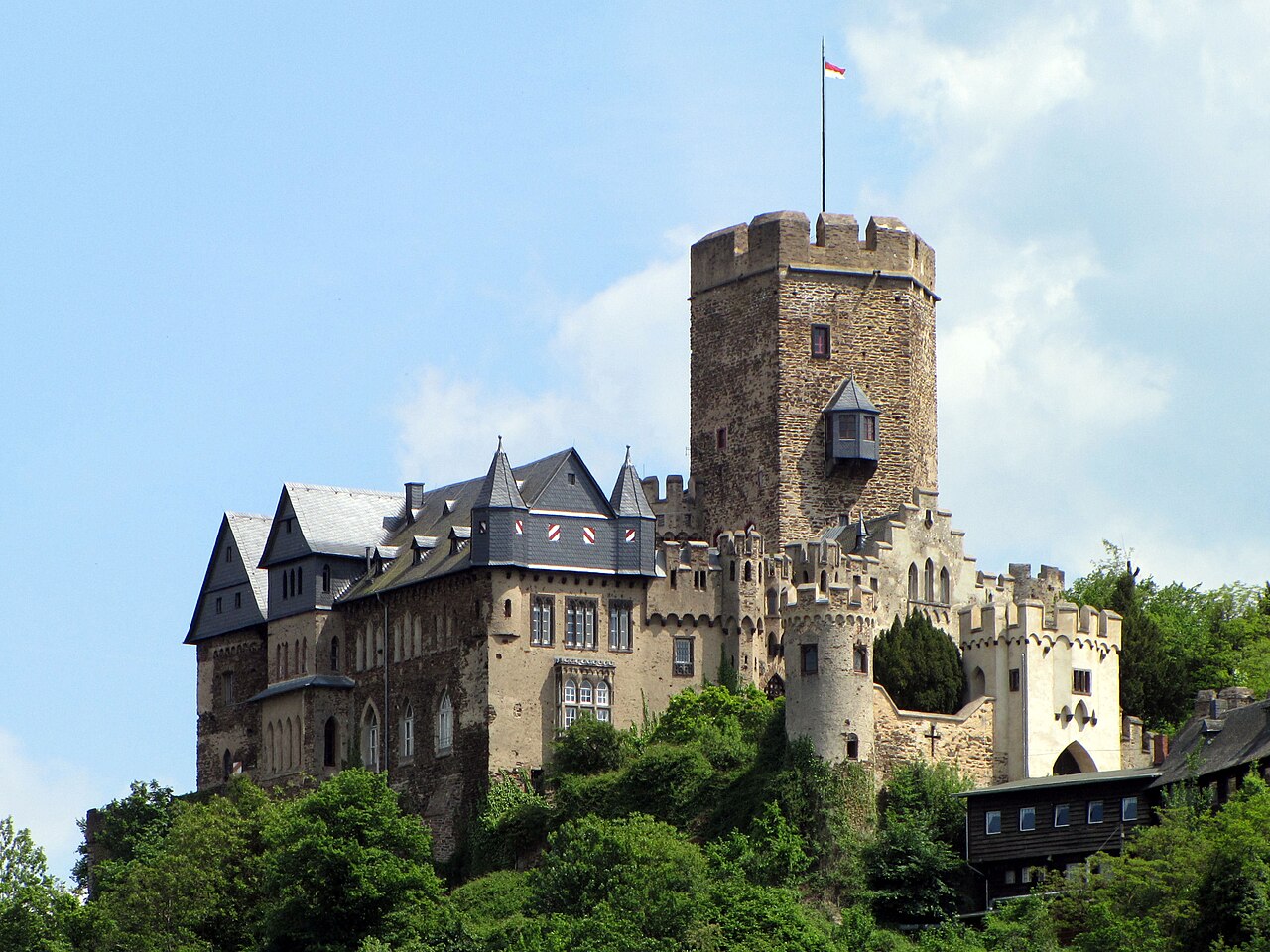
Lahneck Castle stands majestically on a steep rock salient above the confluence of the Lahn River with the Rhine River in the town of Lahnstein, Germany. This 13th-century hill castle is a prime example of medieval fortress architecture, notable for its strategic location opposite the famous Stolzenfels Castle. Its commanding position allowed it to control the important waterways and protect the Archbishopric of Mainz's territorial interests. The castle's layout features a symmetrical, oblong rectangular plan typical of the late Hohenstaufen period, with a rare pentagonal bergfried (keep) that stands approximately 29 meters tall, designed to deflect projectiles and provide panoramic views of the surrounding valleys. Historical significance and construction Lahneck Castle was constructed in 1226 by Archbishop Siegfried III of Eppstein to secure his newly acquired territories around the mouth of the Lahn River, including the town of Oberlahnstein and nearby silver mines obtained in 1220. The castle served as both a military fortress and administrative center. By 1245, the castle chapel dedicated to Saint Ulrich of Augsburg was completed, marking the castle's religious importance. That same year, the first burgrave, Embricho von Lahneck, took residence, overseeing the castle's governance. Throughout the late 13th and early 14th centuries, Lahneck Castle was a focal point of regional power struggles. In 1298, King Adolf of Nassau stayed at the castle shortly before his death in the Battle of Göllheim. The castle's burgrave, Friedrich Schilling of Lahnstein, later conspired against King Albert I of Habsburg, leading to the castle's storming in 1309 and Schilling's execution. A notable legend recounts that the last twelve Knights Templar sought refuge in Lahneck after their order was disbanded in 1312, perishing heroically in battle against forces of Archbishop Peter of Aspelt. Architectural features and fortifications The castle's design exemplifies late medieval military architecture. The pentagonal bergfried is a distinctive feature, with its pointed side oriented southward to deflect attacks. The thick stone walls and symmetrical layout reflect the defensive needs of the period. Significant enhancements were made in 1475 under Archbishop Theodoric of Isenburg-Büdingen, who added two outer curtain walls, a zwinger (killing zone), three shell towers for flanking fire, the Fox Tower, and a square gate tower on the vulnerable side of the castle. These fortifications strengthened Lahneck's defenses during the Mainz Bishops Feud. The castle chapel, built in the Gothic style, contains a preserved copy of a 1332 papal indulgence granted by Pope John XXII, underscoring the site's religious significance. The castle's interior also houses a life-sized portrait of Queen Victoria, a relic from the ownership period of Earl Kleist-Tychow. Damage, restoration, and ownership history Lahneck Castle suffered considerable damage during the Thirty Years' War in the 17th century, when Swedish and Imperial troops attacked in 1632 and 1636. Later, in 1688, French forces burned the roofs during the Nine Years' War, leading to further decline. Following the German Mediatisation of 1803, the castle passed from ecclesiastical to secular control under the Duchy of Nassau and was sold into private hands in 1850. Notable private owners have included Edward Moriarty, director of the Rhenish Railway Company; Count Ewald von Kleist-Wendisch-Tychow, who presented the Queen Victoria portrait; and Imperial Admiral Robert Mischke, who purchased the castle in 1907 and whose family retains ownership today. Restoration efforts began in the mid-19th century and continued sporadically into the early 20th century, including neo-Gothic style modifications such as replacing flat roofs with pointed ones and removing romantic crenellations to better reflect the castle's medieval character. Cultural significance and legends Lahneck Castle is steeped in cultural history and folklore. The castle inspired the renowned German poet Johann Wolfgang von Goethe to write the poem "Geistesgruß" in 1774 during his travels along the Lahn River. The castle is also known internationally for the tragic story of Idilia Dubb, a 17-year-old English girl who died in 1851 after becoming trapped in the castle's pentagonal bergfried when the wooden stairs collapsed. Her diary, discovered years later hidden within the castle walls, recounts her final days and has contributed to the castle's mystique and notoriety. Today, Lahneck Castle is part of the Upper Middle Rhine Valley UNESCO World Heritage Site, recognized for its historical, architectural, and cultural value. It remains a popular destination for hikers and history enthusiasts, connected to major regional trails such as the Rheinsteig, Rheinhöhenweg, Lahnhöhenweg, and the Lahn-Camino. Architectural remains and visitor experience The castle sits atop a rock spur approximately 164 meters above sea level, offering commanding views of the Lahn and Rhine river valleys. Visitors can admire the well-preserved medieval fortifications, including the imposing bergfried, curtain walls, zwinger, shell towers, and gate structures. Although public access to the bergfried is restricted due to safety concerns, guided tours occasionally provide limited entry. The castle chapel remains a highlight for visitors, featuring its Gothic architecture and the historic indulgence document. The castle's interior and grounds offer a glimpse into its layered history, from medieval military stronghold to romanticized 19th-century restoration and modern heritage site. Archaeological excavations have uncovered artifacts and skeletal remains linked to the castle's dramatic past, including those associated with Idilia Dubb. These findings enrich the narrative of Lahneck Castle and its enduring place in German cultural heritage.

High Medieval (11th–13th c.)
Details