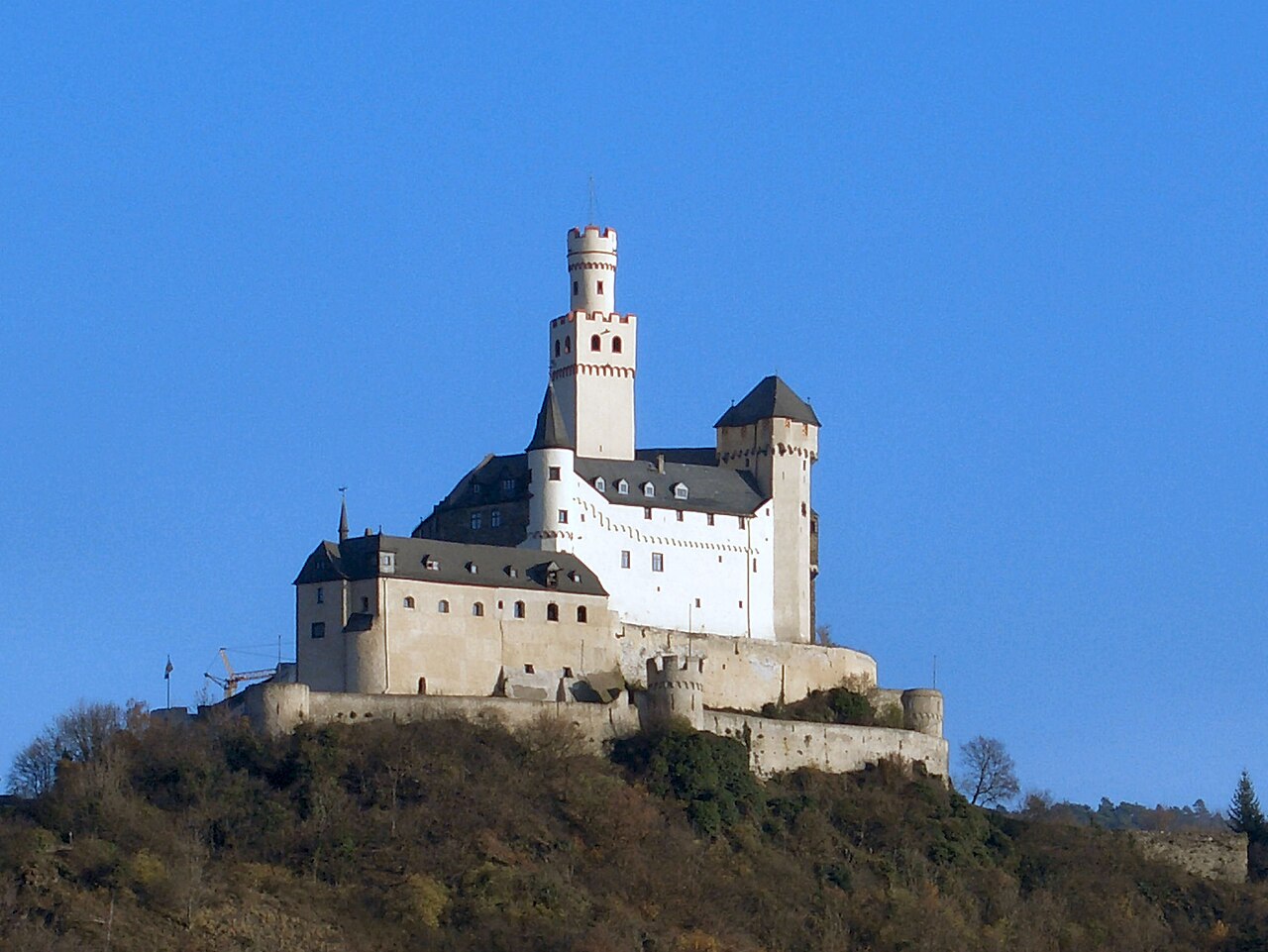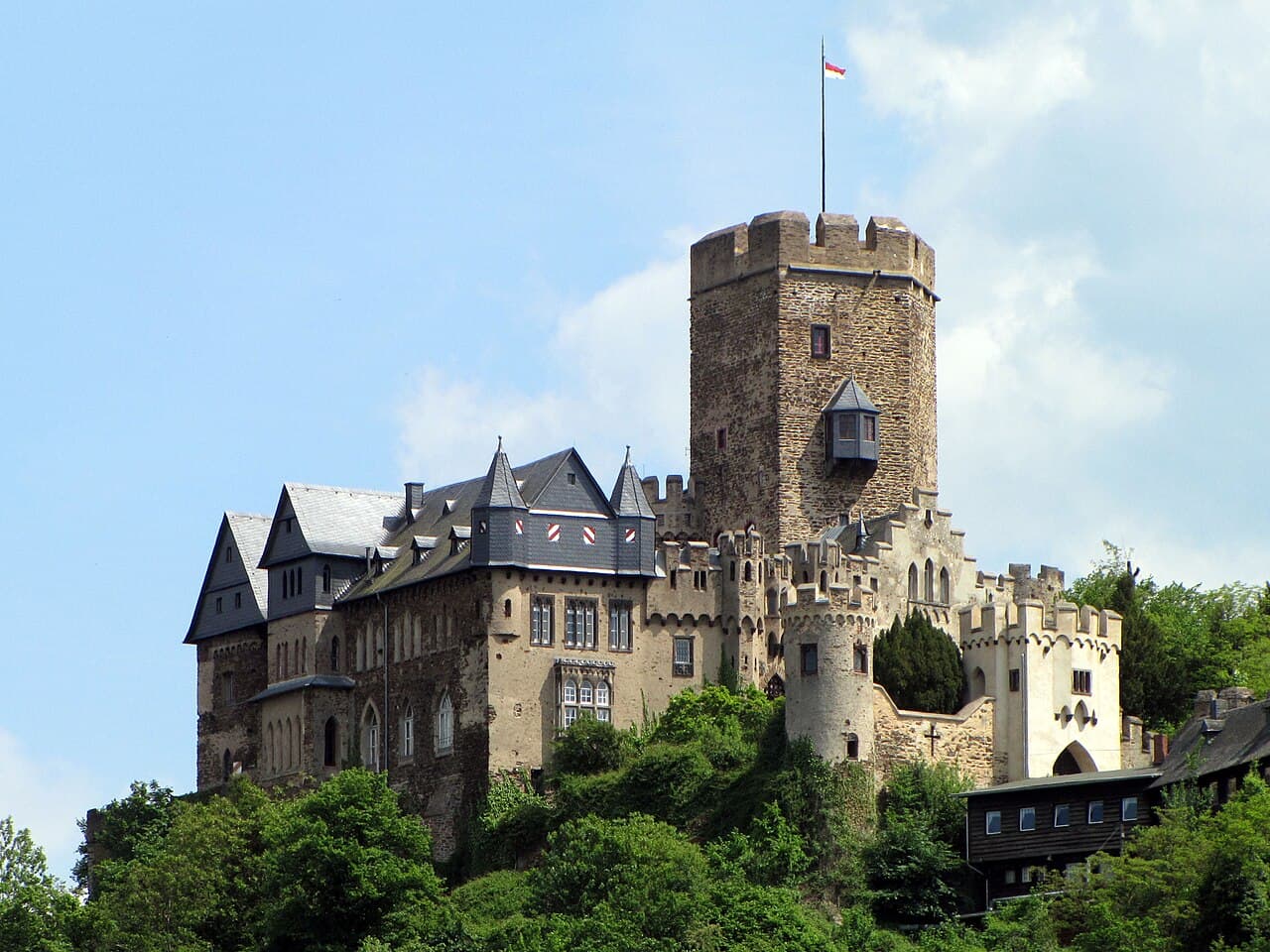
Lahneck Castle
Lahneck Castle stands majestically on a steep rock salient above the confluence of the Lahn River with the Rhine River in the town of Lahnstein, Germany. This 13th-century hill castle is a prime example of medieval fortress architecture, notable for its strategic location opposite the famous Stolzenfels Castle. Its commanding position allowed it to control the important waterways and protect the Archbishopric of Mainz's territorial interests. The castle's layout features a symmetrical, oblong rectangular plan typical of the late Hohenstaufen period, with a rare pentagonal bergfried (keep) that stands approximately 29 meters tall, designed to deflect projectiles and provide panoramic views of the surrounding valleys.
Historical significance and construction
Lahneck Castle was constructed in 1226 by Archbishop Siegfried III of Eppstein to secure his newly acquired territories around the mouth of the Lahn River, including the town of Oberlahnstein and nearby silver mines obtained in 1220. The castle served as both a military fortress and administrative center. By 1245, the castle chapel dedicated to Saint Ulrich of Augsburg was completed, marking the castle's religious importance. That same year, the first burgrave, Embricho von Lahneck, took residence, overseeing the castle's governance.
Throughout the late 13th and early 14th centuries, Lahneck Castle was a focal point of regional power struggles. In 1298, King Adolf of Nassau stayed at the castle shortly before his death in the Battle of Göllheim. The castle's burgrave, Friedrich Schilling of Lahnstein, later conspired against King Albert I of Habsburg, leading to the castle's storming in 1309 and Schilling's execution. A notable legend recounts that the last twelve Knights Templar sought refuge in Lahneck after their order was disbanded in 1312, perishing heroically in battle against forces of Archbishop Peter of Aspelt.
Architectural features and fortifications
The castle's design exemplifies late medieval military architecture. The pentagonal bergfried is a distinctive feature, with its pointed side oriented southward to deflect attacks. The thick stone walls and symmetrical layout reflect the defensive needs of the period. Significant enhancements were made in 1475 under Archbishop Theodoric of Isenburg-Büdingen, who added two outer curtain walls, a zwinger (killing zone), three shell towers for flanking fire, the Fox Tower, and a square gate tower on the vulnerable side of the castle. These fortifications strengthened Lahneck's defenses during the Mainz Bishops Feud.
The castle chapel, built in the Gothic style, contains a preserved copy of a 1332 papal indulgence granted by Pope John XXII, underscoring the site's religious significance. The castle's interior also houses a life-sized portrait of Queen Victoria, a relic from the ownership period of Earl Kleist-Tychow.
Damage, restoration, and ownership history
Lahneck Castle suffered considerable damage during the Thirty Years' War in the 17th century, when Swedish and Imperial troops attacked in 1632 and 1636. Later, in 1688, French forces burned the roofs during the Nine Years' War, leading to further decline. Following the German Mediatisation of 1803, the castle passed from ecclesiastical to secular control under the Duchy of Nassau and was sold into private hands in 1850.
Notable private owners have included Edward Moriarty, director of the Rhenish Railway Company; Count Ewald von Kleist-Wendisch-Tychow, who presented the Queen Victoria portrait; and Imperial Admiral Robert Mischke, who purchased the castle in 1907 and whose family retains ownership today. Restoration efforts began in the mid-19th century and continued sporadically into the early 20th century, including neo-Gothic style modifications such as replacing flat roofs with pointed ones and removing romantic crenellations to better reflect the castle's medieval character.
Cultural significance and legends
Lahneck Castle is steeped in cultural history and folklore. The castle inspired the renowned German poet Johann Wolfgang von Goethe to write the poem "Geistesgruß" in 1774 during his travels along the Lahn River. The castle is also known internationally for the tragic story of Idilia Dubb, a 17-year-old English girl who died in 1851 after becoming trapped in the castle's pentagonal bergfried when the wooden stairs collapsed. Her diary, discovered years later hidden within the castle walls, recounts her final days and has contributed to the castle's mystique and notoriety.
Today, Lahneck Castle is part of the Upper Middle Rhine Valley UNESCO World Heritage Site, recognized for its historical, architectural, and cultural value. It remains a popular destination for hikers and history enthusiasts, connected to major regional trails such as the Rheinsteig, Rheinhöhenweg, Lahnhöhenweg, and the Lahn-Camino.
Architectural remains and visitor experience
The castle sits atop a rock spur approximately 164 meters above sea level, offering commanding views of the Lahn and Rhine river valleys. Visitors can admire the well-preserved medieval fortifications, including the imposing bergfried, curtain walls, zwinger, shell towers, and gate structures. Although public access to the bergfried is restricted due to safety concerns, guided tours occasionally provide limited entry.
The castle chapel remains a highlight for visitors, featuring its Gothic architecture and the historic indulgence document. The castle's interior and grounds offer a glimpse into its layered history, from medieval military stronghold to romanticized 19th-century restoration and modern heritage site.
Archaeological excavations have uncovered artifacts and skeletal remains linked to the castle's dramatic past, including those associated with Idilia Dubb. These findings enrich the narrative of Lahneck Castle and its enduring place in German cultural heritage.
Frequently asked questions (FAQ)
- How do I get to Lahneck Castle?
- Lahneck Castle is located in Lahnstein, Germany, and can be reached by car or local public transport. It is accessible via hiking trails such as the Rheinsteig and Lahnhöhenweg, which offer scenic routes to the castle.
- What is the historical significance of Lahneck Castle?
- Lahneck Castle was built in 1226 to protect the Archbishopric of Mainz's territories and played a key role in regional politics, including hosting important events like the deposition of King Wenceslaus in 1400.
- Can I visit the bergfried (keep) of Lahneck Castle?
- Public access to the pentagonal bergfried is generally restricted due to safety concerns. However, guided tours occasionally allow limited entry to parts of the tower.
- When was Lahneck Castle restored?
- Restoration efforts began in the mid-19th century and continued sporadically into the early 20th century, including neo-Gothic style modifications to roofs and battlements.
- Is Lahneck Castle part of a UNESCO World Heritage Site?
- Yes, Lahneck Castle is part of the Upper Middle Rhine Valley UNESCO World Heritage Site, recognized for its cultural and historical significance.
- What legends are associated with Lahneck Castle?
- A famous legend tells of the last twelve Knights Templar who took refuge in the castle in 1312 and died heroically defending it. The tragic story of Idilia Dubb, who died trapped in the bergfried in 1851, also adds to the castle's lore.
- Are there any notable artifacts inside Lahneck Castle?
- Inside the castle chapel, visitors can see a preserved copy of a 1332 papal indulgence granted by Pope John XXII. The castle also houses a life-sized portrait of Queen Victoria from the 19th century.
Photo gallery

Information
Sources & official resources
Verify the information above using these authoritative references.
Loading map...
Visitor reviews
No reviews yet. Been here? Write the first review and help other travelers!
Write the first reviewVisited this castle? Share your experience
Your review helps other travelers and adds first-hand knowledge to our encyclopedia.