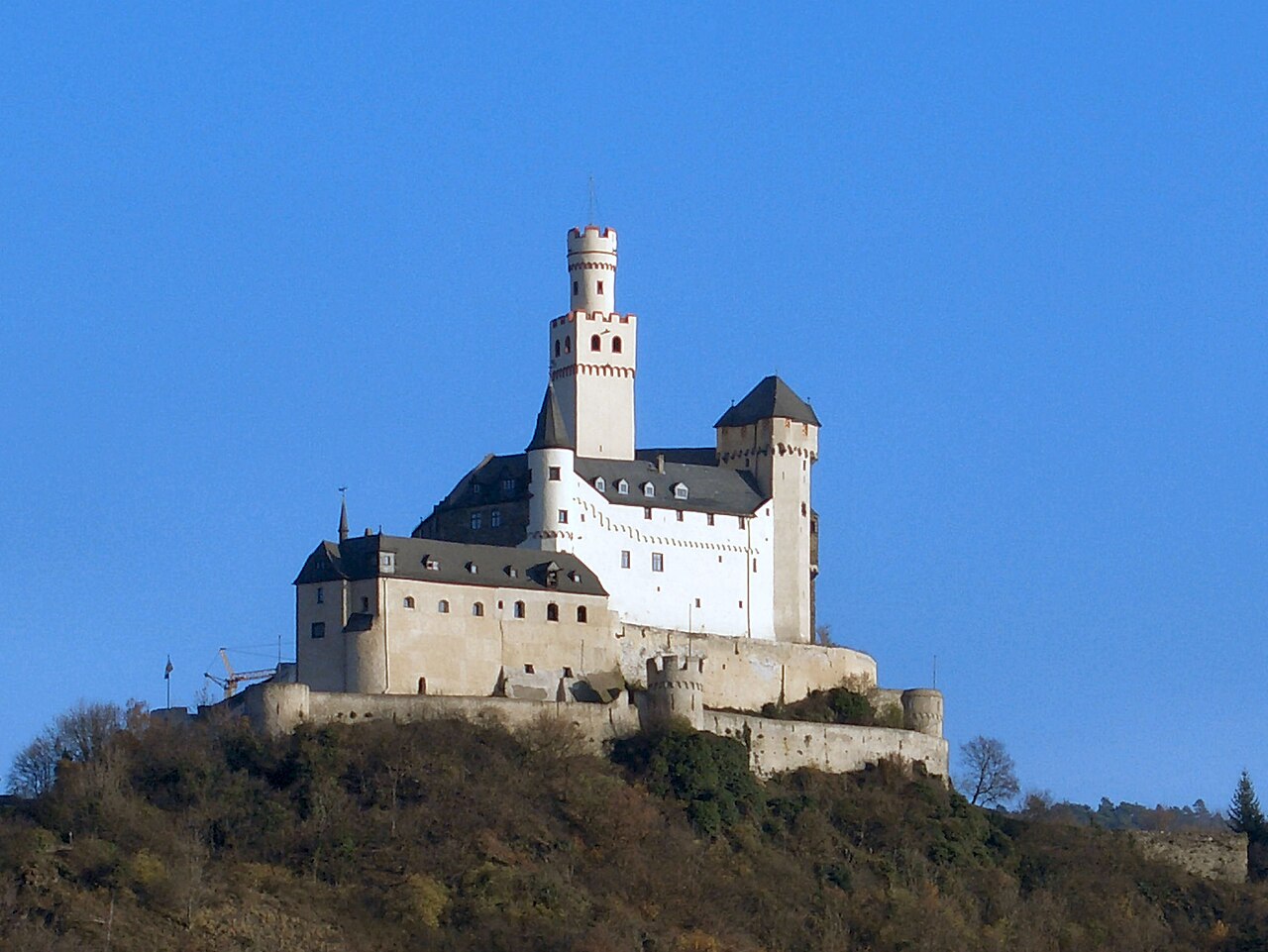
Marksburg Castle
Marksburg castle stands as an exceptional example of medieval fortification perched on a steep slate hill above the town of Braubach in Rhineland-Palatinate, Germany. It is renowned as the only medieval castle in the Middle Rhine Valley that has never been destroyed, preserving its original defensive structures and architectural heritage remarkably intact through over eight centuries. This hill castle embodies the evolution of castle architecture from the High Medieval period through the late Gothic era, reflecting the strategic importance of the Rhine River corridor and the political power of its successive noble owners.
The castle's origins trace back to around 1117, when the noble freemen of Brubach likely constructed the initial keep on the site. The first documented mention of the castle itself dates from 1231, identifying it as a fortified seat under the control of the influential Lords of Eppstein. The Eppsteins were a powerful family in the region, producing several archbishops and electors of Mainz and Trier during the 13th century, which contributed to the castle's prominence and early development.
The architectural evolution of Marksburg castle
Romanesque foundations and Staufer influence
The castle's original design reflects the Romanesque architectural style typical of the Staufer era, characterized by its roughly triangular layout adapted to the natural topography of the 160-meter-high slate cone. The oldest surviving structure is the north wing, a two-story palas or main residential hall featuring double-arched window arcades and thick stone walls. This wing served as the primary living quarters during the early medieval period.
Gothic expansions under the Katzenelnbogen counts
In 1283, ownership passed to the Counts of Katzenelnbogen, a wealthy and influential family who extensively remodeled the castle in the Gothic style during the 14th and 15th centuries. They added significant defensive and residential elements, including the raising of the keep around 1468 by Philipp I of Katzenelnbogen, who added the distinctive four-story "Butterfass" turret with its octagonal upper section, battlements, and covered walkway.
The chapel tower (Kapellenturm) was also enhanced during this period, featuring a chapel dedicated to Saint Markus on its third floor, which gave the castle its current name, Marksburg, replacing the original name Burg Brubach. The chapel contains a remarkable 13th-century ten-part rib vault and frescoes depicting New Testament scenes added in the early 20th century.
Fortifications and adaptations for gunpowder warfare
By the 14th century, the castle was surrounded by a ring wall with zwingers—outer wards designed to trap and expose attackers. In the 16th and 17th centuries, the castle was further fortified with artillery bastions, ramparts, and batteries to adapt to the advent of gunpowder weaponry. These additions were overseen notably by John "the Belligerent" of Hesse, who transformed Marksburg into a formidable hill fortress.
Historical significance and ownership
From noble residence to fortress and prison
Marksburg served primarily to protect the citizens and the strategic Rhine crossing near Braubach. After the Katzenelnbogen line ended in 1479, the castle passed by marriage to the Landgraves of Hesse. Although it became a widow's residence for a time, the construction of the nearby Philippsburg in the late 16th century diminished its residential importance.
During the Thirty Years' War, the castle was repaired and maintained as a defensive site but ceased to function as a noble residence. In the Napoleonic era, it was repurposed as a hospital for invalid soldiers and a state prison, with prison cells installed in the Gothic hall that were later removed in 1901.
Preservation by the German Castles Association
Following a period of military use and neglect under Prussian administration after 1866, the castle was in danger of decay. In 1900, with support from Kaiser Wilhelm II and the initiative of architect Bodo Ebhardt, the German Castles Association (Deutsche Burgenvereinigung) purchased Marksburg for a symbolic price of 1,000 gold marks. Extensive restoration efforts were undertaken to preserve its medieval character, including the reconstruction of the Butterfass turret in 1905.
Marksburg remains the headquarters of the German Castles Association, which maintains a specialist library and archives on castle history. The castle is open to the public year-round and serves as a museum showcasing medieval life and architecture.
Architectural features and castle grounds
The keep and defensive towers
The 40-meter-high keep (Bergfried) is the castle’s dominant feature, originally a three-story square tower built around 1237 and heightened in the late 15th century. The Butterfass turret at its summit is a unique architectural element symbolizing the castle’s adaptation to changing military needs.
Other towers include the Kapellenturm, with its chapel and seven floors, and a four-story corner tower west of the palas, all integrated into the castle’s defensive system with battlements and arrow slits.
Residential and functional buildings
The castle houses a Gothic two-story hall measuring six by twenty-four meters, used historically for feasts and assemblies. Nearby stands a timber-framed bakery with a vaulted cellar, illustrating the self-sufficiency of the castle community.
Inside, visitors can explore reconstructed medieval rooms including a kitchen with a hearth, a wine press dated 1767, a small heated chamber called a Kemenate, and a knights’ hall with an adjacent garderobe (toilet). The castle also contains a torture chamber and a smithy featuring an anvil from 1865.
Defensive walls and outer wards
The castle’s ring wall with its zwingers, including the Inner Zwinger and the Rheinzwinger (outer ward), feature bastions and artillery batteries added in the early modern period. Fortified gates such as the Schartentor and Fuchstor have covered battlements to protect defenders.
Gardens and preservation efforts
A herb garden was established in 1969 within the former zwinger area, cultivating about 170 medieval herbs and medicinal plants, enhancing the historical ambiance of the castle grounds. Starting in 1987, the castle’s exterior walls were restored with new white plaster to maintain its late medieval appearance.
Marksburg castle in the modern era
Despite suffering artillery damage in March 1945 during World War II, which partially destroyed the Butterfass turret and several roofs, the castle was meticulously restored by 1980. Today, Marksburg is one of the best-preserved medieval castles in Germany and a significant cultural landmark.
Since 2002, it has been part of the UNESCO World Heritage Site Upper Middle Rhine Valley, protected under German and international heritage laws. The castle’s preservation exemplifies successful heritage conservation, allowing visitors to experience an authentic medieval fortress that has survived the vicissitudes of history largely intact.
Marksburg’s combination of Romanesque foundations, Gothic enhancements, and early modern fortifications offers a comprehensive insight into castle architecture and military evolution from the High Middle Ages through the Renaissance and beyond. Its continuous occupation, adaptive reuse, and dedicated restoration efforts make it a unique monument in the Rhine region and a must-visit destination for enthusiasts of medieval history and architecture.
Frequently asked questions (FAQ)
- How do I get to Marksburg Castle?
- Marksburg Castle is located in Braubach, Germany, and can be reached by car or public transportation. The nearest train station is in Braubach, from which you can walk to the castle or take a shuttle service during peak season.
- What is the historical significance of Marksburg Castle?
- Marksburg Castle is one of the few castles along the Rhine River that has never been destroyed. It dates back to the 12th century and served as a stronghold for the local nobility, playing a vital role in the defense and administration of the region.
- When was Marksburg Castle built?
- Marksburg Castle was originally constructed in the 12th century, around 1117. Over the centuries, it has undergone numerous renovations and expansions, reflecting the architectural styles of various periods.
- Can I take a guided tour of Marksburg Castle?
- Yes, guided tours are available at Marksburg Castle, providing visitors with an in-depth understanding of its history and architecture. These tours are conducted in multiple languages and offer insights into the castle's strategic importance and daily life during its heyday.
- Why is Marksburg Castle a popular tourist destination?
- Marksburg Castle is popular for its well-preserved medieval architecture and stunning views of the Rhine River. Visitors are drawn to its rich history, picturesque location, and the opportunity to explore a genuine castle experience.
- Is it possible to visit Marksburg Castle year-round?
- Marksburg Castle is open to visitors throughout the year, but opening hours may vary seasonally. It’s advisable to check the official website for specific timings and any potential closures due to weather or special events.
- What are the ticket prices for Marksburg Castle?
- Ticket prices for Marksburg Castle vary based on age and group size, with discounts available for children and families. As of 2023, adult tickets are typically around €8, while children under 6 can enter for free.
- What is the best time to visit Marksburg Castle?
- The best time to visit Marksburg Castle is during the spring and early autumn when the weather is mild and pleasant. Additionally, visiting during weekdays can help avoid larger crowds, allowing for a more enjoyable experience.
- Are there any nearby attractions to Marksburg Castle?
- Yes, nearby attractions include the charming town of Braubach, the scenic Rhine River, and other castles like Stolzenfels Castle. Visitors can also explore the surrounding vineyards and partake in wine tasting tours in the region.
Information
Website
Visit websiteSources & official resources
Verify the information above using these authoritative references.
Loading map...
Visitor reviews
No reviews yet. Been here? Write the first review and help other travelers!
Write the first reviewVisited this castle? Share your experience
Your review helps other travelers and adds first-hand knowledge to our encyclopedia.