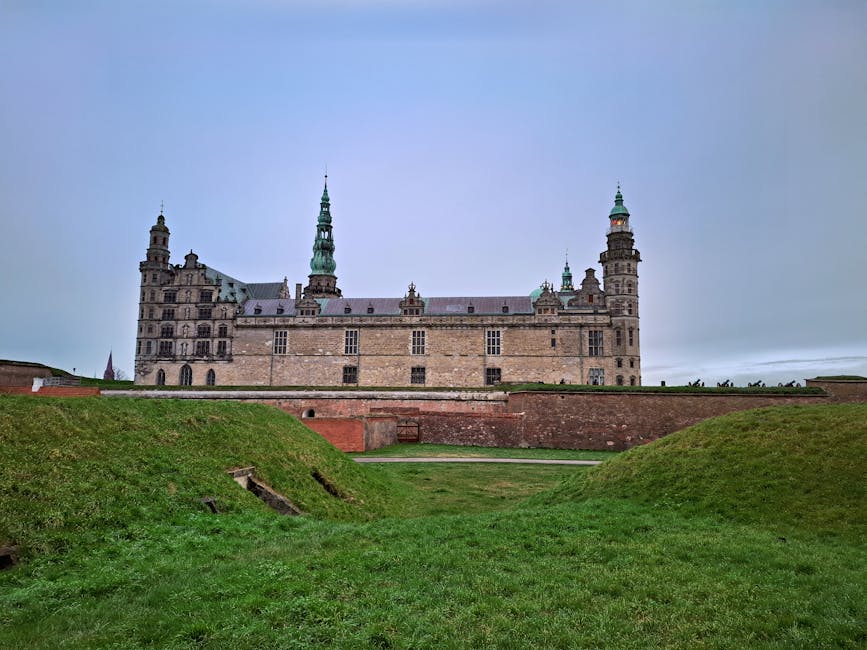
Marienlyst Castle
Marienlyst Castle, located in Helsingør, Denmark, is a distinguished example of post-Renaissance architecture, originally constructed between 1759 and 1763. The castle was named after Queen Juliana Maria, the second wife of King Frederik V of Denmark, reflecting its close ties to Danish royalty. It served primarily as a royal pavilion and a venue for leisure activities such as hunting, complementing the nearby Kronborg Castle.
Historical background and royal connections
The site of Marienlyst Castle has a rich history dating back to the late 16th century. The original pavilion and parterre garden were designed in 1587 by the royal architect Hans van Steenwinckel for King Frederick II of Denmark. This early structure served as a royal retreat and was part of the extensive estate associated with Kronborg Castle, one of Denmark's most famous fortresses.
In 1758, the estate was purchased by Count Adam Gottlob Moltke, a prominent Danish statesman and courtier. Moltke commissioned the French architect Nicolas-Henri Jardin to redesign the pavilion and gardens, resulting in the current architectural form of Marienlyst Castle. Jardin's work between 1759 and 1763 transformed the building into a refined example of classical architecture with a symmetrical façade and elegant proportions characteristic of the period.
Architectural features and garden design
The castle's architectural style reflects the post-Renaissance period with strong influences of French classical design. Jardin's redesign included not only the building itself but also the surrounding gardens. He replaced the original parterre with a larger and more formal garden laid out in the à la française style, featuring symmetrical hedges, straight avenues, fountains, and mirror ponds. This design emphasized order, control, and harmony with the architecture of the castle.
Within the castle's walls, much of Jardin's garden design remains intact, preserving the formal elegance intended by the 18th-century architect. However, the estate's outer gardens have undergone significant changes over the centuries. Notably, the romantic landscape garden created by Johan Ludvig Mansa in the 1790s, once considered Denmark's most renowned, was largely lost due to municipal sales and development.
The romantic garden and later changes
After Helsingør municipality acquired the Marienlyst estate in 1851, much of the original property was sold off. One notable development was the construction of Hotel Marienlyst in 1859 by J.S. Nathanson, Denmark's first luxury hotel in Helsingør, named after the castle. The romantic garden designed by Mansa was eventually removed between 1919 and 1921 by local gardener Gudmund Nyeland Brandt, who replaced it with an 18th-century style garden more in keeping with the castle's classical architecture.
Today, visitors to Marienlyst Castle can experience the formal gardens as they were restored in the early 20th century, which remain part of the Helsingør Municipality Museums since 1930. These gardens reflect the castle's architectural heritage and provide insight into the evolving landscape design trends in Denmark from the Renaissance through the post-Renaissance period.
Use and ownership through history
Beyond its royal origins, Marienlyst Castle has served various roles. Between 1796 and 1847, it was the residence of Colonel Adam Gottlob von Krogh, the director-general of the Øresund Customs House, and his wife Magdalene. This period marked a shift from purely royal leisure use to a more administrative and private function.
Since the 20th century, the castle and its grounds have been managed by Helsingør Municipality Museums, ensuring preservation and public access. The castle's location near the historic Kronborg Castle adds to its cultural significance and appeal to visitors interested in Danish history and architecture.
Architectural significance and preservation
Marienlyst Castle stands as a well-preserved example of 18th-century Danish architecture influenced by French classicism. Its symmetrical design, formal gardens, and historical associations with Danish royalty and prominent figures contribute to its importance. The castle's preservation allows for an understanding of the transition in architectural styles and garden designs from the Renaissance to the post-Renaissance era in Denmark.
The formal gardens, fountains, and mirror ponds are key features that visitors can appreciate, showcasing the aesthetic values of the time. Although some original landscape elements have been lost, the current grounds maintain the character envisioned by Nicolas-Henri Jardin and later restorers.
Frequently asked questions (FAQ)
- What is the historical significance of Marienlyst Castle?
- Marienlyst Castle was originally a royal pavilion connected to Kronborg Castle and named after Queen Juliana Maria. It reflects 18th-century Danish architecture and garden design influenced by French classicism.
- Can I visit the gardens at Marienlyst Castle?
- Yes, the formal gardens designed in the 18th century are largely intact and open to visitors. They showcase symmetrical hedges, fountains, and mirror ponds characteristic of the à la française style.
- When was Marienlyst Castle built?
- The current structure of Marienlyst Castle was built between 1759 and 1763 under the direction of Count Adam Gottlob Moltke and architect Nicolas-Henri Jardin.
- Who was the architect of Marienlyst Castle?
- The French architect Nicolas-Henri Jardin redesigned Marienlyst Castle and its gardens in the mid-18th century, giving it its present classical appearance.
- Is Marienlyst Castle open to the public?
- Marienlyst Castle is managed by Helsingør Municipality Museums, which ensures public access to the castle and its gardens, although specific visiting hours may vary.
Information
Architect
Nicolas-Henri Jardin
Current owner
Helsingør Municipality Museums
Website
Visit websiteSources & official resources
Verify the information above using these authoritative references.
Loading map...
Visitor reviews
No reviews yet. Been here? Write the first review and help other travelers!
Write the first reviewVisited this castle? Share your experience
Your review helps other travelers and adds first-hand knowledge to our encyclopedia.