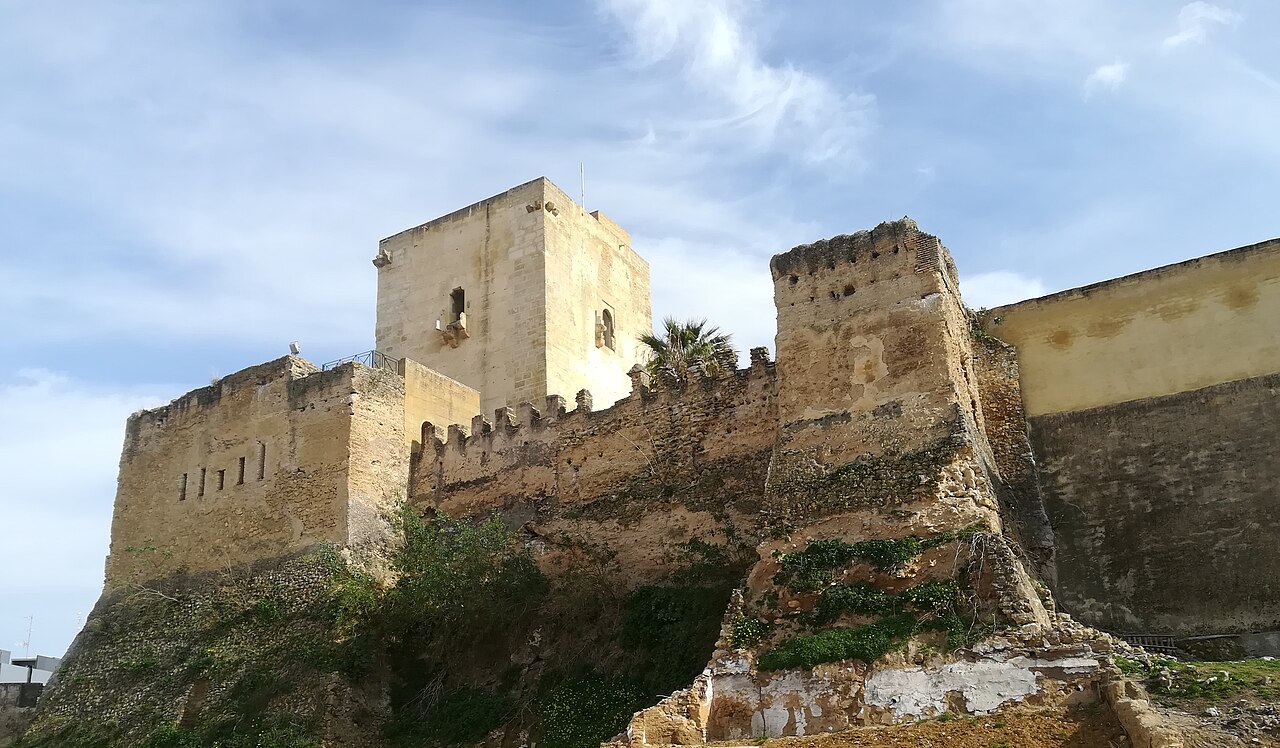
Marchenilla Castle
Marchenilla Castle stands prominently on a high promontory near Alcalá de Guadaíra in Spain, offering commanding views of the surrounding landscape. Its strategic location atop a hill that once hosted Bronze Age settlements underscores the site's long-standing importance for defense and control. The castle's origins trace back to the 11th and 12th centuries during the period of Muslim domination in the Iberian Peninsula, although its current form largely reflects modifications made after the Christian Reconquest by Ferdinand III.
The castle's architectural evolution spans several centuries, with significant developments continuing into the late 15th and early 16th centuries. This prolonged period of construction and renovation reflects the castle's shifting role from a purely military fortress to a complex estate incorporating residential and religious functions.
Historical context and strategic importance
Originally constructed by Christian rulers at the end of the 13th century, Marchenilla Castle was built to defend against incursions by the Benimerines, a Muslim dynasty advancing from Ronda along the route known as the "camino de Morón." The castle’s initial design drew architectural inspiration from the nearby Alcalá de Guadaíra fortress, reflecting the military needs and styles of the time.
During the Late Middle Ages, the castle became part of the lordship of Gandul and Marchenilla, under the authority of Arnao de Solier. In the 14th century, ownership passed to the Velasco family, who undertook extensive expansions and renovations. These changes likely included the addition of a second rectangular enclosure and enhancements characteristic of Gothic military architecture, such as machicolations and battlements.
In the 17th century, the castle's function shifted as a chapel dedicated to San Isidro Labrador was constructed within its walls. A courtyard styled after a traditional Andalusian cortijo was also added, reflecting the castle’s adaptation to more residential and agricultural uses. The site is linked to the medieval landmark Calachibencarro, mentioned in a privilege issued by Alfonso X to define territorial borders near Carmona.
Architectural features and layout
The castle exhibits an almost square layout, typical of medieval fortifications, with robust corner towers and smaller sentry turrets positioned along the walls. The defensive walls and towers are topped with battlements designed to shield guards during attacks. Inside, several rooms feature ribbed vaults or crucería vaults, a hallmark of Gothic construction that combines structural strength with decorative elegance.
The keep (torre del homenaje)
A central feature of the castle is its keep, known as the torre del Homenaje. This tower has a rectangular base measuring approximately 8.60 by 7.10 meters. Its height is recorded as about 14.5 meters by Spanish sources, though some Catalan sources suggest a height up to 27 meters. The keep is constructed mainly from concrete reinforced with ashlar stone and brick. It rises over two floors and is crowned by a terrace.
Entry to the keep is through a narrow doorway on the southern side. The first floor features a vaulted ceiling with continuous stone benches along two walls. A large arch-shaped niche on the northern wall is finished with late Gothic decorative plaster molding, illustrating the blend of military and artistic elements within the castle.
Enclosures and defensive structures
The original fortified enclosure likely corresponds to the section now housing the castle’s farmhouse rooms, chapel, and storage granaries. This area was protected by a strong tower at the northeast corner, whose main gate is believed to survive on its western face. Above this gate, defensive machicolations—openings between supporting corbels—allowed defenders to attack enemies below.
The eastern boundary of the enclosure features a large courtyard enclosed by concrete walls reinforced with ashlar blocks, dating from later modifications. During the second half of the 15th century, probably under the Velasco family, a second rectangular enclosure was added to the north. This expansion includes two round towers at the corners, each topped with projecting machicolations supported by Gothic trilobed arches. Between these towers is a semicircular balcony or turret centered on the battlemented wall, serving defensive and observational roles.
Religious and residential adaptations
The chapel dedicated to San Isidro Labrador within the castle walls reflects the site's religious significance in the early modern period. It contains a notable painting of the Virgin of Guadalupe, underscoring the blending of military and spiritual functions.
The courtyard styled as an Andalusian cortijo on the eastern side indicates the castle's adaptation to agricultural and residential uses. This transformation marks a departure from purely military purposes, highlighting the castle’s role as a multifaceted estate.
Current condition and ownership
Today, Marchenilla Castle remains privately owned. Its exterior has undergone significant alterations due to agricultural use and modifications to the walled enclosures and outer fortifications. Despite these changes, many original architectural elements survive, allowing visitors and historians to appreciate the castle's medieval military architecture and its evolution through centuries of Spanish history.
The castle's hilltop location continues to dominate the landscape, preserving its strategic importance and historical ambiance. While not fully restored, the castle's partially preserved state offers valuable insights into the high medieval fortification techniques and the later adaptations that reflect changing social and military needs.
Frequently asked questions (FAQ)
- What is the historical significance of Marchenilla Castle?
- Marchenilla Castle, located in Alcalá de Guadaíra, Spain, dates back to the 13th century and showcases the rich history of Moorish architecture. It played a vital role during the Reconquista, serving as a strategic fortress to protect the region from invasions.
- When was Marchenilla Castle built?
- The construction of Marchenilla Castle is believed to have begun in the late 1200s, during the period of Muslim rule in the Iberian Peninsula. The castle has undergone various renovations over the centuries, reflecting the architectural styles of different eras.
- Can I visit Marchenilla Castle?
- Yes, Marchenilla Castle is open to visitors who wish to explore its historical grounds and enjoy the panoramic views of Alcalá de Guadaíra. Guided tours are often available to provide deeper insights into the castle's history and significance.
- What are the opening hours of Marchenilla Castle?
- Marchenilla Castle is typically open to visitors from 10 AM to 6 PM, but hours may vary by season or for special events. It is advisable to check the official website for the most current information before planning your visit.
- Is it possible to access Marchenilla Castle with a wheelchair?
- While Marchenilla Castle has some accessible paths, the rugged terrain and historical structure may present challenges for wheelchair users. It is recommended to contact the site in advance to inquire about specific accessibility options and accommodations.
- What is the best time to visit Marchenilla Castle?
- The best time to visit Marchenilla Castle is during the spring and fall months when the weather is mild and pleasant. These seasons offer ideal conditions for exploring the grounds without the extreme heat of summer.
- Are there any nearby attractions to visit?
- Yes, nearby attractions include the picturesque Guadaíra River and the charming town of Alcalá de Guadaíra, known for its vibrant culture and historical sites. Visitors can also explore local parks and enjoy various walking trails around the castle.
- What are the ticket prices for Marchenilla Castle?
- Ticket prices for Marchenilla Castle are generally affordable, with discounts available for students and seniors. It's best to check the official website or contact the castle directly for the latest pricing information and any special offers.
Information
Loading map...
Visitor reviews
No reviews yet. Been here? Write the first review and help other travelers!
Write the first reviewVisited this castle? Share your experience
Your review helps other travelers and adds first-hand knowledge to our encyclopedia.