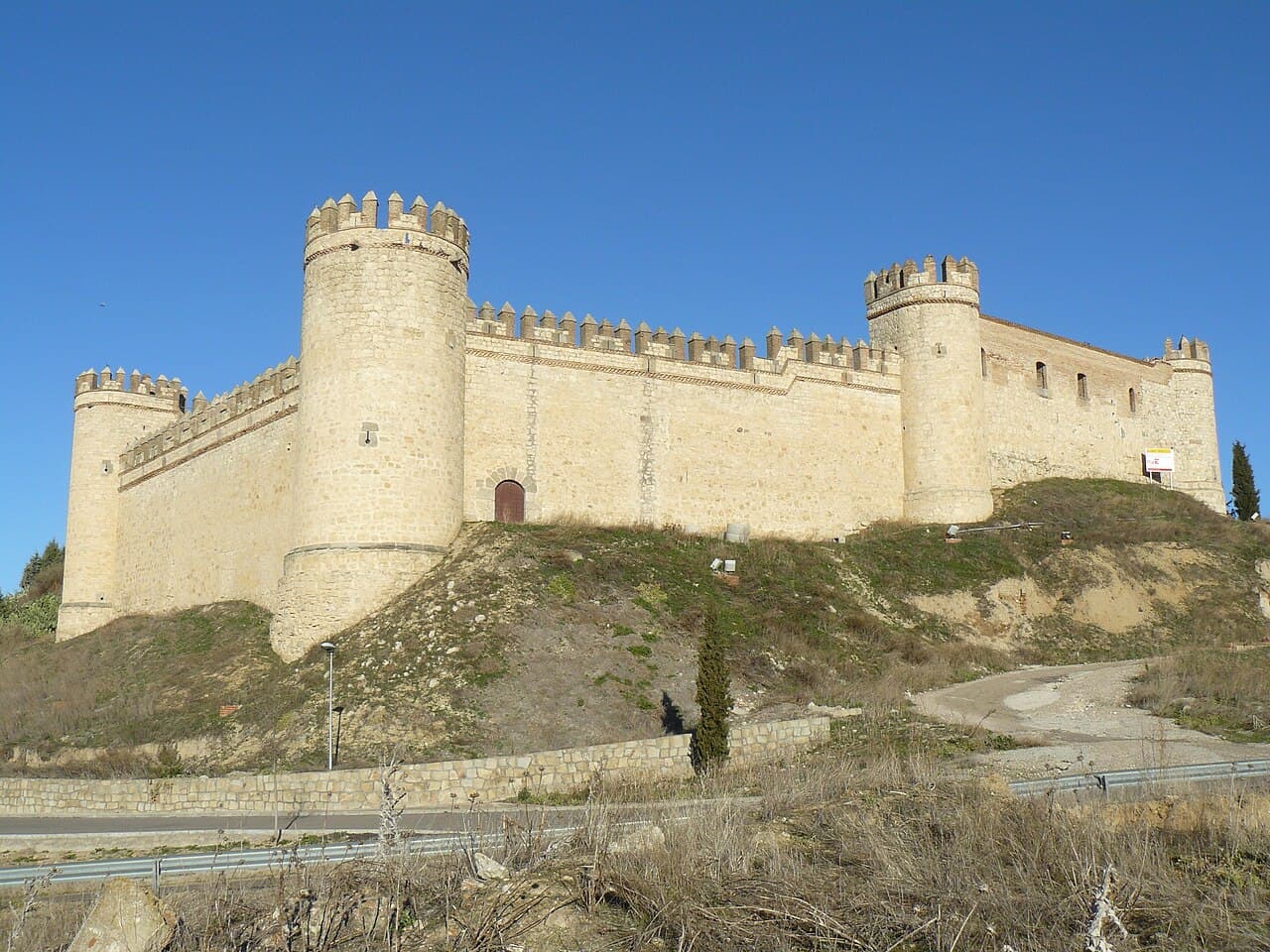
Maqueda Castle
Maqueda Castle stands prominently in the town of Maqueda, located in the province of Toledo, Spain. This Renaissance hill castle is notable for its strategic position atop a steep hill, offering commanding views of the surrounding landscape. Its origins trace back to ancient times, with early fortifications likely established by the Romans, highlighting the site's long-standing military importance.
The castle as it appears today was largely constructed in the 16th century, built upon earlier Moorish remains from the 15th century. These remnants reflect the Islamic architectural influence that persisted in the region during the medieval period. The castle’s rectangular layout, fortified with four round towers, is distinctive in that it lacks a central keep, which is unusual for castles of its era. The curtain walls are impressively thick—about 3.5 meters—and their varying heights adapt to the natural contours of the hill, demonstrating a sophisticated integration of architecture with the terrain.
Historical significance and evolution
The site of Maqueda Castle has a rich history extending back to at least the 10th century. In 981 AD, under the command of the military leader Almanzor, the fortress was significantly reinforced by the architect Fatho ben Ibrahim al-Omeya, marking a period of Islamic dominance and architectural advancement. This early fortification was part of a broader defensive strategy during the Islamic rule of the Iberian Peninsula.
The castle transitioned to Christian control in 1083 when Alfonso VI of León captured it. Subsequently, it was granted to Fernando Yáñez in 1153 and later donated to the Order of Calatrava in 1177. This military-religious order enhanced the castle’s defenses and used it as a commandery headquarters, underscoring its strategic and administrative importance during the Middle Ages.
Between 1196 and 1198, Maqueda Castle endured multiple sieges by the Almoravids, a Berber Muslim dynasty, showcasing its resilience and military significance. Throughout the 14th and 15th centuries, the castle was a focal point in regional power struggles, including its seizure by King Pedro the Cruel. Ownership passed through prominent noble families such as Álvaro de Luna, King Juan II, and the influential Mendoza lineage.
In the 15th century, Gutierre de Cárdenas ordered the demolition of the earlier fortress to construct the castle largely visible today. However, interior construction was never fully completed, which contributed to the castle’s gradual decline. The owners eventually preferred to reside in nearby Torrijos, leading to the castle’s reduced military and residential use. It remained in the possession of the Cárdenas family until the 19th century, when feudal lordships were abolished.
Following this, the Spanish government acquired the castle and repurposed it as barracks for the Civil Guard. In 1931, Maqueda Castle was officially recognized as a Historic-Artistic Monument and remains under the ownership of Spain’s Ministry of the Interior. Since 2013, there have been efforts to find a buyer for the property.
Architectural features and layout
The castle’s rectangular plan is adapted to the hilltop’s steep slopes, resulting in two distinct ground levels and a multi-tiered defensive structure. The curtain walls, constructed primarily of rubblework with some brickwork at the top, are crowned with peculiar merlons similar to those at the nearby Castle of San Silvestre in Novés. These battlements provide effective protection for defenders.
Originally, three round towers were positioned at the southern corners and the center of the eastern wall, with a fourth tower added later. The exact date of this addition is uncertain, but all four towers contribute to the castle’s formidable defense. The walls are approximately 3.5 meters thick, emphasizing the fortress’s strength.
The main gate is located in the northern wall and features a prominent coat of arms combining the heraldry of the Cárdenas and Enríquez families. Above the gate, a machicolation made of finely cut stone and brick offers protection by allowing defenders to drop projectiles on attackers. Behind the gate is an iron grille and a fortified passage about 2.5 meters high designed to trap invaders.
A postern gate in the eastern wall near a corner tower provided a discreet exit or entry point. Inside the castle, there are almost no remains of internal constructions, reflecting the unfinished state of the interior.
Defensive elements
The castle’s parapet and adarve (a narrow walkway along the wall’s edge) are well preserved, standing approximately 2.5 meters high. Arrow slits arranged in pairs between the solid merlons allowed archers to defend the castle efficiently while remaining protected. The castle was also protected by moats on two sides, enhancing its defensive capabilities.
Fortification within the town
Maqueda Castle was once part of a larger fortification system that enclosed the entire settlement, dating back to the 12th century. Although most of the town walls have disappeared, remnants survive in the form of towers known as Vela and Las Infantas. The castle stood at the eastern end of these walls, which were still intact in the 16th century.
Modern use and preservation
In recent decades, Maqueda Castle was utilized by the Guardia Civil and since 2009, it has housed a Guardia Civil museum, preserving the legacy of this Spanish law enforcement agency. The castle’s well-preserved exterior and imposing silhouette continue to attract visitors interested in medieval and Renaissance military architecture.
Despite its robust construction and historical significance, the castle’s interior remains largely unfinished and devoid of decorative elements, providing a stark contrast to its formidable exterior. This unfinished state offers a unique glimpse into the challenges of castle construction and the shifting priorities of its noble owners over centuries.
Maqueda Castle remains a significant cultural and historical monument in the region of Toledo, embodying centuries of Spanish history from Roman times through Islamic rule and Christian reconquest to modern heritage preservation.
Frequently asked questions (FAQ)
- How do I visit Maqueda Castle?
- Maqueda Castle is open to visitors who wish to explore its historic grounds and the Guardia Civil museum housed within. Check local tourism websites or the Guardia Civil museum for current opening hours and any visitor requirements.
- What is the historical significance of Maqueda Castle?
- Maqueda Castle has a rich history spanning Roman times, Islamic rule, and Christian reconquest. It played a strategic role in regional defense and was associated with notable figures such as Alfonso VI and the Order of Calatrava.
- Can I see the interior of Maqueda Castle?
- While the castle's exterior and defensive structures are well preserved, the interior remains largely unfinished with few internal constructions. Visitors can explore the grounds and the Guardia Civil museum but should not expect elaborate interior decorations.
- Why does Maqueda Castle have no keep?
- Unlike many medieval castles, Maqueda Castle was designed without a central keep. Its defense relied on thick curtain walls and multiple round towers adapted to the hilltop terrain, reflecting a unique architectural approach during its Renaissance reconstruction.
- Is Maqueda Castle accessible for people with mobility issues?
- Due to its hilltop location and historic structure, accessibility may be limited for visitors with mobility challenges. It is advisable to contact the museum or local tourist office for detailed accessibility information before visiting.
Photo gallery

Information
Sources & official resources
Verify the information above using these authoritative references.
Loading map...
Visitor reviews
No reviews yet. Been here? Write the first review and help other travelers!
Write the first reviewVisited this castle? Share your experience
Your review helps other travelers and adds first-hand knowledge to our encyclopedia.


