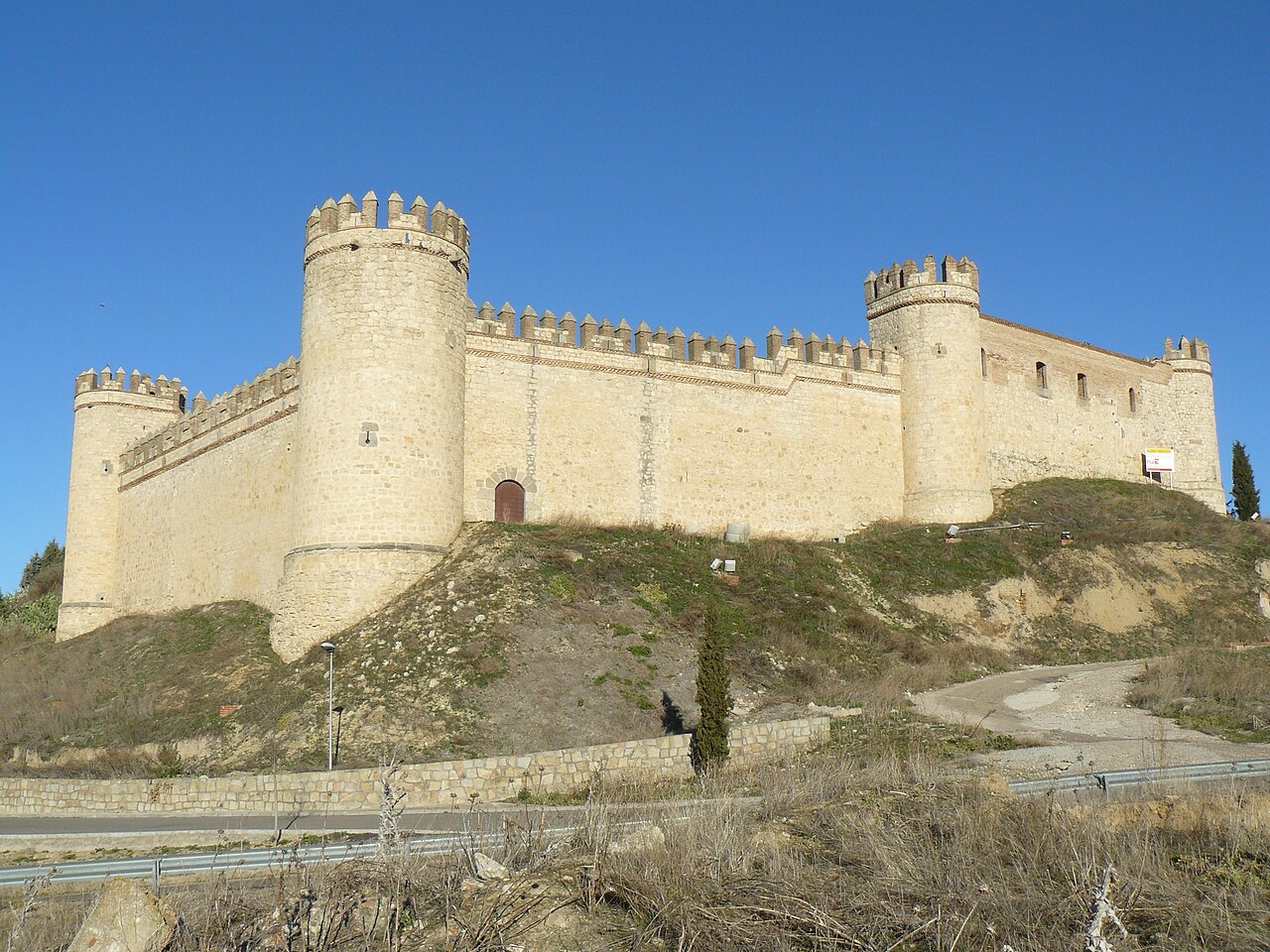
Castillo-palacio de Escalona
The Castillo-palacio de Escalona is a significant historic fortress located in the town of Escalona, Spain. This hill castle occupies a commanding plateau overlooking the Alberche River, a strategic position that historically controlled the vital route between the cities of Ávila and Toledo. Its origins trace back to a Roman fortress, reflecting the site's long-standing military importance.
Throughout its extensive history, the castle has witnessed numerous cultural and political transformations, evolving from a purely military stronghold into a grand palace complex. The castle's architecture is a remarkable example of the Mudéjar style, a distinctive fusion of Christian and Islamic artistic traditions that flourished in medieval Spain.
Early history and medieval significance
The earliest known construction on the site was a Roman fortress, chosen for its natural defensive advantages and control over regional routes. During the Middle Ages, the fortress came under Muslim control before being seized by King Alfonso VI of León in the late 11th century, shortly before the pivotal fall of Toledo in 1085. This marked the beginning of the castle's role as a frontier fortress in the contested borderlands between Christian and Muslim territories.
The fortress endured repeated assaults from Muslim forces, including the Almoravid and Almohad armies in 1131, 1137, and 1196. These attacks highlight the castle's strategic importance in the volatile military landscape of medieval Spain. Control over the castle meant dominance over the critical passage between Ávila and Toledo, making it a coveted prize for both sides.
Royal connections and architectural transformation
In 1281, King Fernando III of Castile granted the castle and town to his son Manuel de Castilla, brother of King Alfonso X. The castle became the birthplace of Don Juan Manuel, Manuel's son, who was not only a nobleman but also a prominent medieval author. The estate later passed to Juana Manuel, Don Juan Manuel's daughter, who married Enrique de Castilla, later crowned King Enrique II of Castile. This marriage intertwined the castle's ownership with the royal lineage, elevating its status and significance.
By the early 15th century, the castle came under the control of Álvaro de Luna, the powerful Constable of Castile and a major political figure. In 1424, King Juan II awarded him the fortress, which Álvaro de Luna extensively enhanced. He transformed the fortress into a magnificent palace complex, making it the principal residence for his estates. Contemporary documents from 1437 laud the castle's construction as among the finest in Spain, reflecting its architectural grandeur and political importance.
Architectural features and the Mudéjar palace
Álvaro de Luna's renovations included enlarging the defensive walls and constructing the palace section that remains a defining feature of the castle. The palace exhibits the Mudéjar architectural style, characterized by intricate brickwork, ornamental tile decoration, horseshoe arches, and geometric patterns blending Christian and Islamic motifs. This style is emblematic of the cultural synthesis in medieval Spain and is a rare and valuable example of such architecture within a military fortress.
Conflicts, sieges, and decline
Following Álvaro de Luna's arrest and execution for treason, his widow Juana Pimentel sought refuge within the castle. The fortress was besieged by royal forces aiming to recover treasures held there. After negotiations, Juana Pimentel was allowed to retain part of her late husband's estates in exchange for surrendering the castle to the crown.
Later in the 15th century, King Enrique IV transferred ownership to Juan Pacheco, Marquis of Villena. The castle witnessed several internal conflicts tied to the complex political struggles of Castile during this era, including the rise of Queen Isabel I.
The fortress suffered multiple destructive fires over the centuries. Significant damage occurred during Álvaro de Luna's tenure and again during the Peninsular War in the early 19th century when French troops under Marshal Soult set it ablaze. These events contributed to the castle's partial ruin and decline as a military stronghold.
Present condition and cultural importance
Today, the Castillo-palacio de Escalona remains a partially preserved monument combining medieval fortress elements with the distinctive Mudéjar palace. The surviving structures include imposing fortress walls, palace sections, and defensive features that reveal the castle's original layout and architectural evolution.
The castle's elevated position continues to offer commanding views over the Alberche River valley, underscoring its historical role in regional defense and control. Its enduring presence reflects the layered history of cultural influences and political power struggles in Castile.
After centuries in private ownership, the castle was acquired by the town council of Escalona in 2024, marking a new chapter in its preservation and public accessibility. It stands today not only as a symbol of medieval military architecture but also as a testament to the rich cultural heritage of Spain's borderlands.
Architectural legacy and significance
The castle is a valuable example of Mudéjar architecture integrated within a military fortress, illustrating the coexistence and fusion of Christian and Islamic artistic traditions. Its architectural features, including fortress walls, palace chambers, decorative tilework, and arched windows, provide insight into the aesthetic and functional considerations of medieval Spanish nobility.
The castle's historical associations with notable figures such as King Alfonso VI, Don Juan Manuel, Álvaro de Luna, and Queen Isabel I enrich its cultural narrative and underscore its importance in Spanish history.
Frequently asked questions (FAQ)
- What is the historical significance of Castillo-palacio de Escalona?
- The Castillo-palacio de Escalona is a stunning example of medieval architecture in Spain, with origins dating back to the 11th century. It has served as a fortress and a royal residence, reflecting the rich history of the region and its strategic importance during various conflicts.
- When is the best time to visit Castillo-palacio de Escalona?
- The best time to visit is during the spring and fall when the weather is mild and suitable for exploring the castle grounds and nearby areas. Additionally, these seasons often feature fewer tourists, allowing for a more enjoyable experience.
- What are the opening hours for Castillo-palacio de Escalona?
- The castle is typically open to visitors from 10 AM to 6 PM, with extended hours during the summer months. It is advisable to check the official website for any holiday hours or special events that may affect access.
- Can I purchase tickets in advance for Castillo-palacio de Escalona?
- Yes, tickets can often be purchased in advance through the castle's official website or at local tourist information centers. This is recommended, especially during peak tourist seasons, to avoid long lines and ensure entry.
- Is Castillo-palacio de Escalona accessible for visitors with disabilities?
- The castle has made efforts to improve accessibility, but some areas may still present challenges due to the historical architecture. It is best to contact the visitor center ahead of your visit to inquire about specific accessibility options and available assistance.
- What nearby attractions can I visit while in Escalona?
- In addition to Castillo-palacio de Escalona, visitors can explore the charming village of Escalona, which features picturesque streets and local shops. Nearby, the Sierra de San Vicente offers beautiful hiking trails and stunning natural scenery for outdoor enthusiasts.
- How do I get to Castillo-palacio de Escalona?
- Castillo-palacio de Escalona is easily accessible by car, located just off the main road connecting Madrid and Toledo. Public transport options are also available, including buses that run regularly from nearby towns, making it convenient for visitors.
- Why is the architecture of Castillo-palacio de Escalona unique?
- The architecture of Castillo-palacio de Escalona showcases a blend of Islamic and Christian influences, reflecting the diverse cultural history of Spain. Its imposing defensive walls, towers, and intricate stonework make it a remarkable example of medieval fortification and design.
Information
Loading map...
Visitor reviews
No reviews yet. Been here? Write the first review and help other travelers!
Write the first reviewVisited this castle? Share your experience
Your review helps other travelers and adds first-hand knowledge to our encyclopedia.