Barcience Castle
Barcience Castle, known locally as Castillo de Barcience, stands as a significant medieval fortress in the province of Toledo within the autonomous community of Castilla-La Mancha, Spain. This high medieval hill castle occupies a strategic elevated position overlooking the village of Barcience, commanding views of the surrounding landscape and reflecting its historical role in regional defense and noble residence.
The site of Barcience Castle has been fortified since at least the 11th and 12th centuries, marking it as a location of longstanding military importance during the turbulent period of the Reconquista and territorial consolidation in medieval Spain. Initially, a simpler fortification occupied the site, but the castle as it stands today was primarily constructed during the 15th century by the influential Silva family, who held the title of Counts of Cifuentes.
Historical background and ownership
The castle's early history is intertwined with the Order of Santiago, a military and religious order that controlled the site in the 13th century. The Order played a crucial role in securing Christian territories and granted the castle to Don Alfonso Tenorio, a prominent nobleman who subsequently passed it to the Silva family. The Silvas were elevated in status when King Enrique IV of Castile granted Alfonso Tenorio the title of Count of Cifuentes in 1454, marking the family's rise in nobility and regional influence.
The construction of the current castle was initiated by Juan de Silva, the first Count of Cifuentes, in the 14th century and completed by his grandson, Juan de Silva y Castañeda, in the 15th century. The fortress was adapted in the 16th century to accommodate artillery and served as a garrison, reflecting the evolution of military technology and the need to defend valuable family holdings. Despite these enhancements, there is no record of the castle engaging in active combat.
Ownership later passed through several ducal families, including the Dukes of Infantado, Osuna, and Pastrana. In the early 20th century, specifically 1901, the castle became private property. It was eventually donated to Pope Leo XIII by the Dukes of Pastrana, who sold it to Cirilo Calderon, a businessman who developed agricultural estates around the castle.
Architectural features and layout
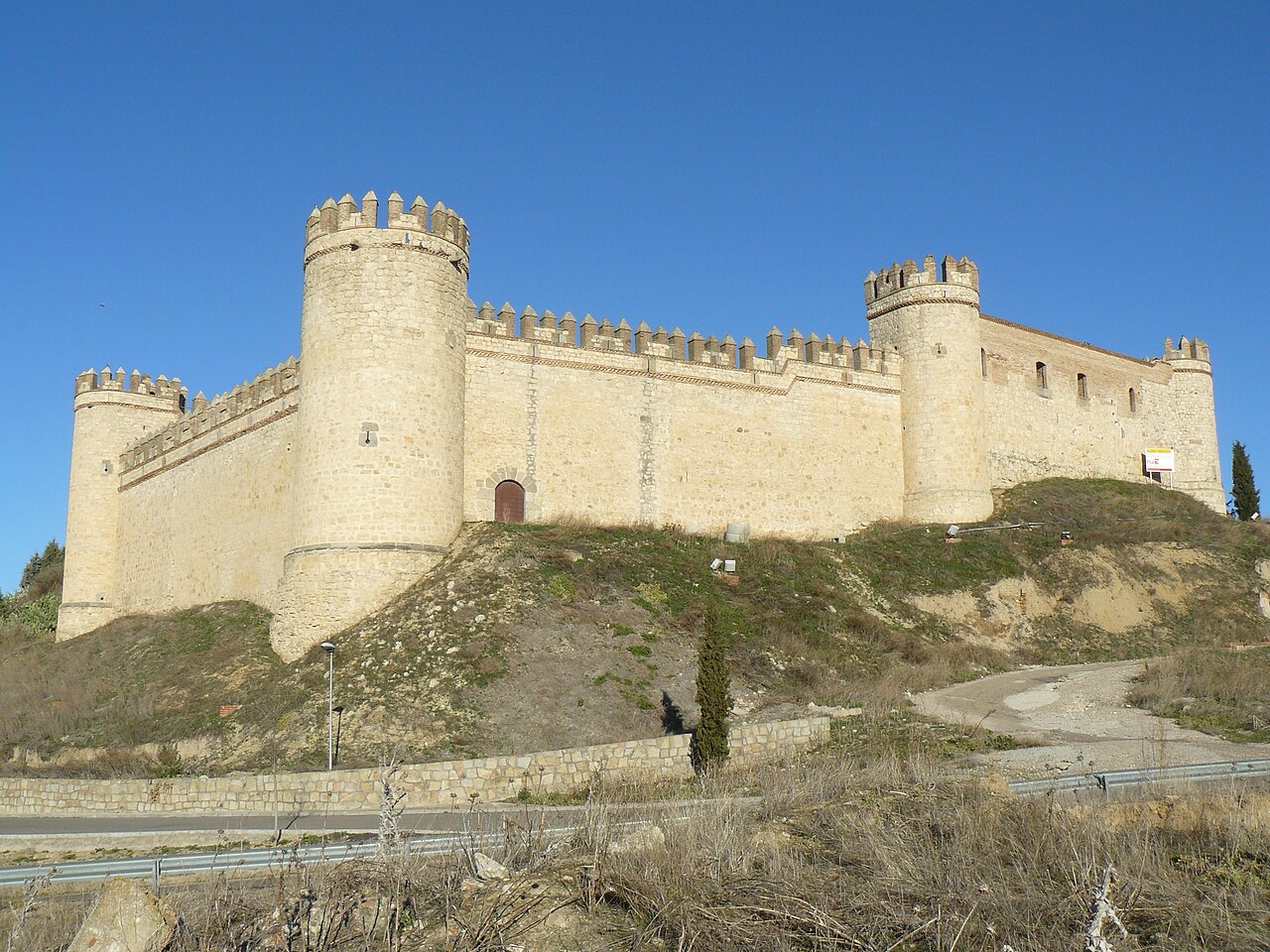
The castle is built on a roughly square or rectangular plan, characteristic of many medieval fortifications designed for both defense and residence. Its masonry construction employs rubblework with finely cut ashlars reinforcing corners and openings, a typical technique for durable fortresses. The castle's walls remain largely intact, preserved up to their original height, showcasing the solidity of its construction.
The most striking architectural element is the large square keep, or tower of homage, located on the eastern facade. This keep is notable for a prominent stone relief of a lion rampant, the heraldic emblem of the Silva family, which is carved into its eastern side. This emblem serves both as a symbol of family pride and a decorative feature enhancing the castle's imposing presence.
The castle's defensive system includes four corner towers: two on the eastern side are square, including the keep, while the two western towers are circular. The eastern gate is protected by the projecting keep, and the original entrance was further secured by an outer enclosure with a moat and drawbridge, though these external defenses have mostly disappeared, save for remnants of two small round towers (cubos) flanking the entrance.
Inside, the castle once contained two floors connected by wall-walks or adarves along the curtain walls, allowing defenders to patrol and defend the perimeter. Today, the interior is largely empty, with only vestiges of walls near the northern curtain wall surviving. The northeast tower contains a spiral staircase, though it has partially collapsed, and none of the towers are currently accessible to visitors.
Defensive adaptations and artillery
In the 16th century, the castle was modernized to accommodate artillery, reflecting the changing nature of warfare during the Renaissance. This adaptation included reinforcing walls and towers to withstand cannon fire, as well as providing suitable platforms for artillery placement. These modifications illustrate the castle's dual function as a noble residence and a military stronghold.
Current condition and visitor information
Today, Barcience Castle is in a partially preserved state. While the main structural elements such as walls, towers, and the keep survive, the castle has suffered from neglect and vandalism, including graffiti within the interior spaces. Despite this, the castle remains freely accessible, allowing visitors and castle enthusiasts to explore its historic footprint and admire its distinctive features, particularly the carved lion on the keep.
Access to the castle is via a dirt track that passes through a pine forest after entering the village of Barcience and passing its cemetery. The site is privately owned but open to the public without charge, making it an attractive destination for those interested in medieval architecture and Spanish history.
Cultural and heritage significance
Barcience Castle holds cultural importance as a representative example of 15th-century Spanish noble fortifications, blending residential comfort with military functionality. Its association with the Silva family and the Order of Santiago situates it within the broader narrative of medieval Spanish history, particularly the Reconquista and the consolidation of noble power.
The castle's heraldic lion relief is a unique artistic feature that symbolizes the family's identity and status. As a protected cultural heritage site under Spanish law, efforts to preserve and study Barcience Castle contribute to understanding the region's architectural and feudal history.
Exploring the castle and surroundings
Visitors to Barcience Castle can explore its imposing exterior, including the well-preserved walls and towers, and appreciate the castle's strategic hilltop location. Although interior access is limited, the castle's silhouette and architectural details provide insight into medieval defensive design and noble residential life.
The surrounding landscape, including the pine forest and the village of Barcience, offers a scenic backdrop that enhances the experience of visiting this historic fortress. Nearby attractions in the province of Toledo and Castilla-La Mancha provide additional cultural and historical context for travelers interested in Spain's rich medieval heritage.
Frequently asked questions (FAQ)
- How do I get to Barcience Castle?
- Barcience Castle is accessible via a dirt track that passes through a pine forest after entering the village of Barcience and passing its cemetery. The castle is located on a hill overlooking the village, making it easy to spot from the surrounding area.
- Is there an entrance fee to visit Barcience Castle?
- There is no entrance fee to visit Barcience Castle as it is privately owned but freely accessible to the public. Visitors can explore the castle grounds without charge.
- Can I enter the towers or climb the keep at Barcience Castle?
- Currently, access to the towers and the keep is restricted due to structural concerns and partial collapse of staircases. Visitors can view these features from the outside but cannot climb or enter them for safety reasons.
- What is the historical significance of Barcience Castle?
- Barcience Castle was built by the Silva family in the 15th century on a site with fortifications dating back to the 11th and 12th centuries. It served as a noble residence and a military stronghold adapted for artillery, reflecting the evolution of medieval Spanish fortifications.
- When was Barcience Castle constructed?
- The current structure of Barcience Castle was constructed primarily in the 15th century by the Silva family, with earlier fortifications existing on the site since the 11th and 12th centuries.
Information
Current owner
Private owner
Address
Camino de Huecas a Barcience, Spain
Loading map...
Visitor reviews
No reviews yet. Been here? Write the first review and help other travelers!
Write the first reviewVisited this castle? Share your experience
Your review helps other travelers and adds first-hand knowledge to our encyclopedia.