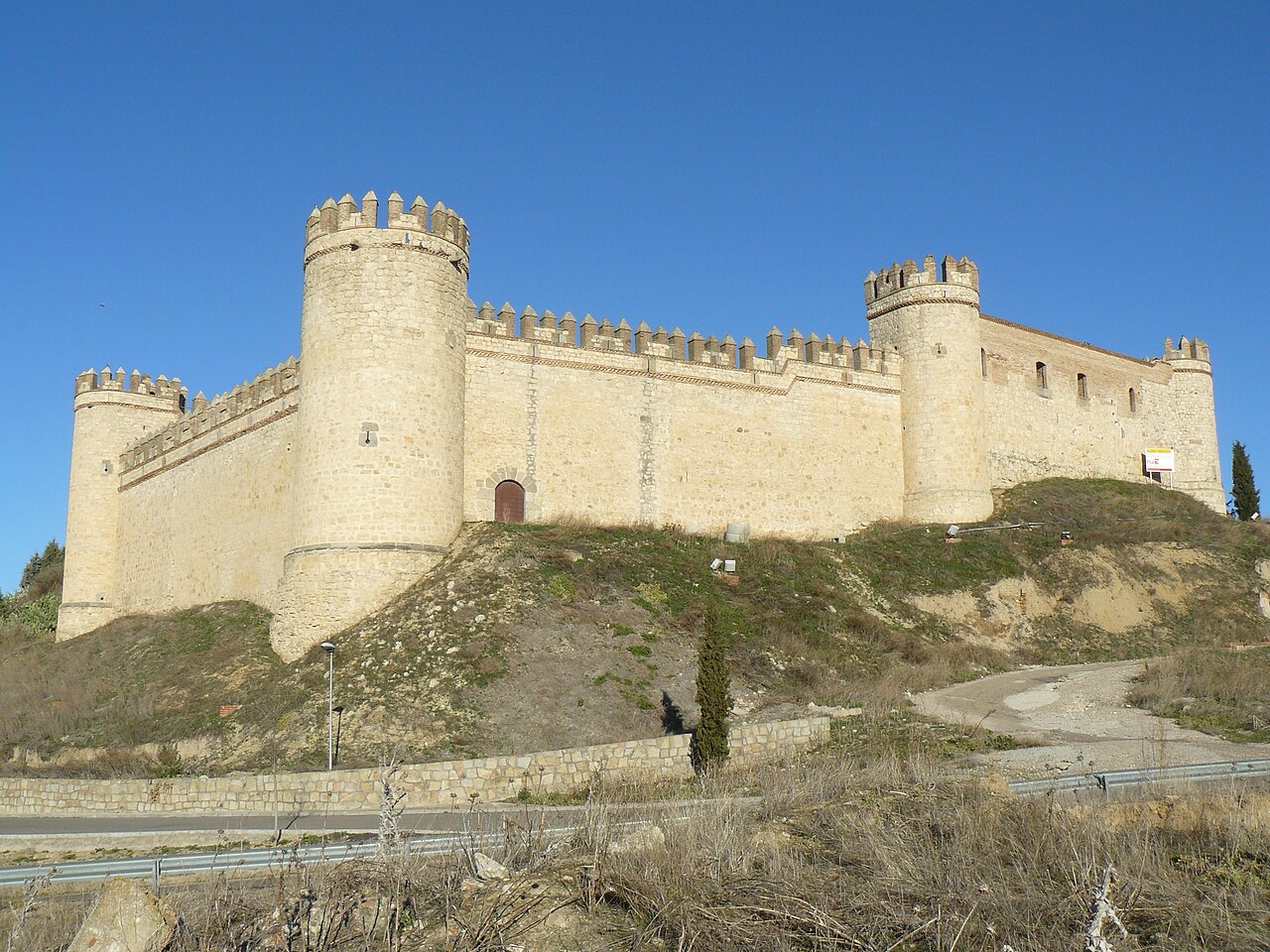
Escalona Castle
Escalona Castle, known locally as Castillo de Escalona, is a significant medieval fortress located in the town of Escalona within the province of Toledo, Spain. This impressive stronghold stands on a 25-meter-high elevation beside the Alberche river, a strategic location that historically provided natural defense and control over the surrounding landscape.
The origins of the site trace back to a Moorish fortification, which was conquered during the Reconquista by King Alfonso VI of Castile. After a fierce battle, the king secured the fortress and used it as a base for further military operations aimed at capturing the city of Toledo. The town of Escalona was subsequently repopulated by settlers Diego and Domingo Alvarez, and in 1130, King Alfonso VII granted it privileges that helped establish its importance in the region.
Medieval origins and early history
The castle's early medieval phase is closely tied to the turbulent history of Castile during the 12th and 13th centuries. By the late 13th century, the castle was donated to Don Juan Manuel, a prominent nobleman and brother of King Alfonso X, known as Alfonso the Wise. During the 14th century, Escalona Castle played a role in regional conflicts, including a notable rebellion against Count Alvaro Osorio. The fortress changed hands multiple times, reflecting the shifting allegiances and power struggles among the Castilian nobility.
Architectural evolution and fortifications
The castle features a complex layout with three successive enclosures that demonstrate its evolution from a military fortress to a noble residence. The outer enclosure originally consisted of a low defensive wall, which today remains partially preserved on the western side. The main enclosure is defined by high curtain walls fortified with seven large flanking towers. These towers are architecturally notable for being detached from the walls and connected only at their tops by arches, a design that enhanced their defensive capabilities by reducing the risk of undermining or siege damage.
Within this main enclosure stands a large square tower, likely the original keep or donjon of the castle, serving as the last line of defense and a symbol of lordly authority. The inner enclosure was partially converted into a palace during the 15th century, reflecting the castle's transition from purely military use to a more residential and administrative function. This inner section contains the present-day keep, which combines defensive features with the comforts expected by the nobility of the period.
Reconstructions and enhancements
Significant reconstruction efforts took place during the 13th and 14th centuries, adapting the castle to evolving military technologies and political needs. However, the most extensive renovations occurred in the 15th century, when the castle was transformed under the ownership of powerful nobles such as Don Alvaro de Luna and later Don Juan Pacheco, Grand Master of the Order of Santiago and Marquess of Villena. These enhancements included the construction of residential buildings, improved fortifications, and the integration of the castle with the town walls.
The castle's perimeter stretches approximately 420 meters, encompassing a northern courtyard and southern residential quarters. The town's defensive walls connected directly to the castle, and the Alberche river functioned as a natural moat, adding an extra layer of protection against invaders.
Historical significance and ownership
Throughout its history, Escalona Castle was a focal point of power struggles among Castilian nobility. After its donation to Don Juan Manuel, the castle was involved in various political upheavals. Under King Juan II, it was granted to Don Alvaro de Luna, who converted it into an opulent palace before his execution led to its return to royal hands.
Later, the castle was controlled by Don Juan Pacheco, one of the most influential lords in Castile, and subsequently passed to the Duke of Arcos. In the 19th century, the castle suffered damage during the Peninsular War, particularly from the French army under Marshal Soult, who systematically destroyed parts of Spanish fortifications. The Duke of Frías undertook repairs to restore the castle's structure after this period of conflict.
Current status and accessibility
Today, Escalona Castle remains privately owned and is not regularly open to the public, which limits visitor access. Despite this, the castle's imposing walls, towers, and historical layers make it an important monument in the province of Toledo. Its preservation status is well preserved in terms of structural remains, although some parts show signs of the historical damage and subsequent restorations.
Visitors interested in medieval military architecture and Castilian history will find Escalona Castle a compelling site, even if access is restricted. The castle's integration with the town's defensive walls and its commanding position overlooking the river provide a vivid example of medieval fortification strategies in central Spain.
Frequently asked questions (FAQ)
- What are the opening hours for Escalona Castle?
- Escalona Castle is open to visitors from 10 AM to 6 PM daily. However, the hours may vary seasonally, so it's advisable to check the official website before planning your visit.
- Is there an entry fee to visit Escalona Castle?
- Yes, there is an entry fee to explore Escalona Castle. Tickets are usually priced at around €5 for adults, with discounts available for children and seniors. Special rates may apply for guided tours.
- When was Escalona Castle built?
- Escalona Castle was constructed in the 14th century, primarily serving as a fortification during the medieval period. Its strategic location made it an important defensive structure during various historical conflicts.
- Can I access Escalona Castle with a wheelchair?
- Escalona Castle has made efforts to improve accessibility for all visitors. While some areas may be challenging due to the castle's historical architecture, there are accessible paths and facilities available for wheelchair users.
- What is the historical significance of Escalona Castle?
- Escalona Castle is renowned for its role in the defense of the region during the Middle Ages. It has witnessed numerous battles and changes in governance, making it a vital piece of local history.
- What is the best time to visit Escalona Castle?
- The best time to visit Escalona Castle is during the spring and fall when the weather is mild and pleasant. This allows you to enjoy the beautiful surroundings and the castle's architecture without the summer crowds.
- Are there any nearby attractions to see after visiting Escalona Castle?
- Yes, after visiting Escalona Castle, you can explore the charming town of Escalona, which features traditional Spanish architecture and local shops. Additionally, the nearby Sierra de San Vicente offers stunning natural landscapes for hiking and outdoor activities.
Loading map...
Visitor reviews
No reviews yet. Been here? Write the first review and help other travelers!
Write the first reviewVisited this castle? Share your experience
Your review helps other travelers and adds first-hand knowledge to our encyclopedia.