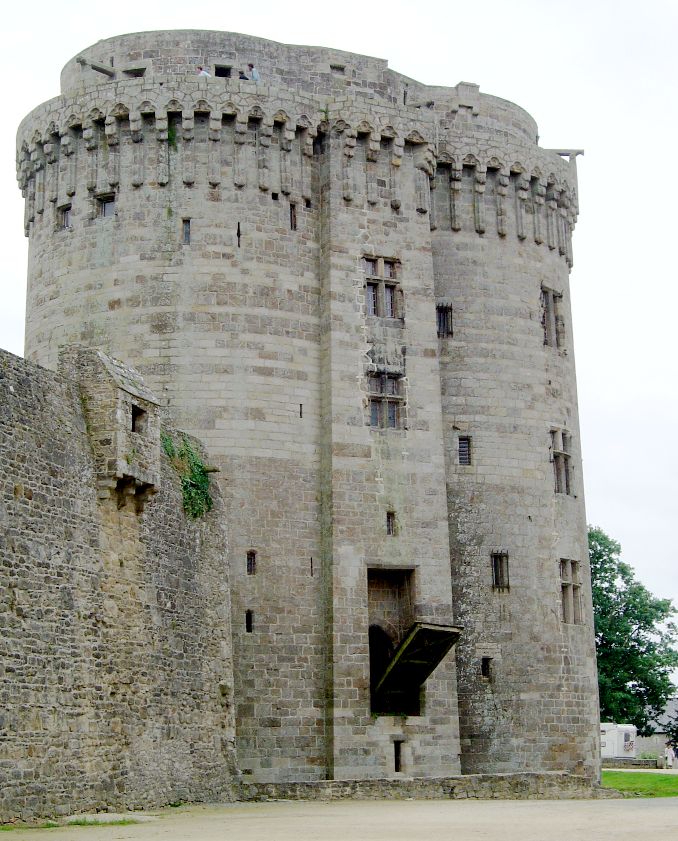
Manoir de la Motte Beaumanoir
The manoir de la Motte Beaumanoir stands as a remarkable example of a Breton rural manor with origins deeply rooted in the medieval period. Situated in the municipality of Pleugueneuc within the historic province of Brittany, this estate reflects centuries of noble lineage, architectural evolution, and agricultural development. Its history is intertwined with several prominent local families, who shaped the manor's character from a fortified lordly residence to a multifunctional estate.
Medieval origins and noble lineage
Originally established during the medieval era, the estate was known as la Motte and was under the ownership of the Boutier family in the 14th and 15th centuries. A key architectural feature from this period is the porte logis, or gatehouse, which served as a fortified entrance to the manor grounds. This gatehouse symbolized the estate's status as a seigneurie (manorial lordship) and fulfilled both defensive and administrative roles. The construction techniques and materials used for this structure were typical of medieval Breton architecture, emphasizing functionality and fortification.
Ownership later transitioned to the Gruel family, leading to the estate being referred to as la Motte-Boutier and subsequently la Motte Gruel. By the mid-16th century, the manor became a fiefdom under the Beaumanoir family, which bestowed its current name, Motte Beaumanoir. This period marked the manor's integration into the Breton nobility, anchoring its social and political significance in the region.
18th and 19th century transformations
In 1764, the manor was acquired by Jean Thomas Baptiste de Lorgeril, a royal navy captain, from Louis Charles Marie de La Bourdonnaye Montluc, who was president of the Brittany parliament. The Lorgeril family retained ownership for nearly two centuries, during which time the estate underwent significant changes.
Under the stewardship of Louis de Lorgeril in the early 19th century, the manor experienced extensive remodeling. He added an eastern wing to the main building to accommodate evolving residential and functional needs. The estate also expanded its agricultural infrastructure with the construction of stables, a barn, a sheepfold, a henhouse, a hayloft, and a press likely used for cider or wine production. These additions reflected the manor's role as a productive agricultural hub, blending noble residence with farm management.
Notably, Louis de Lorgeril organized what is considered the first agricultural fair in France in August 1815, held along the western avenue leading to Plesder. This event underscores the manor's importance not only as a noble estate but also as a center for agricultural innovation and community engagement.
20th century decline and restoration efforts
The manor's fortunes declined after the death of Paul de Lorgeril in 1953, the last family member to reside on the estate, leaving it vacant. In 1977, a private owner named Mr. Bernard purchased the property and initiated restoration efforts to preserve its historical and architectural value.
Restoration included the demolition of some deteriorated outbuildings and the completion of an extension on the western wing. In 1985, a pond was recreated to reflect a similar 19th-century water feature, enhancing the estate's historic landscape character. These efforts helped stabilize the manor and prepare it for adaptive reuse.
Adaptive reuse and current function
Following restoration, the manor transitioned from a private residence to commercial and event spaces. Starting in 2001, under the ownership of Marine Mechin, parts of the estate operated as a hotel-restaurant and wellness center. The western agricultural dependencies were converted into a reception hall for social events, particularly weddings, demonstrating the manor's ongoing evolution.
Today, the manoir de la Motte Beaumanoir functions as a guesthouse and venue, preserving its architectural heritage while serving contemporary needs. The estate's layers of construction, from its medieval gatehouse to 19th-century agricultural buildings, offer valuable insights into the lifestyle and social history of Breton rural nobility.
Architectural features and estate layout
The manor's layout reveals its gradual transformation over several centuries. The medieval porte logis remains a focal point, illustrating the defensive architecture typical of a seigneurial estate. Although detailed records of its masonry and stylistic elements are limited, its presence confirms the manor's original fortified character.
The 19th-century additions reflect a shift towards agricultural productivity and residential comfort. The eastern wing and various outbuildings were constructed using materials and techniques consistent with the period, designed to support farming activities such as livestock rearing and crop processing.
While the manor once included a private chapel, this structure no longer survives. Its former existence indicates the estate's religious functions and the spiritual life of its inhabitants.
Restoration in the late 20th century involved removing some ruined agricultural buildings and enhancing the western wing. The recreated pond adds to the estate's picturesque landscape, reflecting 19th-century design sensibilities.
Agricultural outbuildings
- Stables for horses, essential for transportation and farm work.
- Barn used for storage of crops and equipment.
- Sheepfold for containing livestock.
- Henhouse supporting poultry farming.
- Hayloft for storing dried fodder.
- Press likely used for cider or wine production, indicating local agricultural products.
Landscape and environment
The estate's setting in Hauts-de-France places it within a region known for its rich agricultural land and historical estates. The recreated pond and surrounding avenues contribute to a landscape that balances functional farming with aesthetic considerations, typical of Breton manorial estates.
Frequently asked questions (FAQ)
- How do I visit manoir de la Motte Beaumanoir?
- The manoir de la Motte Beaumanoir operates as a guesthouse and event venue. Visitors can book stays or attend public events like weddings by contacting the venue in advance. Check their official website or local tourist information for current visiting options and availability.
- What is the historical significance of manoir de la Motte Beaumanoir?
- Manoir de la Motte Beaumanoir has a rich history dating back to the medieval period, reflecting the evolution of Breton rural nobility estates. It showcases architectural features such as a medieval gatehouse and 19th-century agricultural buildings, highlighting its role in local social and agricultural development.
- Can I host events at the manor?
- Yes, the manor's western agricultural buildings have been converted into a reception hall suitable for weddings and social gatherings. Event bookings are managed by the current owners, offering a unique historic setting for special occasions.
- When was the manor expanded with the eastern wing?
- The manor's eastern wing was added in the early 19th century by Louis de Lorgeril during a period of significant remodeling and agricultural development.
- Is the manor accessible for visitors with mobility issues?
- Accessibility details are not explicitly documented, but as a historic estate adapted for modern use, some areas may have limited access. Visitors with mobility concerns should inquire directly with the venue to ensure suitable accommodations.
Information
Website
Visit websiteSources & official resources
Verify the information above using these authoritative references.
Loading map...
Visitor reviews
No reviews yet. Been here? Write the first review and help other travelers!
Write the first reviewVisited this castle? Share your experience
Your review helps other travelers and adds first-hand knowledge to our encyclopedia.