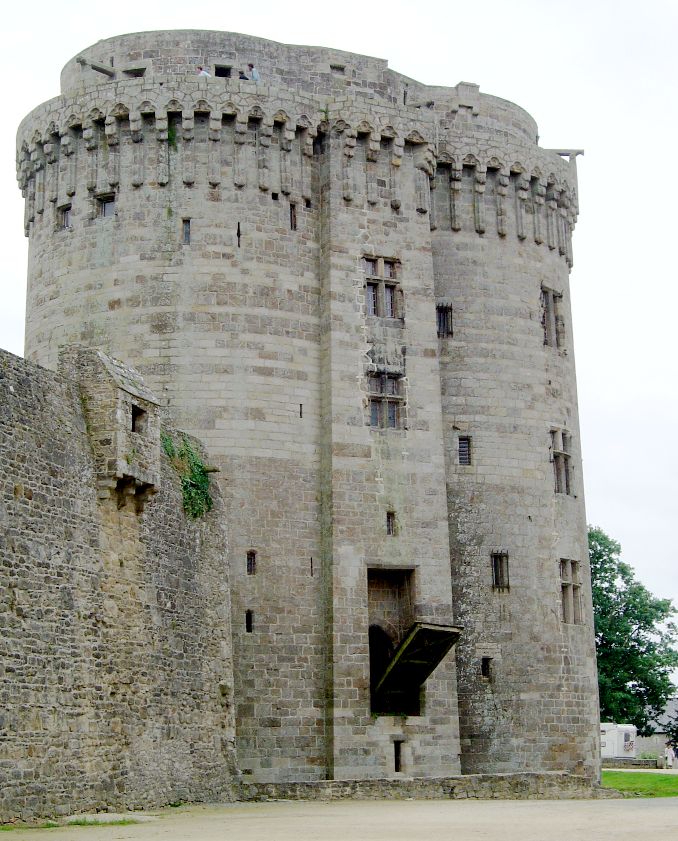
Léhon Castle
Léhon Castle, locally known as Château de Léhon, is a medieval fortress situated near the village of Léhon in the Côtes-d'Armor department of Brittany, France. This castle occupies a commanding position on a rocky spur that overlooks and defends the entrance to the valley of the river Rance. Its strategic location made it an important fortification during the High Medieval period.
Early history and original construction
The first historical mention of Léhon Castle dates back to 1034, indicating its origins in the early medieval era. The original structure was likely a wooden or early stone fortification typical of the period, designed to control the vital river valley and surrounding lands. However, this early castle faced military challenges, notably being besieged in 1168 during the conflicts between the French crown and the English monarchy. The siege ended with the castle being razed in 1169 as part of the peace treaty between King Louis VII of France and King Henry II of England.
Reconstruction and architectural features
The existing ruins primarily date from the 13th century, when the castle was rebuilt by Peter I, Duke of Brittany. This reconstruction marked a transition to more durable stone fortifications typical of the High Medieval castle architecture. The castle's design incorporated defensive elements suited to its rocky outcrop, including thick curtain walls, towers, and a gatehouse that controlled access to the inner bailey.
The castle's layout was adapted to the natural topography, with the defensive walls following the contours of the rocky spur. The elevated position provided excellent visibility over the surrounding valley and the river, crucial for early warning against attacks. The castle likely featured a keep or donjon as a last line of defense, along with residential quarters and storage areas within the walls.
Military significance and historical events
Léhon Castle played an active role in the Breton War of Succession during the 14th century. In 1359, it was besieged by English forces led by the Duke of Lancaster, who also targeted the nearby fortified town of Dinan. After years of conflict, the war concluded in 1365 with the castle returning to the control of John IV, Duke of Brittany.
Despite its strategic importance, the castle's military relevance declined towards the end of the medieval period. By 1490, Léhon Castle was described as being in a ruinous state, reflecting the changing nature of warfare and the reduced need for such fortifications.
Post-medieval decline and preservation
In 1664, the castle ruins were granted by King Louis XIII to Charles Bruslard, the commendatory prior of the nearby monastery of Léhon. Over time, the castle became a convenient source of building materials, leading to further degradation as stones were removed for local construction.
Today, the remains of Léhon Castle stand as a partially preserved ruin accessible to visitors during daylight hours. While much of the original structure has been lost, the site offers a tangible connection to the region's medieval past and the architectural styles of the High Medieval period.
Visitor experience and cultural significance
Visitors to Léhon Castle can explore the ruins freely, appreciating the castle's setting on the rocky spur and its historical role in the defense of the river valley. Although the interior contains limited surviving structures, the castle's silhouette and remaining walls convey the scale and defensive purpose of the fortress.
The castle is part of the rich cultural heritage of Brittany and contributes to understanding the region's medieval history, including the complex relations between France and England during the Middle Ages. Its proximity to the historic town of Dinan makes it a valuable site for those interested in medieval architecture and military history.
Frequently asked questions (FAQ)
- How do I visit Léhon Castle?
- Léhon Castle is open to visitors during daytime hours every day. Entry is free, and visitors can explore the ruins at their own pace.
- What is the historical significance of Léhon Castle?
- Léhon Castle played a key role in the defense of the river Rance valley and was involved in the Breton War of Succession in the 14th century, reflecting the region's medieval conflicts.
- When was Léhon Castle originally built and rebuilt?
- The castle was first mentioned in 1034 and was rebuilt in the 13th century by Peter I, Duke of Brittany, after being razed in 1169.
- Is Léhon Castle wheelchair accessible?
- Due to its location on a rocky spur and the condition of the ruins, Léhon Castle is not fully wheelchair accessible. Visitors should be prepared for uneven terrain.
- What architectural style is Léhon Castle?
- The castle primarily exhibits Gothic architectural features typical of the High Medieval period, including defensive walls and towers adapted to the rocky landscape.
Information
Opening hours
Daytime, daily
Ticket prices
Free
Current owner
Municipality
Address
Allée du Château, Léhon, Côtes-d'Armor, France
Loading map...
Visitor reviews
No reviews yet. Been here? Write the first review and help other travelers!
Write the first reviewVisited this castle? Share your experience
Your review helps other travelers and adds first-hand knowledge to our encyclopedia.